
A lift, a compressor or a climate machine can cost more to run and repair than it cost to buy, and the purchase invoice will not show that. List owning, operating, upkeep and replacement as separate files, and leave every amount blank until you copy it from a bill or a written estimate you hold.
This page is about equipment that supports a stored car. It is not about the price of the car. The car’s own bills are on the blank cost sheet. The room the equipment serves is on the storage checklist. The shelf for this note is equipment costs.
The definition this page borrows, and the limit on it

The definition used here is from the US Code of Federal Regulations, title 10, part 436, subpart A, read on the eCFR on 15 October 2026. Section 436.10 says the subpart is a methodology for estimating and comparing the life-cycle costs of federal buildings, including energy and water conservation measures. It is not a rule for a private garage. This page uses the cost categories in the definitions. It does not claim that a private owner must follow the federal procedure.
Section 436.11 says life-cycle cost means the total cost of owning, operating and maintaining a building over its useful life, including its fuel and water, energy, labor and replacement components, determined by a systematic evaluation and comparison of alternative building systems. For a leased building, the same sentence says the cost is calculated over the effective remaining term of the lease.
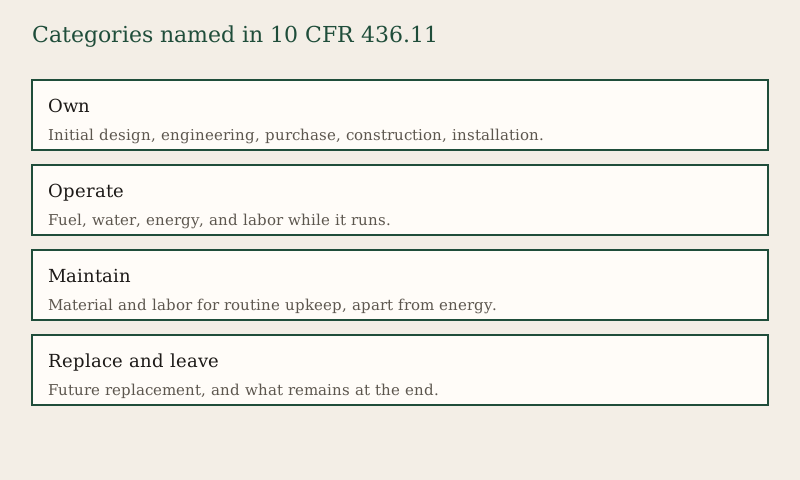
The same section uses these labels:
- Investment costs: the initial costs of design, engineering, purchase, construction and installation, exclusive of sunk costs.
- Sunk costs: costs incurred before the analysis.
- Non-fuel operation and maintenance costs: material and labor for routine upkeep, repair and operation, exclusive of energy cost.
- Replacement costs: the future cost to replace a system, a conservation measure, or a component of one.
- Salvage value: what is removed, resold, or still there at the end of the study period.
Section 436.12 says the method is a systematic analysis of relevant costs, excluding sunk costs, over a study period, relating initial costs to future costs by discounting future costs to present values.
This page stops there. It does not copy a discount rate, a study length, or a sample project from the rest of the subpart. Those figures would be federal assumptions, or they would be inventions. Neither belongs in a blank private list.
No machine model, speed, power or capacity is named. None was taken from a document read for this page.
A blank comparison
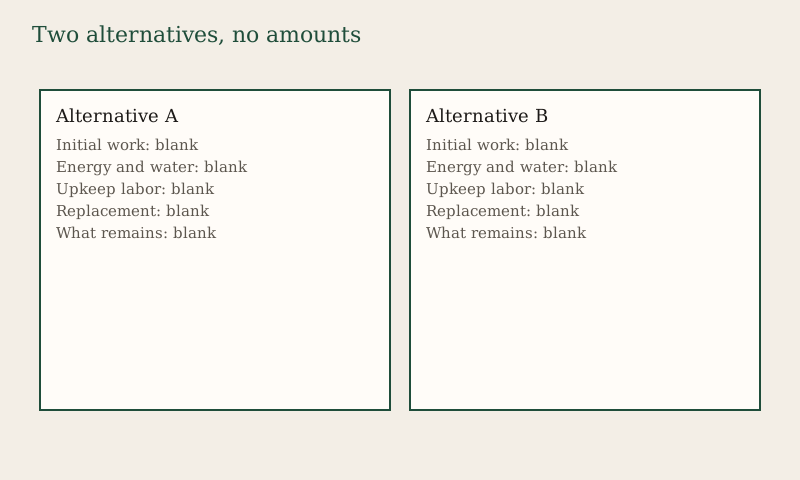
Use two real alternatives, such as repair the machine you have, or install a different one that does the same job. If you do not have two alternatives, do not invent the second column.
| File | Alternative A | Alternative B |
|---|---|---|
| Initial work, excluding what is already spent | — | — |
| Energy and water while it runs | — | — |
| Labor and materials for upkeep, apart from energy | — | — |
| Replacement of a component later | — | — |
| What is left, or sold, at the end | — | — |
Money already spent is a sunk cost under the definition above. Leaving it in the comparison makes a past invoice look like a reason to repeat it. The storage page’s humidity and light lines are about the room, not about a machine’s rated output. If a manufacturer’s plate states a rating, copy it from that plate or from the document that came with the machine, and keep this page’s table for money files only.
How this page was written
The regulatory sentences are from the eCFR page named below, read on 15 October 2026. The eCFR page itself says it is not an official legal edition of the CFR. No equipment catalogue was used, so no model or performance figure appears. The car-cost sheet remains the place for the car’s own bills, and it is also blank.