
A classic car’s story fails when three different papers are treated as one. Keep the registration record, the service file and the sale file apart, and read each one only for the job that office or writer actually did.
This page is a filing method. It is not a title search, and it is not legal advice. The register example is the United Kingdom, because that is the official page read on 15 October 2026. Other countries use other offices and other forms.
The collector cars section starts here. After the files are separate, the repair-or-leave decision is the next question, and the blank cost sheet is where bills go.
What each file is allowed to say

A registration record answers the questions the register was built to answer. A service file answers what a workshop opened, replaced or left alone. A sale file answers who passed the car to whom, and on what date. Mixing them produces a sentence no single paper supports.
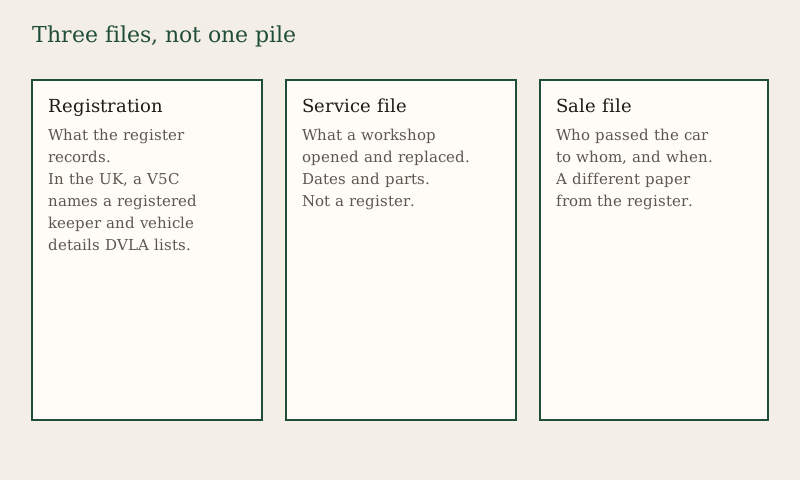
What the UK pages say about a V5C
GOV.UK calls the V5C a registration certificate and a log book. The replacement page, read on 15 October 2026, says the online replacement route is for the registered keeper named on the V5C, and only when the details in the certificate can stay the same. The same page says a reader of that route needs the registration number, the vehicle identification number or chassis number, and the name and postcode registered on the V5C.
That is a statement about who may use one official route. It is not a statement that the registered keeper is the owner in every legal sense, and this site does not add that claim.
The update page, also read that day, says you must update the V5C to tell the Driver and Vehicle Licensing Agency about mistakes on the certificate and about most changes you make to the vehicle. It lists changes that must go on the V5C:
- colour
- engine
- cylinder capacity
- fuel type, including a conversion to electricity
- seating capacity
- weight of a large vehicle, with a goods vehicle or a campervan given as examples
- chassis, monocoque bodyshell or motorcycle frame, when the size or appearance differs from when the vehicle was made
The same page says a like-for-like replacement of a chassis, a combined chassis and bodyshell, or a motorcycle frame still has to be told to DVLA even when the original appearance and dimensions do not change. For that like-for-like case, the page says the V5C itself need not be updated, and a vehicle parts statement (V627/1) is the paper it names.
It also says these changes must be updated on the V5C, and that DVLA will say whether it needs to inspect them: wheel plan; body type, with a van converted to a campervan given as the example; vehicle identification number; chassis number; and frame number for motorbikes.
Those lists are the page’s lists. They are not a world register, and they are not a description of every classic-car club form.
How to read the three files in order
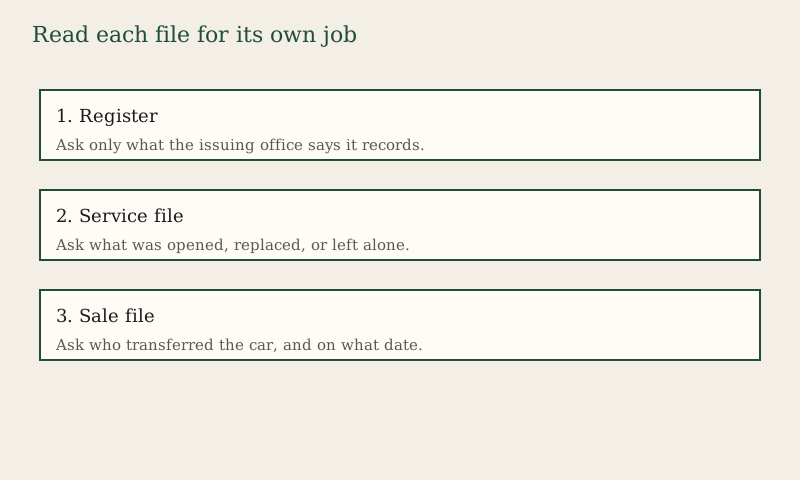
Start with the register entry you actually hold, and write down only the fields that entry shows. If the car is in the UK system described above, the update page is the list of changes that page says must be reported. If the car is registered somewhere else, stop and get that office’s own page. Do not copy the UK list across a border.
Then open the service file. A useful note has a date, what was opened, and what was put back or left out. A note that only says “restored” does not say which pieces changed. That gap matters to the preservation page.
Then open the sale file. Record the names and the date it states. If it disagrees with the register, write the disagreement down. Do not smooth it into one story.
What this page will not do
It will not confirm a car from a photograph. It will not rank sellers. It will not tell you what a car is worth. Bills belong on the cost sheet, which is blank on purpose.
How this page was written
The UK sentences come from the two GOV.UK pages named below, read on 15 October 2026. No fee, processing time or tax figure from those pages is repeated here. Workshop notes and sale papers are described as file types, not as a form required by a statute this site has not read.