A finished surface can hide the evidence the next reader needed, and later work can damage a record that no longer matches the car. Name the goal before the work starts: rebuilding toward an earlier appearance is not the same job as keeping original material stable and visible.
This page uses two public museum records and one professional guideline. It does not say which goal is right for a car you own. It sits in collector cars, beside the paper-trail note.
Two records that state two goals

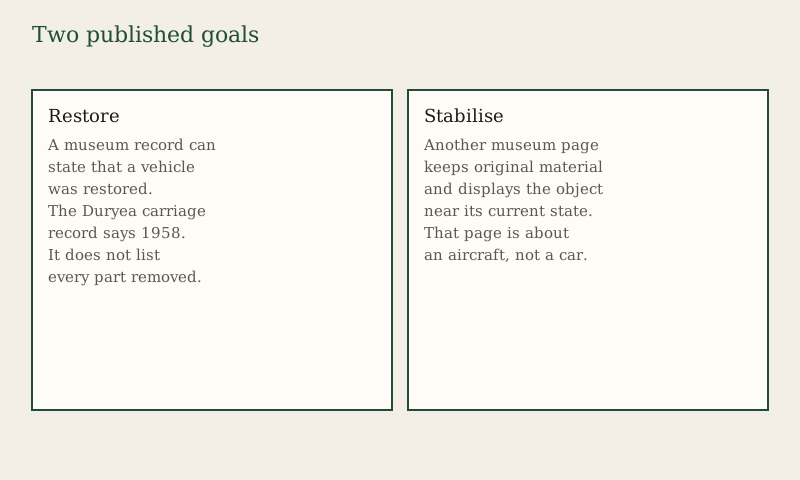
The Smithsonian object record for the Duryea motor carriage, read on 15 October 2026, describes an experimental vehicle road-tested by Frank Duryea on 21 September 1893 in Springfield, Massachusetts. The same record says this forerunner was donated to the Smithsonian in 1920 and was restored in 1958. The record states the restoration year. It does not, on the page read here, list each part that was removed or the paint that was covered. A year is not a treatment report.
The National Air and Space Museum’s page on the Horten Ho 229 V3, also read that day, is about an aircraft, not a car. It is here because it states the other goal in public. The page says that because the Horten Ho 229 V3 is one of a kind, efforts are being made to preserve as much of the original material as possible. It says the conservation approach will be one of materials stabilization, so the artifact can be displayed essentially in its current state but with stabilized original material. It also says a full restoration would have to be judged by whether removing surface layers or patina would compromise historic value.
Those are two different sentences from two different objects. One object is a car whose record says “restored in 1958.” The other is an aircraft whose keepers describe stabilization of original material. Neither sentence is a rule for your garage.
What the guideline says a compensation note must hold
The American Institute for Conservation publishes a Code of Ethics and Guidelines for Practice. The page read on 15 October 2026 presents the code as passed in 1994. Under compensation for loss, it says:
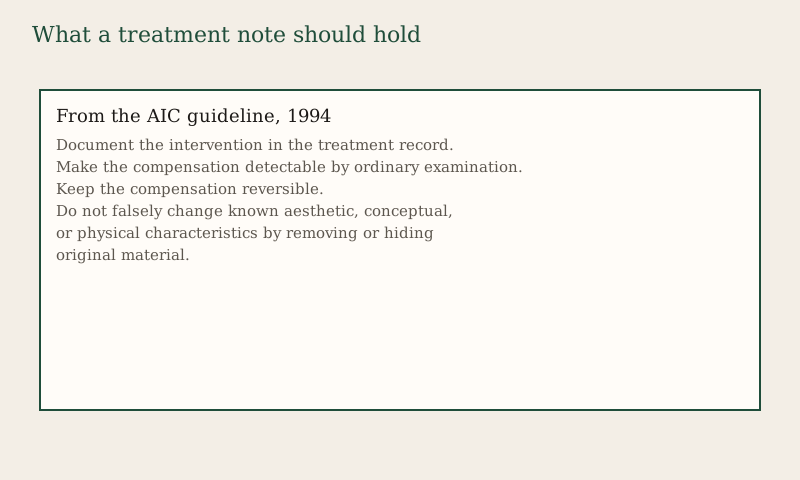
Any intervention to compensate for loss should be documented in treatment records and reports and should be detectable by common examination methods. Such compensation should be reversible and should not falsely modify the known aesthetic, conceptual, and physical characteristics of the cultural property, especially by removing or obscuring original material.
The same page describes preventive conservation as limiting damage or deterioration, giving guidelines for continuing use and care, recommending appropriate environmental conditions for storage and exhibition, and encouraging proper procedures for handling, packing and transport.
The guideline is written for conservation professionals and cultural property. A private owner is not that professional, and a car is not automatically “cultural property” in the code’s sense. The sentences are still a clear published test: if work fills a loss, the note should say so, a later examiner should be able to see the new material, the work should be reversible, and it should not pretend the new surface is the old one.
How to use the test without inventing a car
Write the goal in one line: rebuild toward a stated earlier appearance, or keep what is there and slow further loss. Then write what will be removed, what will be added, and how a later person can tell the addition from the original. If you cannot fill those lines, the file note is unfinished. The service file is where this note belongs, not in the registration certificate.
Storage conditions that limit damage, which is the preventive side of the AIC paragraph, are questions on the storage checklist.
How this page was written
The Duryea and Horten sentences are from the museum pages named below, retrieved on 15 October 2026. Dimensions, prices and part lists from other Smithsonian files are not used. The AIC paragraph is quoted from the institute’s page, not from a commentary. No car in a private collection is described, because no such treatment record was read.