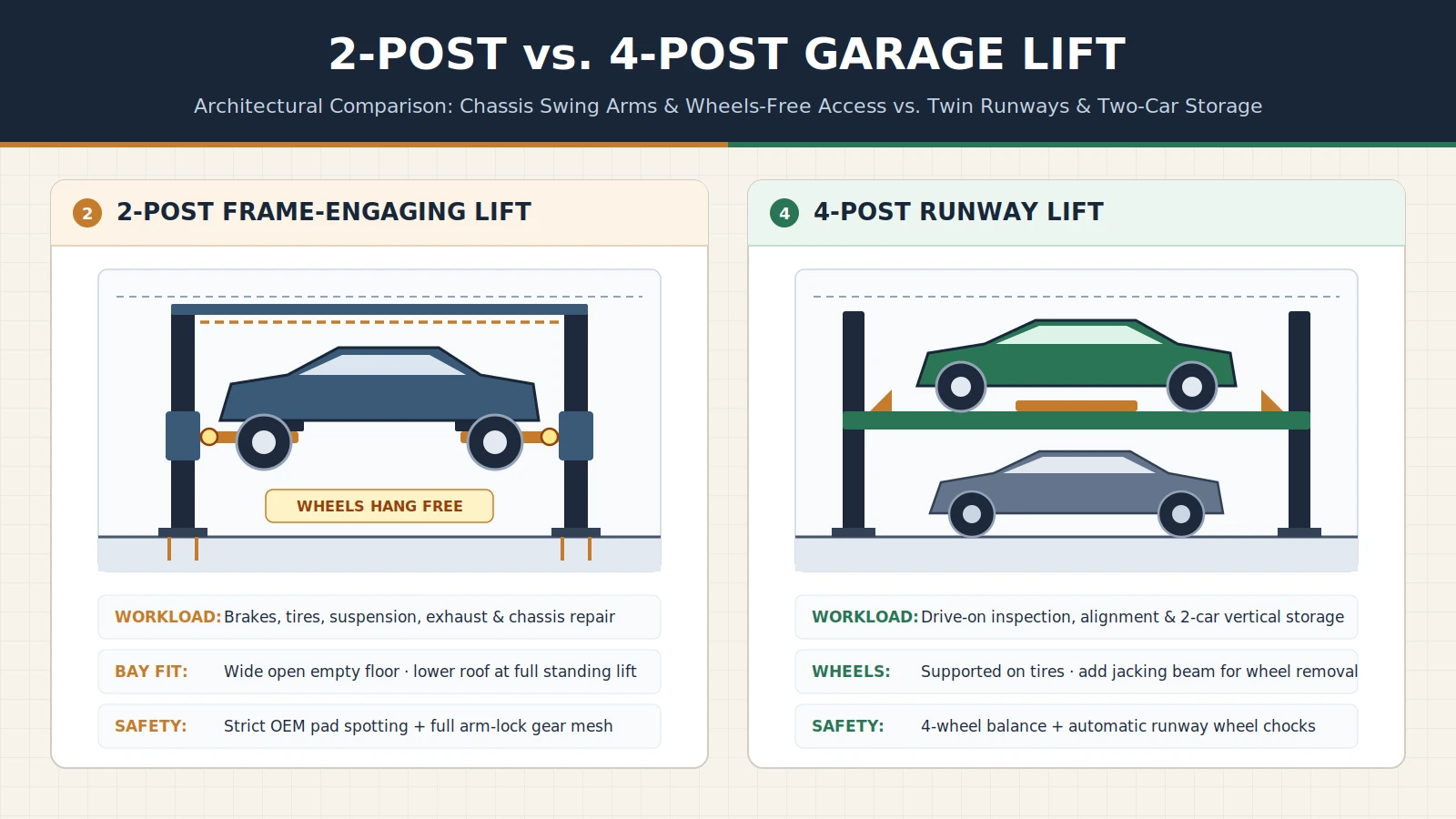
Choose a 2-post lift when brake, tire, suspension, and chassis repairs dominate your bay and you want open floor space whenever the lift is empty. Choose a 4-post lift when drive-on loading balance, full-tire support, undercarriage inspections, or stacked vehicle storage comes first, adding a jacking beam whenever wheels-free work is needed.
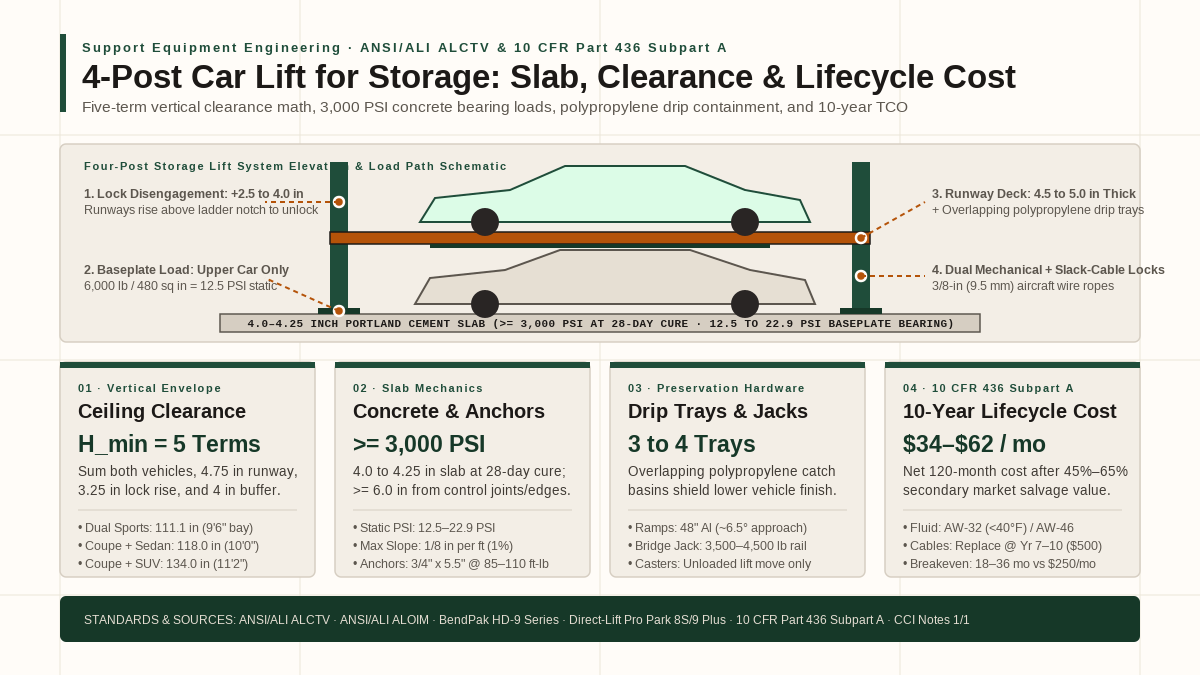
Both designs are surface-mounted bay equipment whose installation, upkeep, and inspection records belong in your equipment life-cycle cost file. If vertical parking is already your primary goal, review the five-term ceiling calculation and concrete bearing math in our 4-post car lift for storage slab and clearance guide before committing a bay.
How do 2-post and 4-post lifts differ in wheel access and underbody work?
A 2-post surface-mounted lift uses frame-engaging swing arms traveling up two columns to grip the chassis underside, leaving all four wheels hanging completely free for brake, tire, and suspension work. A 4-post lift raises the vehicle by its tires on twin runways, giving full underside access while requiring a jacking beam for wheels-free jobs.
According to Automotive Lift Institute lift classifications, two-post surface-mounted lifts are the most popular type of surface-mounted lift purchased today. Data reported in UK Health and Safety Executive Safety Alert FOD1-2018 notes that two-post lifts gained popularity over the last 20 years and outsell traditional four-post lifts by over 3 to 1, partly because they have become available at lower purchase outlay.
While two-post lifts were originally used mainly for inspection and routine servicing such as oil, tire, and exhaust changes, workshops now rely on them for major mechanical repairs as well. Multi-post runway lifts—most commonly configured as four-post surface-mounted lifts—remain required for formal UK MOT testing and excel whenever driving onto twin platforms speeds up routine inspections, underside checks, or parking.
Capacity alone rarely separates a two post vs four post lift for passenger cars and light utility vehicles. Representative light-commercial equipment lines overlap closely, spanning roughly 3,500 kg to 6,500 kg for two-post models and 4,000 kg to 6,500 kg for four-post platforms. Both styles provide standing underside access, and four-post runways can be configured with a rolling jacking beam to lift axles clear of the tracks when occasional brake or hub service arises.
| Engineering dimension | 2-post frame-engaging lift | 4-post runway lift |
|---|---|---|
| Load-bearing contact | Swing arms attach to manufacturer-designated chassis underside points | Vehicle drives onto twin steel runways and is lifted by all four tires |
| Wheel and suspension access | Immediate wheels-free access once raised | Wheels bear full vehicle weight unless lifted with a jacking beam |
| Positioning and balance | Central chassis support requires precise arm placement and center-of-gravity checks | Four-wheel platform support distributes weight evenly across four corners |
| Empty-bay floor space | Compact two-column footprint leaves open walking and equipment floor | Four posts and full-length runways remain in the bay when empty |
| Raised roof height | Chassis engagement leaves raised vehicle roof lower by up to roughly half a metre | Tire-base elevation places the raised roof higher for the same lift stroke |
| Primary mechanical retention | Arm-locking gear mechanisms plus clicking column load-holding devices | Mechanical column locks plus automatic runway wheel chocks and end stops |
| Representative capacity range | 3,500 kg to 6,500 kg in commercial light-vehicle lines | 4,000 kg to 6,500 kg in light-commercial runway lines |
Which lift is safer and easier to position for maintenance versus storage?
A 4-post runway lift offers wider loading forgiveness because driving onto twin platforms balances weight across four tires, making it the cleaner fit for repeat drive-on storage and routine inspections. A 2-post lift demands stricter chassis-point spotting, verified full arm-lock gear engagement, and active center-of-gravity management whenever heavy drivetrain parts are removed.
Two-post arm-lock geometry and the 75 percent engagement cliff
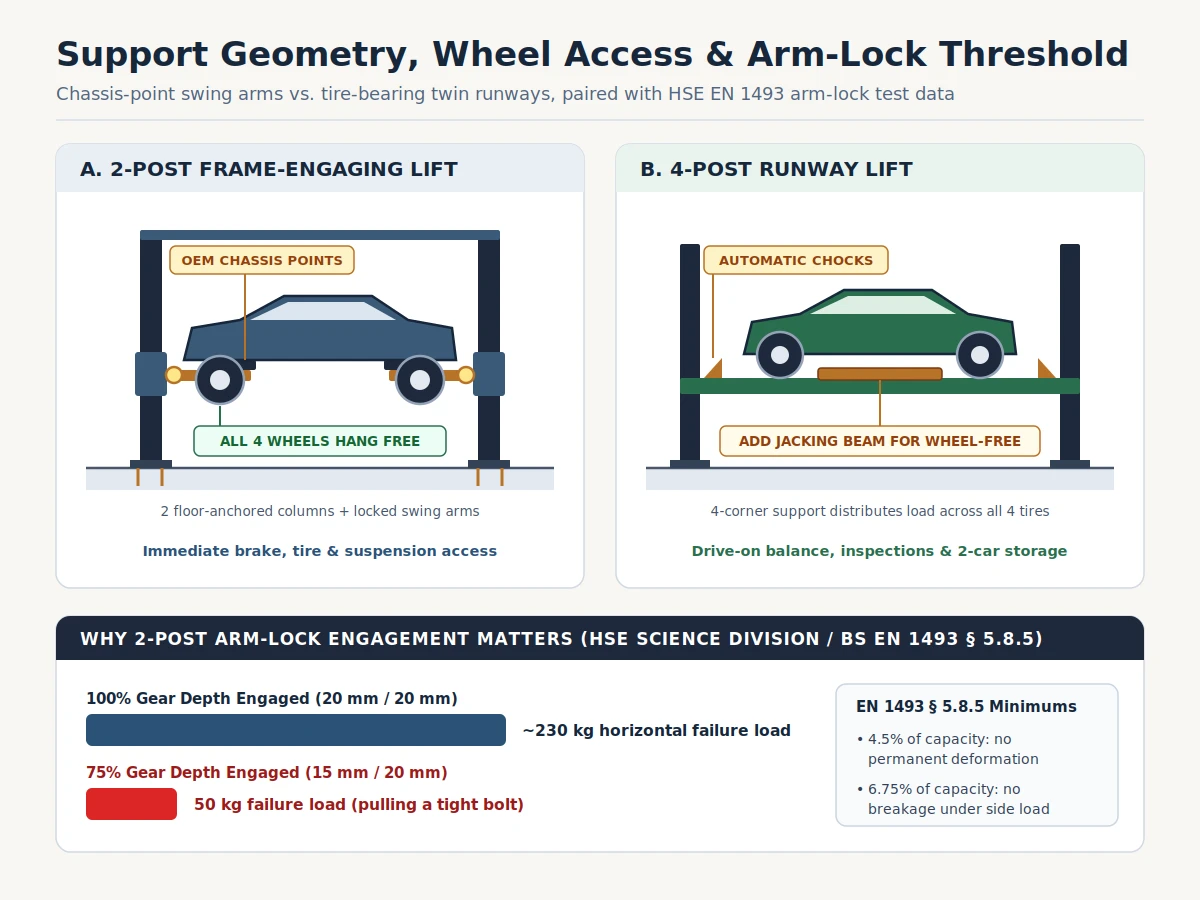
Because a two-post lift supports a car centrally along its chassis rather than under its tires, positioning accuracy and arm restraint hardware are critical safety barriers. HSE guidance on safety in the use of 2-post vehicle lifts followed two severe workplace accidents—one fatal and one very serious—where vehicles fell from two-post lifts whose arm locking systems were missing or had stopped working. Industry representatives and HSE agreed that arm locking systems must be fitted to all two-post lifts, and any legacy two-post lift lacking arm locks should be removed from service or scrapped.
Laboratory testing documented in HSE Safety Alert FOD1-2018 explains why partial arm-lock meshing turns a routine repair into a drop hazard. Under European standard BS EN 1493 Section 5.8.5, two-post arm-locking systems must resist a horizontal force of 4.5 percent of rated lift capacity without permanent deformation and 6.75 percent of capacity without breakage. When HSE Science Division engineers tested locked arms at only 75 percent gear engagement (15 mm of mesh over a 20 mm depth), the horizontal load required to cause failure plunged from about 230 kg to 50 kg.
A 50 kg horizontal force is easily generated by one mechanic pulling on a seized bolt, and the car’s own weight can induce sideways force if a support pad is not perpendicular to the jacking point. HSE’s alert—which flagged up to 1,700 or more BendPak two-post lifts in Britain with potential arm-restraint gear faults—contrasted substandard cast or sintered gears featuring oval holes and narrow cross sections against properly machined steel gears with circular holes seated snugly against the swing pin without visible clearance.
Removing large components changes the stability equation just as sharply. Both HSE and CCOHS hydraulic lift operation guidance warn that pulling an engine, gearbox, axle, or universal joint—or lifting a car carrying loose cargo—can shift the center of gravity enough to tip a chassis-supported vehicle.
Four-post runway balance, automatic chocks, and proof-lift steps
Driving onto a four-post platform places four equal wheel contact points across the runways, simplifying safe weight balance for frequent parking or collector-car storage. That layout shifts the primary loading check from arm-restraint gears to wheel containment: CCOHS instructs operators on drive-on or runway lifts to verify that automatic chock devices are in position, confirm permanent wheel blocks are sufficient to stop rolling, and watch the automatic chocks at the drive-on end of the lift runners engage as the platform rises.
Whichever lift sits in the bay, safe elevation follows the same disciplined sequence verified across Automotive Lift Institute, HSE, and CCOHS procedures:
- Check nameplate ratings and lift points: Confirm the vehicle weight stays within the rated capacity displayed on the manufacturer’s nameplate for both lift and adaptors, and inspect chassis lifting points for rust, oil, or structural damage.
- Run a short proof lift: Raise the vehicle until the tires clear the floor by about 30 cm (1 ft), then pause to verify pad placement and, on a two-post lift, apply deliberate hand force to confirm the swing arms are fully locked before continuing upward.
- Seat onto mechanical locks: Two-post lifts are synchronized mechanically, hydraulically, or electronically and emit a clicking sound from their load-holding devices during ascent; lower either lift style onto its mechanical load-holding locks or rated jack stands rather than working beneath unsupported hydraulic pressure.
- Avoid destabilizing shortcuts: Do not raise only one end of a vehicle, do not rock a raised car, and do not use wooden blocks or homemade devices in place of proper lifting adaptors.
How do ceiling height, overhead shut-off bars, and bay floor space compare?
An occupied bay holds the same car footprint on either machine, yet an empty 2-post lift leaves far more open floor area than an empty 4-post lift. At full standing lift height, raising a car by its chassis on a 2-post lift also keeps the roof lower—by up to roughly half a metre—than lifting by the base of the tires on a 4-post runway lift.
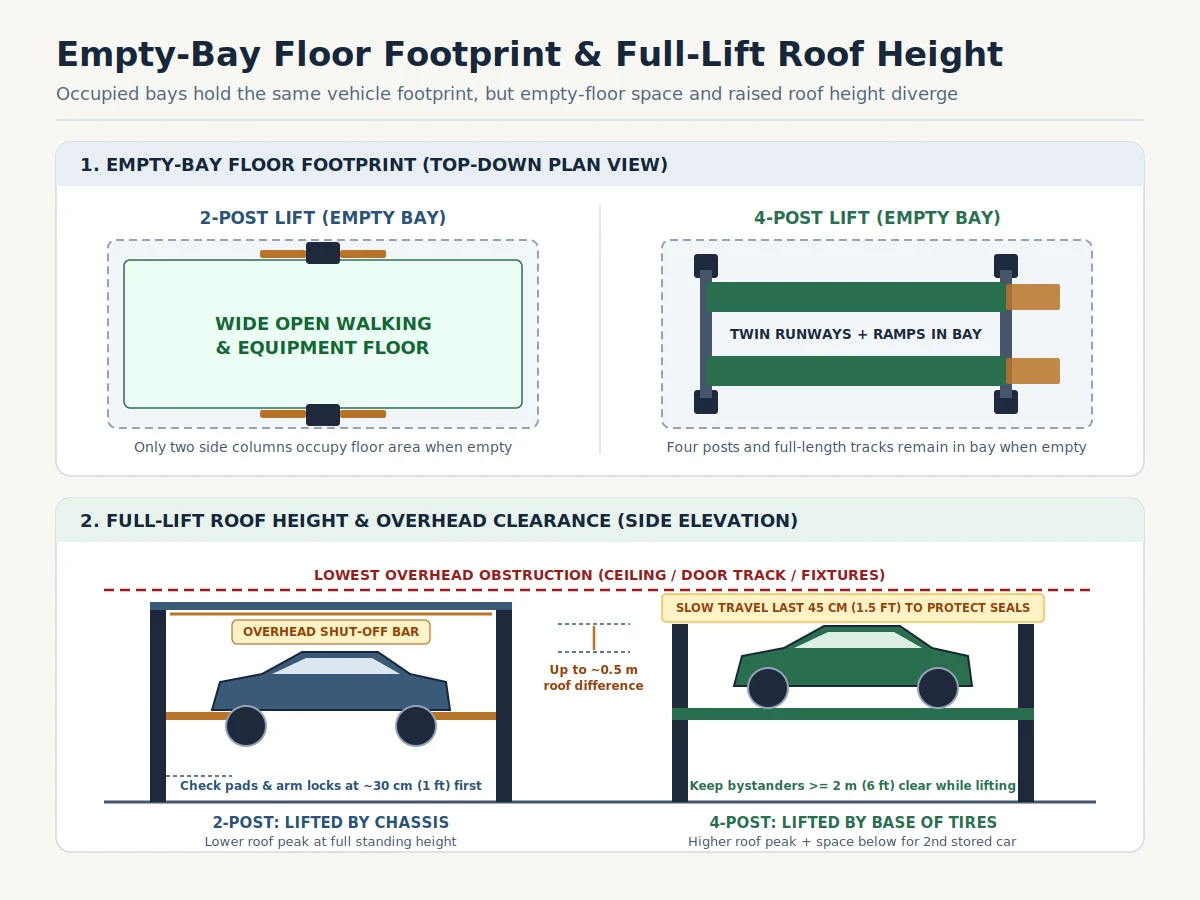
Empty-bay floor space and under-lift floor geometry
In a home collector garage that doubles as a detailing bay, tool corridor, or seasonal workshop, empty-bay footprint matters every day a car is not aloft. When unused, a two-post lift occupies only two narrow side columns with folded swing arms, making it easier to roll toolboxes, floor jacks, or parts carts across the center of the slab. A four-post lift leaves four corner columns, twin full-length steel tracks, and approach ramps occupying the bay floor even when empty.
Floor geometry under any installed lift is also governed by slip and trip controls. Under California Code of Regulations Title 8 Section 3547, floor slots or abrupt recesses under a lift cannot exceed 2 1/4 inches in width unless closable by integral hinged flat covers, recessed rail slopes cannot exceed 1 inch in 4 inches, and floor surfaces underneath must stay reasonably free of oil or grease.
Roof height, overhead shut-off bars, and top-of-stroke clearances
Vertical clearance behaves differently for repair height versus double-stacked parking. When elevating a single car to full working height, a two-post lift raises the vehicle from the bottom of its chassis while a four-post lift raises it from the bottom of its tires, leaving the roof slightly lower on a two-post lift—a margin of up to roughly half a metre that can decide whether a vehicle clears low garage rafters or door hardware.
Before every lift cycle, CCOHS requires closing the doors, hood, and trunk with nobody inside, keeping bystanders at least 2 m (6 ft) away, and verifying overhead clearance for antennas, signs, and roof attachments. Many two-post models include an overhead shut-off bar to halt upward motion before a roof contacts the top beam, and CCOHS cautions operators to raise hydraulic lifts slowly over the final 45 cm (about 1.5 feet) so slamming the top stop does not stretch seal bolts and trigger oil leaks. For multi-car vertical stacking clearances, overhead door track geometry, and room-envelope checks, cross-check our storage facility checklist and dedicated 4-post storage clearance note.
What floor anchoring and safety standards govern installing either lift?
Surface-mounted 2-post and 4-post lifts rely on verified floor strength, proper anchoring, and recognized construction standards rather than guesswork. Where concrete slab specifications lack written documentation, UK HSE advises drilling test holes and obtaining expert assessment before installing a floor-bolted lift, while California safety orders mandate compliance with ANSI/ALI ALCTV construction and testing provisions.
Until the 1980s, most vehicle lifts were in-ground installations; today, surface-mounted lifts bolted to the garage floor and driven by an electric motor operating either a hydraulic pump or a screw drive are the predominant format. Both CCOHS general hydraulic lift guidance and HSE emphasize competent installation and appropriate anchoring, backed by routine inspections of anchor bolts and surrounding concrete for cracks.
In the United States, California Code of Regulations Title 8 Section 3542 provides a concrete public regulatory benchmark across lift construction, controls, hydraulics, and descent speed. New automotive lifts manufactured after July 28, 2005 must be installed according to manufacturer instructions and meet ANSI/ALI ALCTV-1998 Section 8 (Construction) and Section 9.2 (Testing), while operation, inspection, maintenance, installation, and service reference ANSI/ALI ALOIM-2000 and ANSI/ALI ALIS-2001.
| Safety parameter | Published regulatory or standard reference | Verified requirement or measured limit |
|---|---|---|
| Construction and testing baseline | California Title 8 CCR Section 3542 | Lifts built after July 28, 2005 must meet ANSI/ALI ALCTV-1998 Section 8 and Section 9.2 |
| Operation and installation guidelines | California Title 8 CCR Section 3542(d) | Qualified personnel per manufacturer manual; references ANSI/ALI ALOIM-2000 and ANSI/ALI ALIS-2001 |
| Compliance nameplate | California Title 8 CCR Section 3543 | Legibly stamped, etched, or embossed durable plate permanently attached and unobstructed |
| Operator control switch | California Title 8 CCR Section 3544 | Direct control device automatically returns to neutral or off when released |
| Hydraulic oil reservoir reserve | California Title 8 CCR Section 3545 | Minimum safe level at least three inches deep or ten percent of total oil volume at full rise |
| Pressurized oil storage tank | California Title 8 CCR Section 3546 | Non-integral pressurized tanks rated for at least 200 pounds per square inch under ASME Code |
| Under-lift floor recesses | California Title 8 CCR Section 3547 | Max 2 1/4 inch unclosable slot width; max 1 inch in 4 inches recess slope; oil-free surface |
| Chassis and axle supports | California Title 8 CCR Section 3548 | Approved chassis, frame, wheel, or axle supports designed to transfer load safely |
| Maximum descent speed | California Title 8 CCR Section 3549 | Average speed of descent controlled so it does not exceed 20 feet per minute |
| Two-post arm-lock horizontal strength | BS EN 1493 Section 5.8.5 (cited by HSE) | Resist 4.5 percent of capacity without permanent deformation and 6.75 percent without breakage |
What daily checks and periodic inspections keep a 2-post or 4-post lift safe?
Safe long-term ownership depends on brief daily pre-use checks of pads, arm locks or wheel chocks, cables, controls, and floor anchors, paired with scheduled independent examinations. Any hydraulic lift that jerks, settles slowly after rising, moves on its own, or leaks oil at connections must be removed from service immediately until repaired by trained lift service personnel.
Daily pre-use checks and seven stop-use hydraulic symptoms
HSE’s two-post lift safety guidance highlights three daily checks before the first lift of the day: confirming support-arm rubber mounts are serviceable, verifying the arm-lock mechanism operates smoothly, and testing that all controls work properly. CCOHS expands routine inspection across all surface-mounted hydraulic lifts to include anchor bolts, floor cracks, bent arms, weld cracks, cables, adaptors, packing nuts, pistons, and loose hydraulic fittings.
CCOHS lists seven specific warning signs that require taking a hydraulic lift out of service immediately:
- Raises very quickly or comes down very slowly.
- Jerks or jumps while being raised.
- Slowly settles down after reaching height.
- Slowly rises on its own, whether in use or idle.
- Blows oil out of the exhaust line or leaks oil at connections.
Because hydraulic oil escaping through a pinhole leak travels at high enough pressure to puncture skin, CCOHS advises not to use your hands to search for leaks; instead, pass a strip of cardboard or wood over suspected hoses and fittings, bleed residual pressure by cycling levers after shutting down power, and lock out switches before servicing.
Periodic thorough examinations and record keeping
For structured inspection intervals and documentation, UK HSE guidance on thorough examinations under LOLER provides a clear governance model. Lifting equipment assembled on site must be examined by a competent person before first use, followed by regular examinations at 6-month intervals for equipment lifting people or lifting accessories and 12-month intervals for all other lifting equipment (unless a competent person draws up a formal examination scheme).
LOLER also requires a fresh thorough examination after exceptional circumstances—including damage or failure, long periods out of use, or major changes such as replacing critical arm-lock parts. Critically, the competent examiner should be independent of the person performing routine maintenance, and every written report must capture all 11 items listed in Schedule 1 of LOLER, including the examination date, next due date, and any defects affecting safety. Retaining those inspection sheets alongside maintenance invoices keeps your equipment research folder and life-cycle cost ledger complete.
How should a home collector-car garage choose between a 2-post and 4-post lift?
Match the lift architecture to the task you perform most often, not an idealized once-a-year repair. Pick a 2-post lift if frequent brake, wheel, exhaust, and suspension work or an unobstructed empty bay drives the purchase; pick a 4-post lift if stacked collector storage, drive-on convenience, and four-wheel balance come first, adding an approved jacking beam for occasional wheel removal.
| Garage scenario or constraint | Better primary fit | Key engineering verification before ordering |
|---|---|---|
| Regular brake, tire, suspension, and undercarriage restoration | 2-post frame-engaging lift | Verify concrete slab strength (drill test holes if undocumented), machined circular-hole arm-lock gears, and rated jack stands for heavy drivetrain removals |
| Seasonal two-car stacking and drive-on inspection | 4-post runway lift | Verify automatic drive-on wheel chocks, permanent end stops, overhead obstruction clearance, and oil containment over the lower car |
| Mixed storage bay with occasional tire or brake jobs | 4-post runway lift with approved jacking beam | Confirm both lift and jacking beam nameplate capacities and approved axle/frame support adaptors |
| Tight multi-use single bay where floor stays empty most days | 2-post frame-engaging lift | Measure column layout, door-swing width, and overhead shut-off bar clearance below ceiling fixtures |
| Low ceiling height for single-car standing maintenance | 2-post frame-engaging lift | Chassis-level lifting lowers full-rise roof height by up to roughly half a metre compared with tire-level runway elevation; still verify antennas and final 45 cm travel |
| Unknown older residential concrete slab | Verify foundation first on either lift | Obtain competent installer assessment and floor test holes before bolting down columns or applying high overturning anchor loads |
Frequently asked questions
Can you do brake and suspension work on a 4-post lift?
Yes, provided the lift is fitted with an approved jacking beam or rolling bridge jack. A standard four-post lift raises the vehicle by its tires on twin steel runways, leaving the wheels loaded; adding a jacking beam elevates the chassis or axles clear of the runways to provide wheels-free service access.
Why do 2-post lifts require stricter positioning and arm-lock checks than 4-post lifts?
A two-post lift supports the entire vehicle centrally at four manufacturer-designated chassis points rather than evenly under all four tires. HSE Science Division testing showed that if two-post arm-locking gears are only 75 percent engaged (15 mm over 20 mm depth), horizontal failure resistance drops from about 230 kg to 50 kg—a load easily reached while pulling on a tight bolt or when a pad is misaligned.
Does a car sit higher toward the ceiling on a 2-post or 4-post lift?
At full lift height, the top of a vehicle sits higher on a four-post lift than on a two-post lift by up to roughly half a metre. A four-post lift raises the car from the bottom of its tires, whereas a two-post lift grips the underside of the chassis with the wheels hanging below the arms.
How should you check concrete floor suitability before installing a surface-mounted lift?
Both lift styles require a floor of verified strength and appropriate anchoring, with ongoing checks of anchor bolts and concrete for cracks. When written supporting evidence for an existing garage slab is unavailable, HSE recommends making test holes, obtaining expert opinion, and using competent accredited installation engineers.
Which hydraulic lift symptoms mean you should stop using the lift immediately?
According to CCOHS guidance, take a hydraulic lift out of service immediately if it raises very quickly, jerks or jumps while rising, slowly settles down after lifting, slowly rises on its own, descends very slowly, blows oil out of the exhaust line, or leaks oil at hydraulic connections.