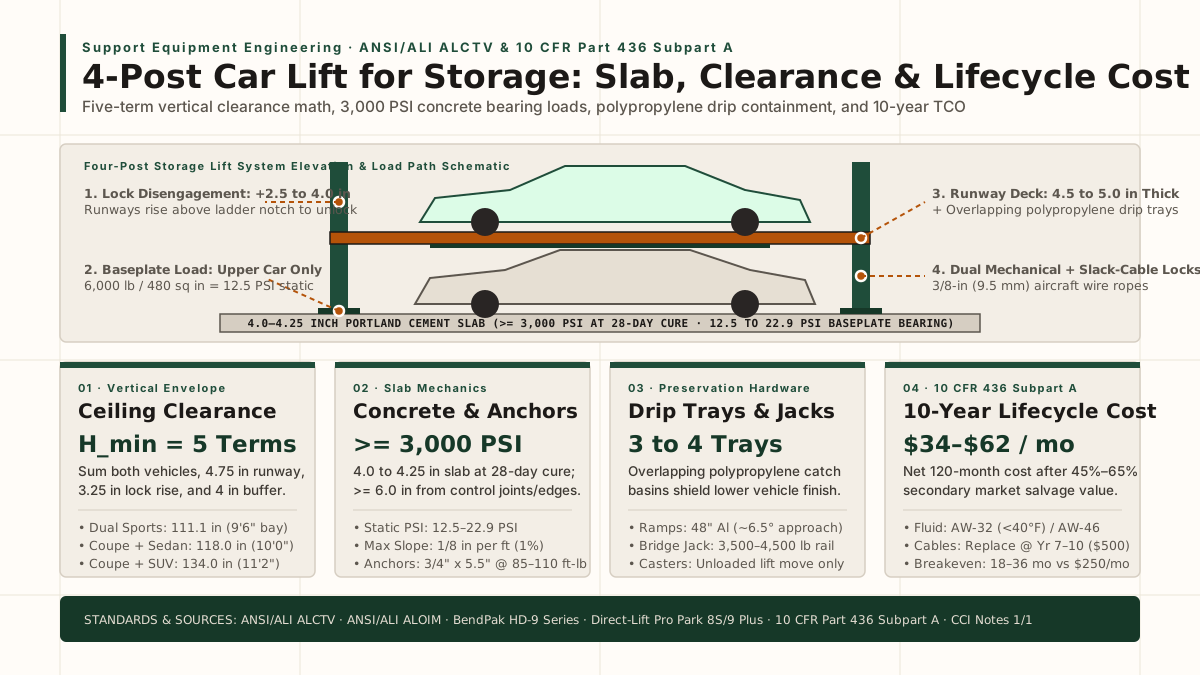
Selecting a 4 post car lift for storage requires verifying five vertical clearance dimensions, confirming a 4.0-inch minimum 3,000 PSI concrete slab, and accounting for every installation and maintenance file across a 10-year study period. Omitting the 4.5-to-5.0-inch steel runway deck thickness or the 2.5-to-4.0-inch mechanical lock disengagement rise from ceiling math causes upper-roof contact damage against overhead door tracks, while skipping overlapping drip trays for 4 post lift bays lets upper-vehicle fluids leak onto the collector car parked below.
Evaluating a garage storage lift lifecycle cost under the federal cost-accounting structure introduced in our parent note on the life-cycle cost of equipment that supports a stored car separates initial equipment, freight, electrical, and high-lift door conversion bills from recurring hydraulic fluid, wire-rope replacement, and 10-year salvage value files. Unlike the vehicle’s own upkeep and insurance entries tracked on the blank collector-car cost worksheet, a four-post lift is a capital support machine shelved under equipment costs that doubles usable floor capacity inside an existing bay.
4-Post Storage Lift Representative Engineering Comparison Table
Before ordering a lift or scheduling an electrical and garage-door contractor, compare the dimensional, structural, and lock-release specifications across four widely deployed 8,000 lb and 9,000 lb storage lift platforms.
| Lift Model & Series | Rated Capacity & Certification | Max Under-Runway Clearance | Runway Width × Deck Thickness | Overall Width × Runway Length | Lock Release & Power Unit Spec |
|---|---|---|---|---|---|
| BendPak HD-9ST / HD-9 / HD-9XW | 9,000 lbs · ALI Certified (ANSI/ALI ALCTV) |
65.0 in (HD-9ST / HD-9) · 77.0 in (HD-9XW Tall) |
19.0 in wide × 4.75 in thick |
100.25 in (ST) or 110.25 in (HD-9/XW) × 164 in (188 in XW) |
Pneumatic push-button (50–125 PSI air) + slack-cable locks · 110V/220V (45–55 s rise) |
| Direct-Lift Pro Park 8S / 9 Plus | 8,000 lbs (8S) · 9,000 lbs (9 Plus) · ALI Certified |
67.5 in (8S) · 79.25 in (9 Plus Extended) |
18.5 in × 4.5 in (8S) · 20.0 in × 4.75 in (9 Plus) |
103.5 in (8S) or 109.75 in (9 Plus) × 157.5 in (176 in 9 Plus) |
Manual single-point mechanical rod linkage + slack-cable locks · 115V 1 HP (70–75 s rise) |
| Wildfire WF9000 / WF9000XLT / Exotic | 9,000 lbs · ALI Certified (WF9000 series) |
72.0 in (Std) · 82.0 in (XLT / Exotic Tall) |
20.0 in (23.0 in Exotic) × 4.75 in thick |
109.0 in (115.5 in Exotic) × 166 in (185 in XLT/Exotic) |
Manual single-point handle (3/4-in laser-cut pawls) + slack-cable latches · 110V/220V |
| Atlas Garage Pro 8000 / 8000EXT | 8,000 lbs · Non-ALI hobbyist storage tier |
67.0 in (8000) · 79.25 in (8000EXT) |
18.75 in driving surface (21.5 in w/ rails) × 4.75 in |
104.0 in (109.5 in EXT) × 165 in (185 in EXT) |
Manual single-point pull handle + slack-cable latches · 110V (20A–30A breaker, 60–70 s) |
Selection takeaway: Match the lift’s maximum under-runway clearance (65.0 to 82.0 in) to the tallest vehicle you intend to park on the concrete slab, and verify whether the lock release requires shop air (50 to 125 PSI pneumatic push-button) or uses a self-contained mechanical linkage lever.
Ceiling Clearance Formula & Worked Stacking Scenarios
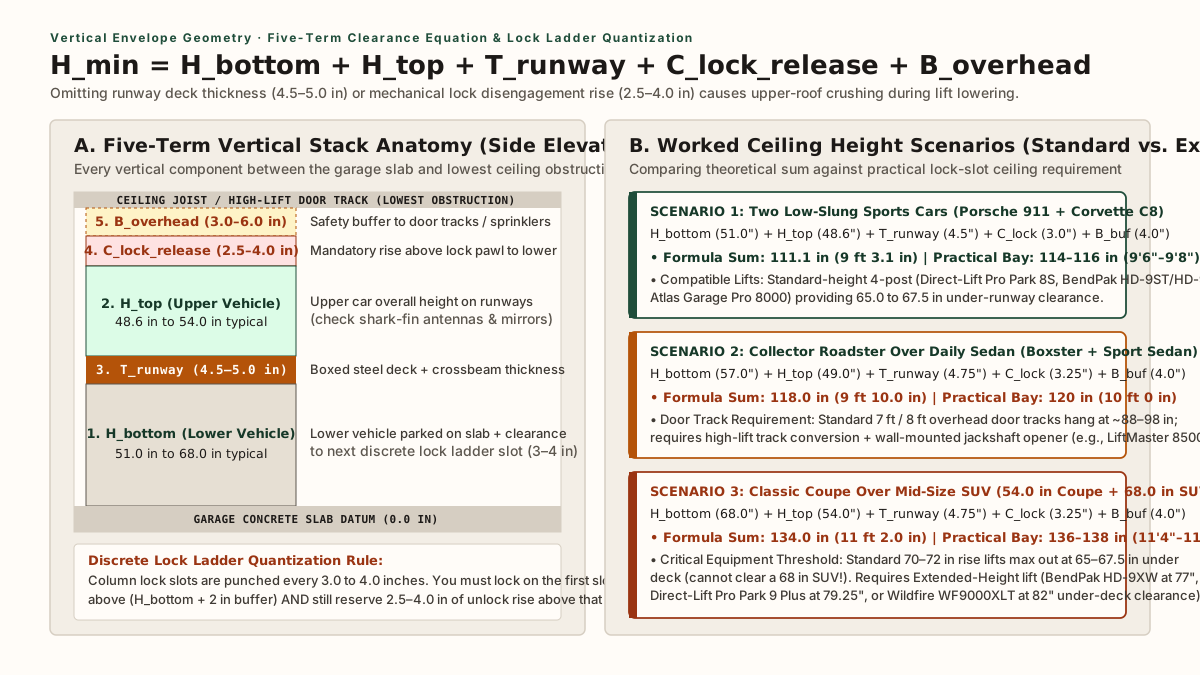
A recurring mistake in residential and collector garage planning is adding the roof heights of two cars (H_bottom + H_top) and assuming a lift will fit if the sum is two inches less than the drywall ceiling. That two-term shortcut ignores three mechanical realities of a four-post lift: the upper vehicle’s tires sit on top of a 4.5 to 5.0 inch boxed-steel runway deck (T_runway), the hydraulic cylinder must raise the crossbeams 2.5 to 4.0 inches above the active mechanical lock ladder slot (C_lock_release) to disengage the spring-loaded safety pawls before the lift can lower, and column lock slots are punched at fixed 3.0 to 4.0 inch vertical intervals.
The Five-Term Minimum Ceiling Height Equation (H_min)
To prevent upper-vehicle roof or open-hood damage during lifting and unlocking, calculate the minimum clear height from the concrete floor to the lowest overhead obstruction (H_min in inches) using the five-term engineering formula:
H_min = H_bottom + H_top + T_runway + C_lock_release + B_overhead
Each variable represents a measurable physical dimension inside the bay:
H_bottom(Lower vehicle overall height, in inches): Measured from the garage slab to the highest point of the lower car. Because the crossbeams must lock on a discrete ladder slot above the lower car’s roof, add at least2.0 inchesof under-deck clearance betweenH_bottomand the underside of the runway, then roundH_bottom + 2.0 in + T_runwayup to the next column lock notch position.H_top(Upper vehicle overall height, in inches): Measured from the steel runway surface to the highest point on the elevated vehicle, including fixed roof antennas, shark-fin GPS pods, or Targa roll hoops.T_runway(Runway deck and crossbeam thickness,4.5 to 5.0 in): On standard 8,000 lb lifts such as the Direct-Lift Pro Park 8S, the formed steel runway deck measures4.5 inches (114 mm)thick; on 9,000 lb platforms such as the BendPak HD-9 series, Pro Park 9 Plus, and Wildfire WF9000, the deck and crossbeam profile measures4.75 to 5.0 inches (121 to 127 mm).C_lock_release(Safety lock disengagement rise,2.5 to 4.0 in): When parked for storage, hydraulic pressure is bled off so the crossbeam lock pawls rest mechanically on the steel column lock ladder tabs. To lower the upper car in spring, the operator must first press the Up button and raise the runways2.5 to 4.0 inches (64 to 102 mm)so the primary pawls clear the ladder tabs and swing back. If the upper car’s roof sits only2.0 inchesbelow a garage door track while parked on the locks, pressing Up to unlock will drive the roof straight into the steel track.B_overhead(Overhead safety buffer,3.0 to 6.0 in): Minimum air gap between the upper vehicle’s peak height (at the top of theC_lock_releasestroke) and the lowest ceiling fixture, such as high-lift door tracks, structural beams, LED shop lights, or fire sprinkler heads inspected under our collector-car storage facility checklist. Notice also that parking a vehicle within 6 to 12 inches of the ceiling exposes it to the warmest air layer in the room; consult our climate-controlled car storage humidity and temperature guide to verify vertical thermal and relative-humidity stratification between the slab and upper joists.
Three Worked Ceiling Clearance Scenarios
Applying the five-term equation across three common collector and daily-driver combinations illustrates how discrete lock-slot rounding and under-runway clearance limits govern lift selection:
- Scenario 1: Two Low-Slung Sports Cars (Porsche 911 Carrera at
51.0 in+ Chevrolet Corvette C8 at48.6 inon a Direct-Lift Pro Park 8S):H_min = 51.0 in + 48.6 in + 4.5 in + 3.0 in + 4.0 in = 111.1 in (9 ft 3.1 in)When accounting for discrete column lock slots spaced every3.5 to 4.0 inches(locking the underside of the runway at53.5 into clear the51.0 inlower car by2.5 in, putting the top of the4.5 inrunway at58.0 in), the practical required ceiling height is114.0 to 116.0 inches(9 ft 6 in to 9 ft 8 in). Any standard-height 4-post lift (65.0 to 67.5 inmaximum under-runway clearance) accommodates this pair. - Scenario 2: Collector Roadster Over Daily-Driver Sport Sedan (Porsche Boxster / Mazda Miata at
49.0 in+ Sport Sedan at57.0 inon a BendPak HD-9):H_min = 57.0 in + 49.0 in + 4.75 in + 3.25 in + 4.0 in = 118.0 in (9 ft 10.0 in)Rounding to the nearest lock ladder slot above59.0 inchesof under-deck clearance sets the practical minimum bay ceiling at120.0 inches(10 ft 0 in). Because standard 7-foot or 8-foot residential sectional garage doors hang their horizontal tracks at88 to 98 inchesabove the slab, a 10-foot ceiling bay requires a high-lift door track conversion and a wall-mounted jackshaft opener so the door hugs within4 to 6 inchesof the ceiling joists. - Scenario 3: Classic Grand Tourer Over Mid-Size SUV (
54.0 inCollector Coupe +68.0 inSUV):H_min = 68.0 in + 54.0 in + 4.75 in + 3.25 in + 4.0 in = 134.0 in (11 ft 2.0 in)With lock-slot rounding, plan on136.0 to 138.0 inches(11 ft 4 in to 11 ft 6 in) of clear ceiling height. More importantly, a standard-height 4-post lift will fail this scenario even inside a 14-foot warehouse: standard lifts such as the BendPak HD-9 (70 inrise /65 inunder-deck clearance) and Direct-Lift Pro Park 8S (72 inrise /67.5 inunder-deck clearance) cannot raise high enough to drive a68.0-inchSUV underneath. IfH_bottom > 64.0 inches, engineering rule of thumb dictates specifying an Extended-Height / Tall lift model such as the BendPak HD-9XW (77.0 inunder-runway clearance), Direct-Lift Pro Park 9 Plus (79.25 in), Atlas Garage Pro 8000EXT (79.25 in), or Wildfire WF9000XLT (82.0 in).
Calculation takeaway: Always measure ceiling clearance from the slab to the lowest overhead door track or sprinkler head, add 7.0 to 9.0 inches for T_runway + C_lock_release plus 3.0 inches for discrete lock-slot rounding, and select an extended-height lift (82 to 84 in rise) whenever the lower vehicle exceeds 64 inches in roof height.
Concrete Slab Engineering, Baseplate Bearing PSI & ANSI/ALI Locks
Unlike a two-post asymmetric service lift (which cantilevers a vehicle’s entire mass from two narrow column footprints and induces severe overturning bending moments on anchor bolts), a four-post storage lift places the elevated vehicle inside a stable four-corner structural rectangle.
Concrete Slab Thickness, 28-Day Cure & Joint Setback Rules
Manufacturer installation manuals (including the published BendPak HD-9 installation specification and Direct-Lift Pro Park guidelines) establish four mandatory concrete foundation parameters:
- Minimum slab thickness (
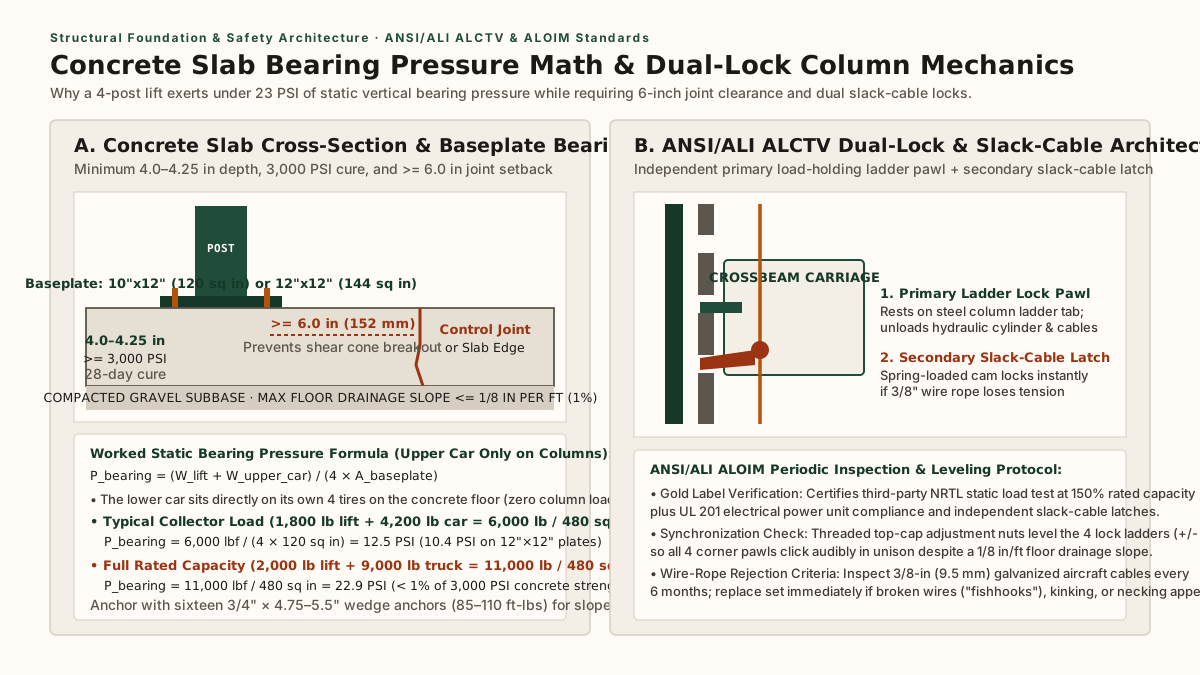
4.0 to 4.25 inches): Poured structural Portland cement concrete must measure at least4.0 inches (102 mm)thick for standard freestanding storage installations and4.25 inches (108 mm)minimum when drilling mechanical wedge anchors under BendPak HD-9 specifications. Never install a lift over asphalt, post-tensioned residential cables (without X-ray/GPR scanning), or cracked thin topping screeds. - Compressive strength and cure time (
>= 3,000 PSIat28 days): The concrete mix must achieve a minimum compressive strength of3,000 PSI (20.7 MPa). Newly poured garage slabs or concrete replacement pads must cure for a full 28 days before drilling anchor holes or loading vehicles onto the posts. - Edge and control-joint clearance (
>= 6.0 inches): Every column baseplate edge and anchor bolt hole must sit at least6.0 inches (152 mm)away from saw-cut expansion joints, control seams, structural cracks, floor drains, or slab perimeters. Drilling or loading closer than6.0 inchesto a discontinuity risks concrete shear-cone breakout. - Garage floor drainage slope (
<= 1/8 inch per foot): Residential garage slabs are commonly poured with a slight pitch toward the overhead door so snowmelt drains outward. Most four-post lifts tolerate up to1/8 inch per foot(~1.0%grade, or1.75 inchesover a14-footrunway length) because the internal steel lock ladders hang from threaded top-cap adjustment rods offering+/- 1.5 inchesof independent vertical leveling at each corner. If floor slope exceeds1/8 inch per foot, the low-side baseplates must be shimmed with full-contact steel shims and anchored with3/4-inch × 4.75-to-5.5-inchwedge anchors (four per post, 16 total) torqued to85 to 110 ft-lbs.
Worked Static Baseplate Bearing Pressure Math (P_bearing)
A common misconception among homeowners is that stacking two 4,000 lb cars on a 1,800 lb lift puts 9,800 lbs onto the four column baseplates. In physical reality, the lower car parks directly on the concrete floor on its own four tires and contributes 0 lbs to the lift structure. Only the lift’s dead weight (W_lift) plus the upper vehicle’s curb weight (W_upper_car) bears on the four steel baseplates (A_baseplate each):
P_bearing = (W_lift + W_upper_car) / (4 × A_baseplate)
Compare two worked loading conditions across standard 10 in × 12 in (120 sq in per post, 480 sq in total) and heavy-duty 12 in × 12 in (144 sq in per post, 576 sq in total) steel baseplates:
- Worked Case A (Collector Coupe Storage:
1,800 lblift +4,200 lbupper car =6,000 lbftotal column load):- On four
10 in × 12 inbaseplates (480 sq intotal area):P_bearing = 6,000 lbf / 480 sq in = 12.5 PSI - On four
12 in × 12 inbaseplates (576 sq intotal area, such as Wildfire WF9000):P_bearing = 6,000 lbf / 576 sq in = 10.4 PSI
- On four
- Worked Case B (Full 9,000 lb Rated Capacity:
2,000 lblift +9,000 lbupper truck =11,000 lbftotal column load):- On four
10 in × 12 inbaseplates (480 sq intotal area):P_bearing = 11,000 lbf / 480 sq in = 22.9 PSI - On four
12 in × 12 inbaseplates (576 sq intotal area):P_bearing = 11,000 lbf / 576 sq in = 19.1 PSI
- On four
Even at full 9,000 lb rated capacity, a 22.9 PSI average static bearing stress is less than 0.8% of a 3,000 PSI concrete slab’s compressive strength, and substantially lower than the 32 to 40 PSI contact-patch pressure exerted directly by a car’s own rubber tires!
ANSI/ALI ALCTV Gold Label Certification & Dual-Lock Mechanics
When evaluating structural safety, distinguish between third-party certified lifts bearing the Automotive Lift Institute (ALI) Gold Label under ANSI/ALI ALCTV (Standard for Automotive Lifts: Safety Requirements for Construction, Testing and Validation) and uncertified import storage lifts:
- 150% static load & UL 201 electrical testing: To earn an ALI Gold Label, a Nationally Recognized Testing Laboratory (NRTL) physically load-tests the exact lift model to
150%of rated capacity (13,500 lbson a9,000 lblift), verifies structural safety factors of>= 3.0on load-bearing steel members and>= 4.0 to 5.0on wire ropes, confirms electrical motor compliance withUL 201, and audits the manufacturing plant. - Primary multi-position load-holding ladder locks: Inside each of the four columns hangs an adjustable vertical steel lock ladder. As the crossbeams rise, spring-loaded primary lock pawls glide over the ladder slots and drop positively into engagement every
3.0 to 4.0 inches. Lowering the runways1.0 inchafter reaching target height seats all four corners onto solid steel shear tabs, removing hydraulic pressure from the cylinder rod seal and relaxing continuous working tension on the lifting cables. - Independent secondary slack-cable safety latches: Beneath each primary lock pawl sits a second, spring-actuated cam or dog kept retracted solely by the tension of the
3/8-inch (9.5 mm)aircraft-grade galvanized wire rope passing over its sheave roller. If a lifting cable ever stretches excessively, slips a sheave, or parts while the primary lock handle is held open, tension loss lets the secondary spring drive the slack-cable pawl into the column ladder within fractions of an inch. - Pneumatic vs. manual single-point lock release: Models such as the BendPak HD-9 series use pneumatic air cylinders at all four corners to retract the primary lock pawls when the operator holds a push-button valve during descent (requiring
50 to 125 PSIof shop air or a compact$1201-gallon air compressor). Models such as the Direct-Lift Pro Park 8S/9 Plus, Wildfire WF9000, and Atlas Garage Pro 8000 use a mechanical linkage rod assembly connected to a single manual pull lever beside the power unit, eliminating the need for an air supply.
Key takeaway: A 4-post storage lift imposes only 10.4 to 22.9 PSI of static vertical bearing pressure on a >= 4.0-inch, 3,000 PSI concrete slab, provided every baseplate stays at least 6.0 inches clear of control joints and all four column lock ladders are synchronized so the primary pawls engage simultaneously.
Drip Trays for 4-Post Lift, Approach Ramps & Seasonal Layup Prep
Storing a vintage or high-performance vehicle directly above another collector car introduces a serious preservation hazard: gravity pulls every drop of weeping engine oil, transmission fluid, power-steering fluid, coolant, or melting road slush from the upper chassis directly onto the hood, roof, or convertible canvas of the lower vehicle.
Overlapping Polypropylene Drip Trays (36–45 in × 38–42 in)
In accordance with the preventive containment principles in Canadian Conservation Institute CCI Notes 1/1: General Precautions for Storage Areas and the finish-protection standards in our restoration versus preservation guide, never store an upper vehicle on open 4-post runways without full underbody drip containment. Even a minor seepage of polyglycol brake fluid (DOT 3 or DOT 4) acts as a chemical paint stripper that blisters acrylic lacquer, urethane clearcoat, or original single-stage enamel on the lower car within hours.
Between the left and right steel runways runs an inner utility / accessory rail flange (1.5 to 2.0 inches wide) designed to support drip trays for 4 post lift bays:
- Material & dimensions: Specify a set of three or four injection-molded high-impact polypropylene drip trays (typically measuring
36 to 45 incheslong by38 to 42 incheswide, weighing only6 to 9 lbseach, with molded grid ribs that prevent caught fluids from sloshing when removed). - Overlapping lip geometry: Each polypropylene tray features an offset perimeter flange so adjacent trays overlap like roof shingles along the inner utility rail. Position the linked set continuously from the front radiator core support past the engine oil pan, bellhousing, and transmission tailshaft (plus a fourth tray beneath the rear differential on front-engine/rear-drive or transaxle cars).
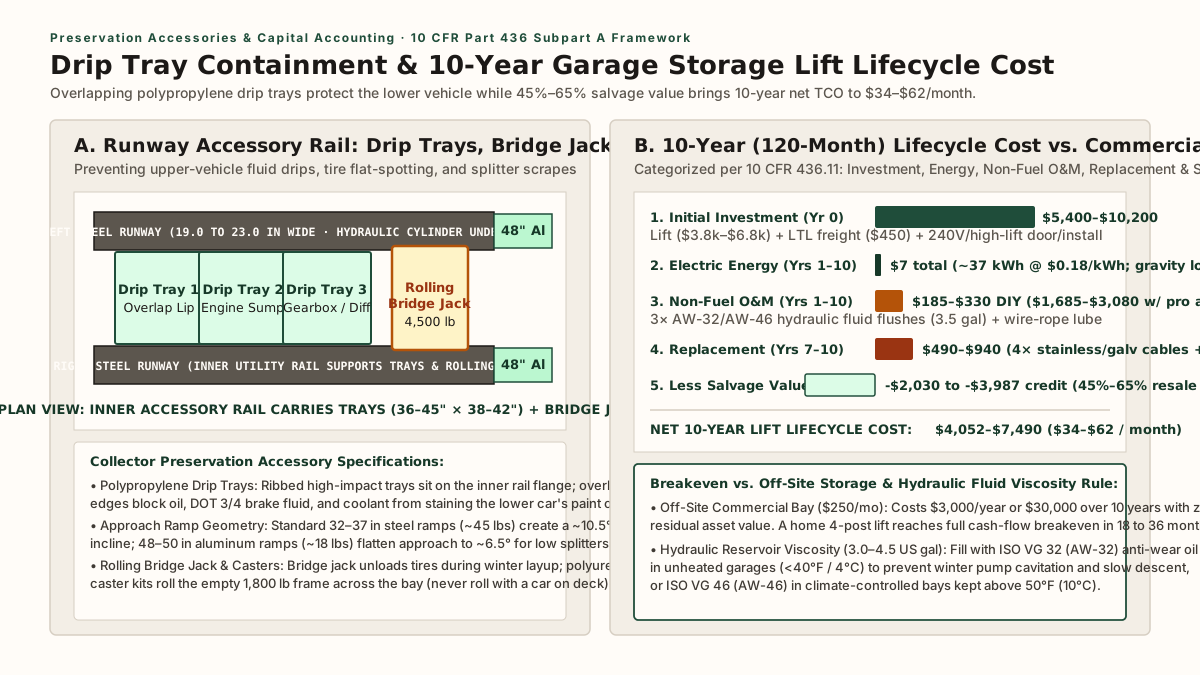
Rolling Bridge Jacks, Aluminum Approach Ramps & Caster Kits
Integrating three mechanical accessories with the pre-layup procedures in our winter car storage fuel, battery, and tire preservation guide transforms a basic parking lift into a complete preservation bay:
- Rolling bridge jack (
3,500 to 4,500 lbcapacity,$650 to $1,600): A telescoping manual-hydraulic or pneumatic-hydraulic scissor jack rides along the same inner utility rail as the drip trays. During a 90-to-180-day winter layup, either park the upper vehicle’s tires inside concave closed-cell foam cradles (Race Ramps FlatStoppers,14 to 16 incheswide) placed on the steel runways, or use two rolling bridge jacks positioned under the factory suspension pickup points to unload tire contact-patch deflection completely. - Extended aluminum approach ramps (
48 to 50 inches,$350 to $650/pair): Standard hinged or hook-on steel approach ramps measure31 to 37 incheslong, weigh35 to 50 lbseach, and create an approach incline angle (theta) across a4.75-inchhigh runway of:theta_steel = arctan(4.75 in / 32 in) = 8.4° to 10.5°(often11°to12°including ramp crown) Sports cars with low front splitters (< 4.5 inchesground clearance) or long front overhangs will scrape on a32-inchramp. Upgrading to48-to-50-inchextruded aluminum or high-density composite ramps (16 to 20 lbseach) reduces the climb angle to:theta_aluminum = arctan(4.75 in / 48 in) = 5.65° (approx. 6.0° to 6.5° effective) - Polyurethane caster kit (
$200 to $450): Four steel caster brackets fitted with4-to-6-inchnon-marking polyurethane swivel wheels pin onto the four crossbeam ears while the empty runways sit6 inchesoff the floor. Lowering the runways fully levers the four column baseplates1 to 2 inchesoff the concrete, allowing two people to roll the unloaded1,800 lblift across the garage or out onto the driveway for floor cleaning. Strict operating rule: Never attach caster kits or attempt to roll a 4-post lift with a vehicle on the runways. - Upper-runway smart battery maintainer routing: When storing a collector car on the upper deck over winter, never drape a
120Vextension cord loosely across the moving crossbeam path or lifting cables. Mount the microprocessor battery maintainer (CTEK MXS 5.0orNOCO GENIUS5) to the front column leg, route the low-voltage DC lead through magnetic cable clips along the stationary post and hinged runway transition, and leave a quick-disconnect SAE/eyelet tail with a bright red warning streamer on the driver’s mirror so the cord is unplugged before lowering.
Key takeaway: Position three to four overlapping polypropylene drip trays along the inner runway rail beneath the upper car’s drivetrain, upgrade to 48-inch aluminum ramps (~6.0° incline) for low front splitters, and never engage caster brackets while a vehicle rests on the lift.
10-Year Garage Storage Lift Lifecycle Cost (10 CFR Part 436 Subpart A)
To evaluate whether purchasing a home 4-post lift is more economical than renting an off-site storage unit (analyzed in our monthly car storage cost comparison), we organize every cash flow over a 10-year (120-month) study period using the five cost definitions in 10 CFR Part 436 Subpart A (§ 436.11) from our parent equipment life-cycle cost framework:
LCC_10yr = C_investment + C_energy + C_non_fuel_OM + C_replacement - V_salvage
10-Year (120-Month) Lifecycle Cost Comparison Table
The table below compares two documented home-garage 4-post lift configurations against a $250/month commercial collector-car storage bay over a 10-year horizon.
| 10 CFR § 436.11 Cost File | Option A: Hobbyist 8,000 lb Lift (DIY Install, Existing High Ceiling) | Option B: ALI-Certified 9,000 lb Lift (Pro Install + High-Lift Door + Rolling Jack) | Option C: Off-Site Commercial Vehicle Storage Bay ($250 / Month) |
|---|---|---|---|
| 1. Initial Investment Costs (Year 0) | Total: $5,400 · Lift w/ casters & drip trays ($3,950) + LTL terminal freight & rollback offload ($550) + 120V/20A circuit ($300) + 48“ aluminum ramps ($600) |
Total: $10,200 · ALI 9,000 lb lift ($5,800) + LTL freight/install ($1,450) + 240V circuit ($450) + high-lift door tracks & LiftMaster 8500W jackshaft opener ($1,650) + 4,500 lb rolling jack ($850) |
Total: $0 capital (security deposit only; zero facility modification) |
| 2. Energy Costs (Years 1–10) | Total: $7 · 1.5 kW (115V) motor @ 70 s rise × 100 cycles/yr = 29.2 kWh over 10 yrs @ $0.18/kWh (0 kWh gravity lowering) |
Total: $7 · 2.2 kW (220V) motor @ 50 s rise × 120 cycles/yr = 36.7 kWh over 10 yrs @ $0.18/kWh (0 kWh gravity lowering) |
Total: $0 direct (embedded in monthly facility rent) |
| 3. Non-Fuel O&M Costs (Years 1–10) | Total: $195 · 3× hydraulic fluid flushes (3.5 gal AW-32 every 3 yrs = $115) + 6-month wire-rope lubricant & lithium grease ($80) + owner inspection ($0) |
Total: $2,030 · 3× AW-32/AW-46 hydraulic flushes ($130) + cable/sheave lubricant ($100) + 10× annual ALI-qualified inspector visits ($180/yr = $1,800) |
Total: $30,000 · 120 months × $250/month lease rate (assuming 0% rent escalation over 10 years) |
| 4. Replacement Costs (Years 7–10) | Total: $490 · Preventative 4-cable wire-rope set at Year 8 ($360) + cylinder rod seal & UHMW slide blocks ($130) |
Total: $740 · OEM 4-cable aircraft wire-rope set at Year 8 ($480) + hydraulic breather/seal kit & slide blocks ($260) |
Total: $0 (facility owner maintains building envelope) |
| 5. Less Salvage Value (Year 10) | Credit: -$2,038 (~51.6% resale retention on $3,950 lift hardware) |
Credit: -$3,480 (60.0% resale retention on $5,800 ALI-certified lift + rolling jack) |
Credit: $0 (100% of lease payments are non-recoverable rent) |
Net 10-Year Lifecycle Cost (LCC_10yr) |
$4,054 net ($33.78 / month equivalent; 18.2-month breakeven vs. $250/mo rent) |
$9,497 net w/ pro inspections or $7,697 net w/ owner inspections ($64.14–$79.14 / mo; 34.8-month breakeven) |
$30,000 net ($250.00 / month; zero equity or home real-estate utility) |
Critical Installation, Freight & Hydraulic Maintenance Notes
When assembling estimates for your facility equipment folder (kept alongside your provenance and service documentation), verify four operational details that determine actual Year 0 and Year 1–10 costs:
- Shipping bundle offloading logistics (
14 to 17 ftlong,1,600 to 2,200 lbs): A 4-post lift ships as a single heavy steel-strapped steel bundle that is twice as long as a standard8-footfreight truck liftgate. Standard residential liftgate delivery cannot offload a 4-post lift. Either pick up the bundle at the local LTL freight terminal on an open car trailer (where the terminal forklift loads it free of charge) or arrange a local flatbed rollback tow truck ($150 to $300) to meet the freight carrier, winch the bundle onto the tilted bed, and slide it directly onto your garage floor. - High-lift garage door conversion & jackshaft opener (
$1,250 to $2,500combined): Standard overhead door tracks hang24 to 32 inchesbelow a 10-to-12-foot ceiling and use a center-mounted trolley opener right where the upper car’s roofline sits. A door technician installs extended vertical tracks, conical high-lift cable drums, re-rated torsion springs, and a wall-mounted jackshaft torsion-bar opener (such as the LiftMaster 8500W / 98022) so the door rises vertically to within4 to 6 inchesof the ceiling before curving back. - Hydraulic fluid viscosity (
AW-32vs.AW-46): The power unit tank holds3.0 to 4.5 US gallons (11.4 to 17.0 L)of anti-wear hydraulic oil. In unheated garages where winter temperatures drop below40°F (4°C), fill with ISO VG 32 (AW-32) hydraulic oil (orDexron IIIATF if permitted on the reservoir placard) so cold viscosity does not starve the gear pump on startup or slow gravity return descent to a crawl. In heated garages kept above50°F (10°C), use ISO VG 46 (AW-46). Drain and refill the tank every 2 to 3 years (3 flushesover 10 years) to remove condensed atmospheric moisture. - ANSI/ALI ALOIM wire-rope stretch & inspection schedule: Under ANSI/ALI ALOIM (Standard for Automotive Lifts: Safety Requirements for Operation, Inspection and Maintenance), new
3/8-inch (9.5 mm)braided aircraft cables experience initial construction stretch during the first10 to 30lift cycles; re-check cable tension nuts and synchronize the four column lock ladders after Month 1 so all four corner pawls click simultaneously. Every 6 months, wipe down the cables and apply penetrating wire-rope lubricant (never heavy chassis grease, which traps abrasive grit on the outer strands and hides broken inner wires), grease the corner sheave pulley Zerk fittings, and inspect the full cable length for broken wire strands (“fishhooks”), necking, flattened spots, or rust.
Buying takeaway: Over a 10-year study period, a 4-post storage lift delivers a net lifecycle cost of $34 to $79 per month after 50% to 60% secondary-market salvage credit, paying back its full initial capital investment in 18 to 36 months compared with a $250/month off-site storage bay.