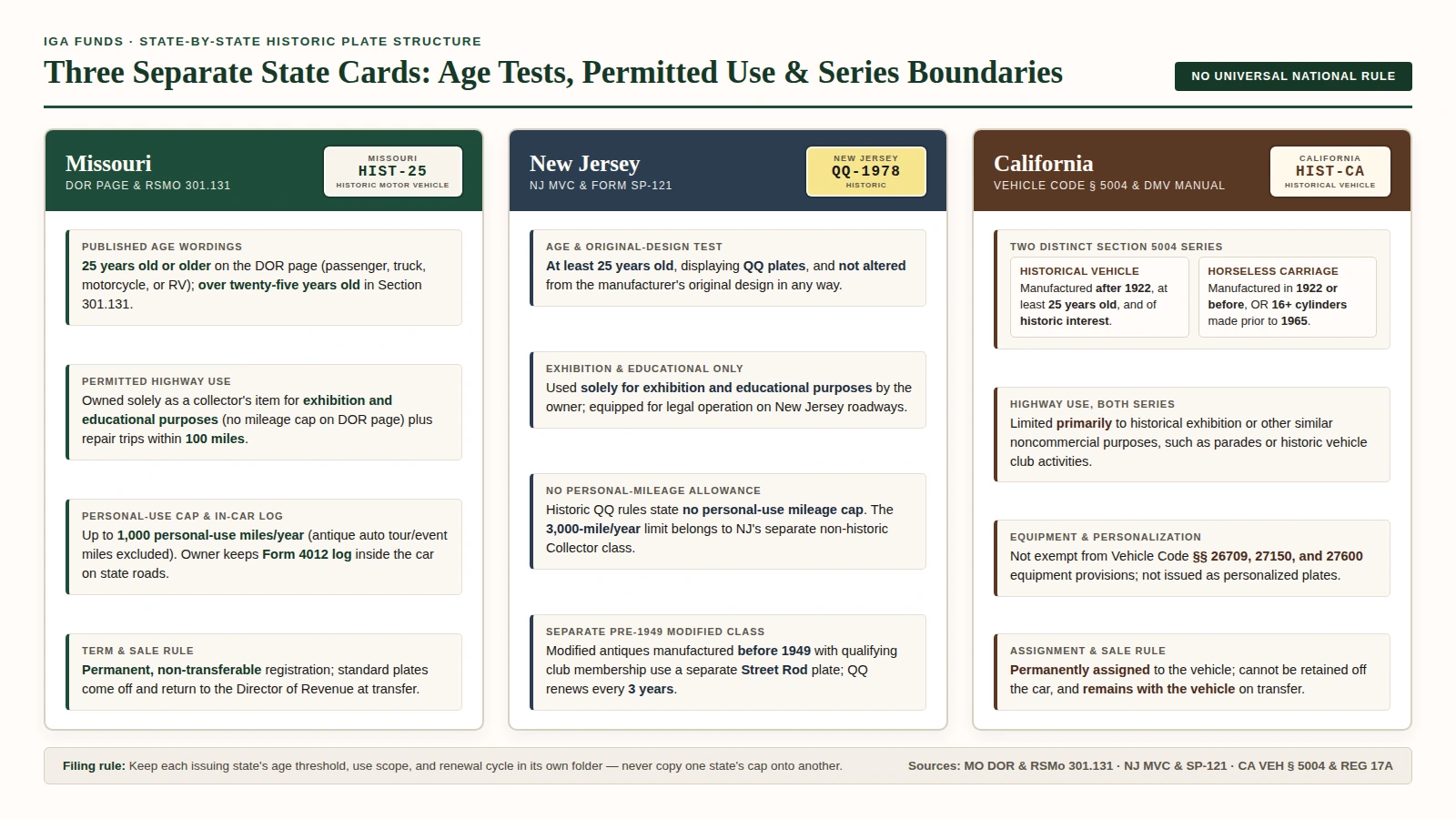
Historic vehicle registration is a restricted state motor-vehicle registration class governed by the issuing jurisdiction’s own age test, alteration rule, highway-use limit, renewal term, and title-transfer rule rather than a single national rule. On the Missouri Department of Revenue historic plates page, a qualifying passenger vehicle, truck, motorcycle, or RV must be 25 years old or older, owned solely as a collector’s item, and used for exhibition and educational purposes. Under Missouri Revised Statutes Section 301.131, any motor vehicle over twenty-five years old owned solely as a collector’s item and used and intended to be used for exhibition and educational purposes qualifies for permanent registration. On the New Jersey Motor Vehicle Commission historic vehicles page, a historic vehicle must be at least 25 years old and only used for exhibition and educational purposes by the owner. Under California Vehicle Code Section 5004, Historical Vehicle plates apply to vehicles manufactured after 1922 that are at least 25 years old and of historic interest, while Horseless Carriage plates cover motor vehicles manufactured in 1922 or before or vehicles with an engine of 16 or more cylinders manufactured prior to 1965.
Within our collector cars documentation series, keeping state registration papers, mileage logs, and plate-transfer records in their own folder follows our provenance and documentation guide, which keeps register entries separate from workshop repair records and sale papers. When assembling registration copies and chassis photographs for a valuation appointment, organize those items with our classic car appraisal documentation checklist, and enter official registration charges alongside storage, upkeep, and insurance bills on the collector-car total cost worksheet.
What Qualifies a Car for Historic Vehicle Registration by State?
Qualification for antique license plates or classic car registration under a state historic statute depends on the exact age cut-off, vehicle-weight class, and originality rule published by the issuing agency and legislature. A 25-year threshold in one state does not govern Maryland’s fixed model-year cutoff, Alaska’s 30-year threshold, or California’s 1922 split between Historical Vehicle and Horseless Carriage series.
| Jurisdiction | Age or Model-Year Rule | Originality or Series Boundary | Registration Term |
|---|---|---|---|
| Missouri (DOR and RSMo 301.131) | 25 years old or older on DOR page (passenger, truck, motorcycle, or RV); over twenty-five years old in RSMo 301.131 | Owned solely as a collector’s item; optional Year of Manufacture plate if Missouri plate is over 25 years old, matches model year, and does not conflict with current numbering | Permanent, non-transferable registration |
| New Jersey (MVC and Form SP-121) | At least 25 years old (at least twenty-five (25) years old on Form SP-121) | Displays QQ plates; cannot be altered from the manufacturer’s original design in any way and must be equipped for legal operation on New Jersey roadways | Renewed every three (3) years with no renewal fee |
| California (VEH Section 5004 and DMV Manual) | Historical Vehicle: manufactured after 1922 and at least 25 years old; Horseless Carriage: manufactured in 1922 or before, or 16+ cylinders prior to 1965 | Historical series requires historic interest; neither series is exempt from Vehicle Code Sections 26709, 27150, and 27600 equipment rules, and neither is available personalized | Permanent plates assigned to the vehicle; no additional fee for renewal |
| New York (DMV and VAT Section 401 Schedule G) | Manufactured more than 25 years before the current calendar year based on model year (or under 25 years if DMV determines historical, classic, or exhibit value, or the commissioner determines historical, classic, or exhibition value) | Separate Vintage plate option requires model year 2000 or older and original vintage plates (no reproductions accepted) | Optional registration valid for 1 year |
| Maryland (MVA Specialty Plates and 2025 Bulletin) | Model year 1999 or older for passenger vehicles, motorcycles, and trucks at or under 10,000 lbs GVWR; 25 calendar years old or older for trucks over 10,000 lbs GVWR, tractors, and motor homes | Must not have been substantially altered, remodeled, or remanufactured from original design; vehicles 60 years or older may obtain a one-time permanent non-transferable registration (no specialty plates) | Standard historic term, or one-time permanent registration at 60+ years |
| Alaska (DMV and AS 28.10.181) | 30 or more years old on DMV historic page; manufactured 30 or more years before the year of application for AS 28.10.181(b)(2) plates | Primarily driven for historical exhibition; separate Custom Collector plate covers body and frame manufactured before 1949 or replica models | Annual registration renewal is not necessary for historic registration |
| District of Columbia (DC DMV and Code Section 50-1501.01) | Model year at least 25 years old, or at least 15 years old for a discontinued make (Kaiser, Hudson, DeSoto, Nash, Edsel, Studebaker, and Packard named in code) | Class F(I) has not been substantially altered or modified from original manufacturer specifications; Class F(II) covers event-only highway operation | Two-year inspection sticker on F(I); non-expiring inspection sticker on F(II) |
Reading each state’s published text side by side exposes four age and eligibility distinctions that owners keep separate:
- Missouri publishes two age phrasings across its agency page and statute. The Missouri Department of Revenue historic plates page states that a passenger vehicle, truck, motorcycle, or RV must be 25 years old or older, owned solely as a collector’s item, and used for exhibition and educational purposes. Missouri Section 301.131 states that any motor vehicle over twenty-five years old owned solely as a collector’s item and used and intended to be used for exhibition and educational purposes qualifies for permanent registration.
- California divides vehicles manufactured in 1922 or before and vehicles manufactured after 1922 into two different plate programs. Under both the California DMV Registration Procedures Manual and California Vehicle Code Section 5004, Historical Vehicle License Plates require three conditions together: manufactured after 1922, at least 25 years old, and of historic interest—defined in Section 5004 as a vehicle collected, restored, maintained, and operated by a collector or hobbyist principally for purposes of exhibition and historic vehicle club activities. Horseless Carriage License Plates apply instead to a motor vehicle manufactured in 1922 or prior thereto, or to a motor vehicle with an engine of 16 or more cylinders manufactured prior to 1965.
- Maryland replaced its former rolling 20-year passenger rule with a model-year 1999 cutoff. Under the Maryland MVA registration-law bulletin effective July 1, 2025, “at least 20 years old” was replaced by “model years of 1999 or older,” requiring currently historic vehicles of model years 2000 through 2005 to convert to a standard registration subject to VEIP requirements and, if there is no record of a safety inspection by the current owner, a safety inspection. On the Maryland MVA specialty plates page, trucks with a GVWR in excess of 10,000 pounds, tractors, and motor homes remain in a separate historic category requiring 25 calendar years of age or older and no substantial alteration from original design.
- Alaska sets a 30-year historic threshold, while DC adds a 15-year discontinued-make clause. On the Alaska DMV historic and collector plates page, a historic vehicle is 30 or more years old and primarily driven for historical exhibition, and Alaska Statutes AS 28.10.181 requires manufacture 30 or more years before the year of application for its owner-supplied year-plate subsection. In the District of Columbia, both the DC DMV historical vehicles page and DC Official Code Section 50-1501.01 admit vehicles whose model year is at least 25 years old as well as vehicles at least 15 years old of makes no longer manufactured, with Section 50-1501.01 naming Kaiser, Hudson, DeSoto, Nash, Edsel, Studebaker, and Packard.
Can You Drive Every Day on Historic or Antique License Plates?
None of the seven historic-plate programs covered here authorizes ordinary daily commuting, though each jurisdiction defines permitted non-commute driving in its own statutory or agency words:
- New Jersey (exhibition and educational use only): The New Jersey MVC historic page limits a historic vehicle to exhibition and educational purposes only, and Form SP-121 assigns historic registration to an antique vehicle owned as a collector’s item and used solely for exhibition or educational purposes, and neither page states a mileage allowance.
- California (primarily historical exhibition and club events): Under the California DMV handbook, vehicles carrying Historical Vehicle or Horseless Carriage plates are limited to operation or movement over the highway primarily for historical exhibition or other similar noncommercial purposes, such as parades or historic vehicle club activities, and the applicant certification on Special Recognition License Plate Application (REG 17A) states that the vehicle is primarily operated in or moved over the highway for historical exhibitions, parades, or historic vehicle club activities.
- New York (agency bar on daily transportation alongside Schedule G occasional transportation): The New York DMV historical and vintage plates page states that you can use a vehicle with historical license plates only as a collector’s item or exhibition piece and cannot use the vehicle for daily transportation. Separately, New York Vehicle and Traffic Law Section 401 Schedule G sets its annual historical registration for vehicles used for participation in club activities, exhibit, tours, parades, occasional transportation, and similar uses, but not used for general daily transportation.
- Maryland (light-vehicle occasional transportation vs heavy-vehicle exhibition limit): On the Maryland MVA specialty plates page, owners of passenger vehicles, motorcycles, and trucks of 10,000 pounds GVWR or less (model year 1999 or older) certify use in exhibitions, club activities, parades, tours, occasional transportation, and similar uses, and certify that the vehicle will not be used for general daily transportation or primarily for transporting passengers or property on highways. By contrast, trucks over 10,000 pounds GVWR, tractors, and motor homes registered under Maryland’s 25-year heavy historic criteria may not be used for occasional transportation or for any commercial transportation of passengers or property on highways, and are restricted solely to exhibitions, club activities, parades, tours, and similar uses.
- Alaska (primary historical exhibition): The Alaska DMV historic-vehicle page describes a historic vehicle as primarily driven for the purpose of historical exhibition, while Alaska Statutes AS 28.10.421 sets the one-time exhibition fee for a vehicle driven or moved on a highway for the primary purpose of historical exhibition or similar activity.
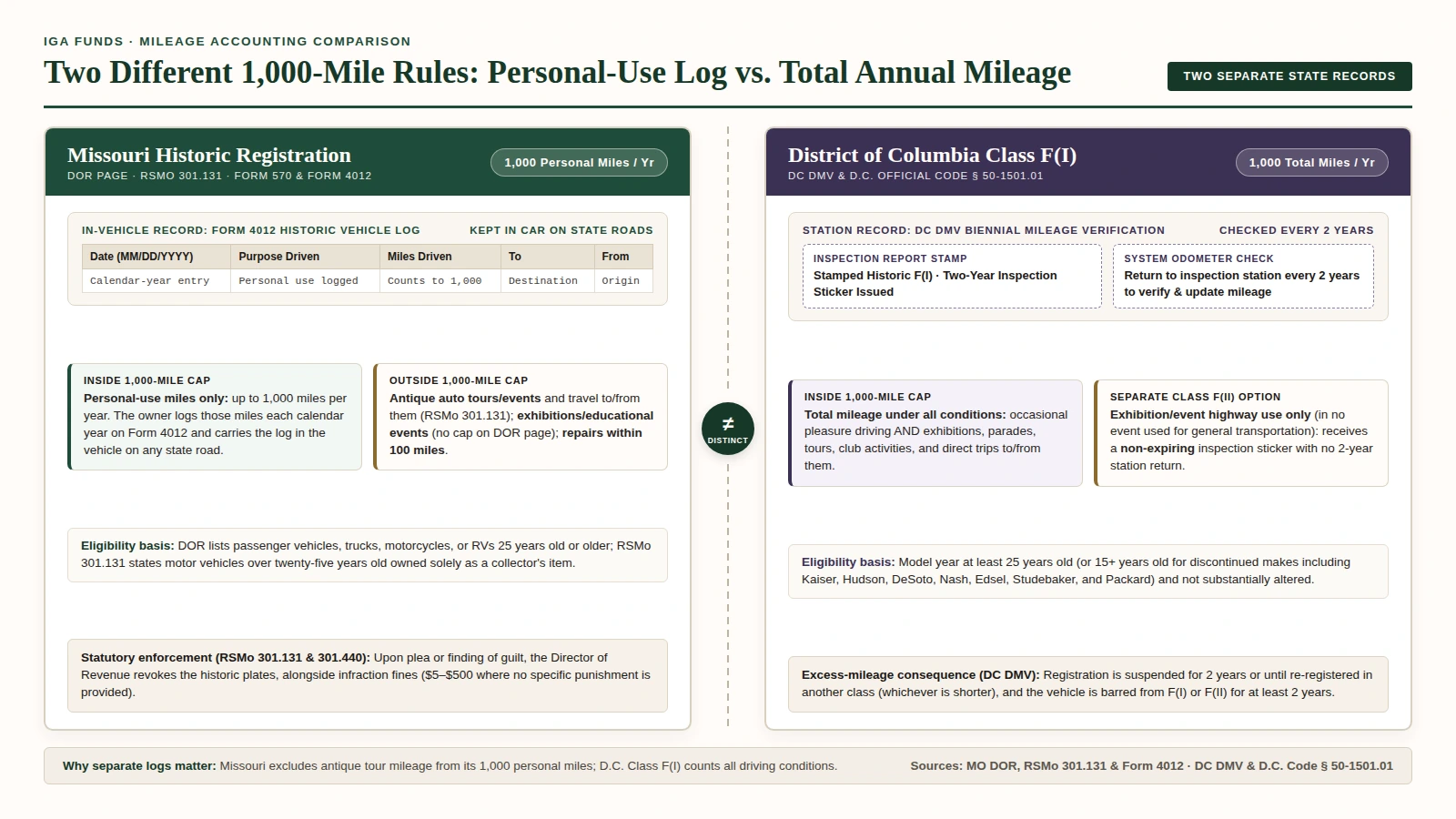
- Missouri and the District of Columbia (distinct 1,000-mile structures): Missouri pairs exhibition and 100-mile repair allowances with a logged 1,000-mile personal-use allowance. Separately, the District of Columbia splits historic tags into a Class F(I) tag capped at a total mileage of 1,000 miles annually and an event-only Class F(II) tag, both barring general transportation.
How Do Missouri and DC 1,000-Mile Historic Rules Differ?
Missouri and the District of Columbia both print a 1,000-mile annual figure, yet the two jurisdictions count completely different trips and verify mileage through separate records.
In Missouri, driving privileges under the Department of Revenue page, Form 570, and Section 301.131 separate into three distinct allowances:
- Exhibitions, educational events, and antique auto tours: On the Missouri Department of Revenue page, driving to and from exhibitions and educational events carries no mileage limitation. Under Section 301.131, mileage driven in an antique auto tour or event—and mileage driven to and from such a tour or event—is not counted for the purpose of the section’s mileage limitations.
- Repair trips: Historic vehicles may be driven to repair facilities within a 100-mile limit on the Department of Revenue page and Form 570, phrased in Section 301.131 as one hundred miles from the vehicle’s location.
- Logged personal use: In addition, Missouri allows up to 1,000 miles per year (one thousand miles per year in Section 301.131) for personal use. Under the Department of Revenue page, Section 301.131, and Form 570, the owner is responsible for keeping a log of the miles driven for personal use each calendar year, and that log must be kept in the historic vehicle whenever it is driven on any state road. Form 570 points owners to the downloadable Historic Vehicle Log (Form 4012), which provides five recording columns: Date (MM/DD/YYYY), Purpose for which the Vehicle was Driven, Miles Driven, To, and From.
In the District of Columbia, DC DMV historical vehicle rules and DC Official Code Section 50-1501.01 establish two separate historic classifications instead of an in-car personal-mileage exemption log:
- Class F(I) (1,000 total miles under all conditions): Class F(I) covers a qualifying vehicle that has not been substantially altered or modified from the manufacturer’s original specifications and is used on the public highways for the transportation of passengers or property for occasional pleasure driving or in conjunction with exhibitions, expositions, parades, tours, club activities, or similar activities or events, including transportation directly to or from those activities or events, not exceeding a total driving mileage under all conditions of 1,000 miles annually, and in no event used for general transportation. Because the code specifies total driving mileage under all conditions, exhibition and club-event trips count inside the 1,000-mile annual ceiling. Class F(I) vehicles receive a two-year inspection sticker and must return to the inspection station every two years to have vehicle mileage verified and updated in the system.
- Class F(II) (event-tied highway use with non-expiring sticker): Class F(II) covers a vehicle whose model year is at least 25 years old (or at least 15 years old for a make no longer manufactured) used on public highways in conjunction with exhibitions, expositions, parades, tours, club activities, or similar activities or events, including transportation directly to or from them, and in no event used for general transportation. The DC DMV Class F(II) definition states no 1,000-mile cap, and Class F(II) vehicles receive a non-expiring inspection sticker with no requirement to visit the inspection station every two years.
How Do Historic Plates Differ From Street Rod, Vintage, and Collector Classes?
Several states place modified vehicles manufactured before 1949, higher-mileage collector cars, or owner-supplied vintage tags into separate registration classes so owners do not apply historic-plate rules to the wrong vehicle:
- New Jersey Historic QQ vs Street Rod vs Collector Vehicle: On the New Jersey inspection exemptions page, a historic vehicle must be at least 25 years old, must not be modified from the original manufacturer specification, and displays QQ plates, while Form SP-121 states that the vehicle cannot be altered from the manufacturer’s original design in any way and is used solely for exhibition or educational purposes. Owners of modified antique automobiles manufactured before 1949 that are registered in a New Jersey street rod club or an affiliate of the National Street Rod Association Inc. apply instead on the New Jersey MVC historic page for a Street Rod plate for $15. A New Jersey collector vehicle on the inspection page is a third class altogether: it is not registered as a historic vehicle or a street rod, and it is not driven more than 3,000 miles per year.
- Maryland Historic vs Maryland Street Rod: On the Maryland MVA specialty plates page, historic vehicles—both the model-year 1999 or older passenger/light-truck class and the heavy truck, tractor, or motor-home category of 25 calendar years old or older—must not have been substantially altered, remodeled, or remanufactured from their original design. A Maryland street rod reverses that alteration requirement: it must be 25 years old or older and must have been substantially altered from the manufacturer’s original design.
- New York Historical Plates vs New York Vintage Plates: New York DMV issues new Historical plates to vehicles manufactured more than 25 years before the current calendar year (or younger vehicles with unique characteristics if DMV determines historical, classic, or exhibit value, or if the commissioner determines historical, classic, or exhibition value). New York Vintage plates are a separate optional 1-year registration on the DMV page requiring a vehicle with a model year that is 2000 or older and original vintage plates, because DMV does not accept reproductions; like historical plates, vintage plates are restricted on the DMV page to collector’s-item or exhibition-piece use and barred from daily transportation.
- Alaska Historic Plates vs Custom Collector Plates: While Alaska’s historic registration covers vehicles 30 or more years old driven primarily for historical exhibition, the Alaska DMV page defines a separate custom collector vehicle as having a body and frame manufactured before 1949 (or a replica of such a model), carrying an initial plate fee of $50.00 along with all applicable fees for the vehicle’s class and body style.
- National Historic Vehicle Register vs State Registration Plates: Owners researching provenance also encounter the National Historic Vehicle Register maintained by the Hagerty Drivers Foundation, which is a federally recognized program that records the history of America’s most significant automobiles and preserves their information in perpetuity at the Library of Congress; it is an archival documentation program rather than a state motor-vehicle plate authority.
Which Application Papers and Official Fees Apply in Each State?
Filing packets and official fee schedules must be copied directly from the issuing state’s forms and statutes, then stored in your registration folder beside the title and insurance proof described in our provenance and documentation guide.
Missouri Application Checklist and Statutory vs Agency Fee Lines
On the Missouri Department of Revenue historic plates page, an applicant submits a completed Application for Missouri Historic or Personalized Historic License Plates (Form 570), a paid personal property tax receipt (original or copy) or statement of non-assessment from the county of residence (or city of St. Louis) for the previous year, a current insurance identification card (original or copy) or other proof of financial responsibility, and a copy of the vehicle’s title or registration receipt.
Missouri’s statute and agency checklist state the registration charges in three separate lines:
- Under Missouri Revised Statutes Section 301.131, a qualifying motor vehicle over twenty-five years old is permanently registered upon payment of a registration fee of twenty-five dollars.
- On the Missouri Department of Revenue historic-plate application list, the listed charge is a one-time registration fee of $25.25.
- On that same Missouri Department of Revenue application list, the filing also requires a $9 processing fee.
New Jersey In-Person Filing Packet and Plate Fees
Applying in person on the New Jersey MVC historic page requires a completed Application for Historic Vehicle Registration (Form SP-121), two color photographs of the vehicle (front view and right or left side view, which can be printed on plain paper), and a copy of the vehicle’s New Jersey title. Form SP-121 also requires the vehicle to be covered by the minimum automobile insurance coverage required by the State of New Jersey. On the MVC historic page, historic plates can be purchased for $44, while Form SP-121 itemizes $44 for Standard Historic Plates, $74 for Courtesy Historic Plates, and $94 for Personalized Historic Plates (or $50 to personalize if the owner already holds Standard Historic Plates), followed by renewal every three (3) years with no fee for the renewal.
California REG 17A Application and Three Fee Provisions
Under the California DMV Registration Procedures Manual, applying for Historical Vehicle or Horseless Carriage plates requires a completed Special Recognition License Plate Application (REG 17A) form, the registration card in the applicant’s name (or the documents required to register the vehicle to the applicant), the license plates currently assigned to the vehicle, and the fees due.
California’s statute and DMV handbook state three distinct fee provisions across those sources:
- Under California Vehicle Code Section 5004, a fee of twenty-five dollars ($25) is charged for the initial issuance of the permanent special identification plates, which are not required to be replaced.
- Under the California DMV Registration Procedures Manual, vehicles assigned Horseless Carriage or Historical Vehicle License Plates are limited to operation or movement over the highway primarily for historical exhibition or similar noncommercial purposes and are subject to a fixed annual vehicle license fee (VLF) of $2.
- Under that same California DMV handbook section, there is no additional fee for renewal.
New York Forms, Insurance Card Wording, and Passenger Fee Tiers
On the New York DMV historical and vintage plates page, a historical-plate application requires a completed Historical License Plates form (MV-440H), a completed Application for Registration/Title (MV-82), and a valid Insurance ID Card (form FS-20 or form FS-21) issued and dated within 180 days of registration containing a scannable barcode and the computer-printed word HISTORICAL; the DMV page specifies that antique and classic are not acceptable words on that insurance card.
New York passenger historical-plate charges vary by prior registration status, plate personalization, and county:
- Under New York Vehicle and Traffic Law Section 401 Schedule G, the statutory schedule states an annual fee of twenty-eight dollars and seventy-five cents.
- On the New York DMV page, if you already hold a valid New York State registration for the vehicle in your name, the passenger fee is $28.75 for standard historical plates or $60 for personalized historical plates.
- If you do not have the vehicle registered in your name, the New York DMV page sets the fee at $53.75 for standard historical plates or $113.75 for personalized historical plates, and, if the owner lives in New York, Bronx, Kings, Queens, Richmond, Rockland, Nassau, Suffolk, Orange, Putnam, Dutchess, or Westchester County, an annual $25 Metropolitan Commuter Transportation District supplemental registration fee brings that not-yet-registered fee to $78.75 for standard historical plates or $138.75 for personalized historical plates.
- For yearly passenger renewal, the New York DMV page lists $28.75 for standard historical plates or $60.00 for personalized historical plates.
Maryland, Alaska, and District of Columbia Filings and Posted Amounts
- Maryland: On the Maryland MVA fee schedule—whose header notes that listed fees include the yearly $40.00 surcharge for the EMS system except where noted otherwise, and whose July 1, 2025 bulletin notes that posted website fees include surcharge fees—historic vehicles of model year 1999 or older are posted at $55.50, while historic vehicles over 60 years old are posted at $50 (one time)*. For Maryland’s heavy historic category (trucks over 10,000 pounds GVWR, tractors, and motor homes at least 25 calendar years old), the MVA specialty plates page requires insurance under a Historic Vehicle, Show Vehicle, or Antique Vehicle insurance policy.
- Alaska: The Alaska DMV historic-vehicle page lists an initial registration fee of $10.00 with no annual renewal necessary. Under Alaska Statutes AS 28.10.421, a historic vehicle registered under AS 28.10.181(b)(1) or (b)(2) that is driven or moved on a highway for the primary purpose of historical exhibition or similar activity pays $10 one time only upon initial registration, whereas an AS 28.10.181(b)(2) owner-supplied historic plate not eligible under that exhibition subparagraph pays $30 (collected only on first issuance and plate replacement) plus the ordinary registration fee required under subsection (b).
- District of Columbia: On the DC DMV historical vehicles page, registration requires a completed Certificate of Title/Tag application, the vehicle title (only if titling the vehicle in DC for the first time), a DC credential, DC vehicle insurance, and a DC vehicle inspection report stamped either Historic F(I) or Historic F(II). On the DC DMV vehicle registration fees page, the Historic Vehicle fee entry is $25.00.
When recording any of these official state charges in your ownership binder, enter the exact receipt on the collector-car total cost worksheet, and attach copies of the current registration card and title when preparing an inspection packet with our classic car appraisal documentation checklist.
What Happens to Historic Plates When the Vehicle Is Sold?
Selling a collector car triggers opposite plate-handling duties depending on whether the issuing state ties the historic plate to the former owner’s cancelled registration or permanently assigns the plate to the vehicle itself.
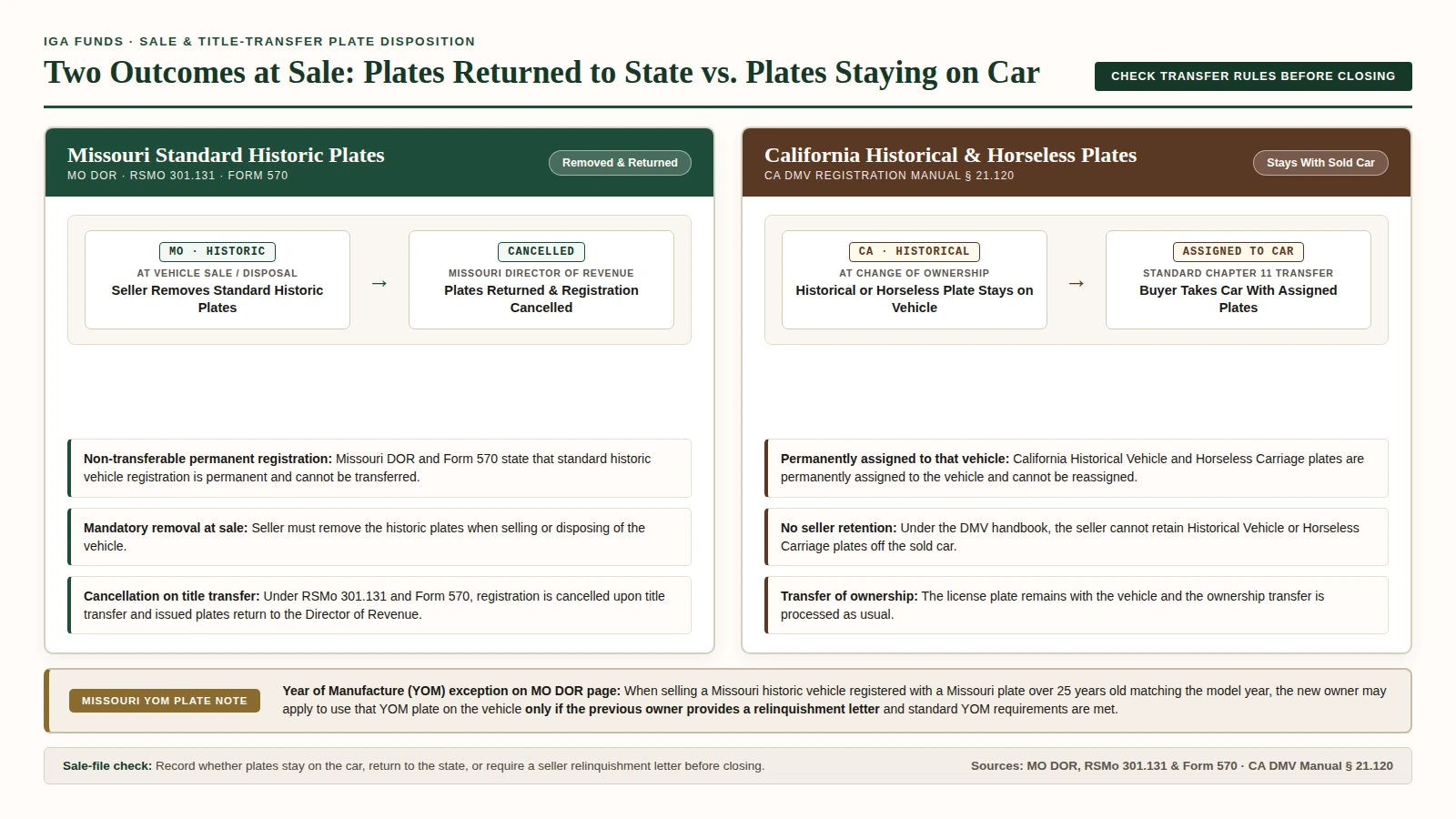
- Missouri standard historic plates (remove and return for cancellation): The Missouri Department of Revenue page states that historic vehicle registration is permanent, cannot be transferred, and requires removing the plates if you sell or dispose of the vehicle. Form 570 directs that if the vehicle is disposed of, historic license plates must be returned to the Director of Revenue for cancellation, and Section 301.131 states that upon transfer of title the registration is cancelled and the issued license plates must be returned to the director of revenue.
- Missouri Year of Manufacture plates (relinquishment-letter exception): On the Missouri Department of Revenue page, an owner possessing a Missouri plate over 25 years old whose year of issuance matches the vehicle’s model year (without conflicting with the current numbering system) may register it as a Year of Manufacture historic plate under Section 301.131. When selling a historic vehicle with a Year of Manufacture registration, the new owner may apply to use those Year of Manufacture license plates on the vehicle if the previous owner provides a relinquishment letter and standard Year of Manufacture requirements are met.
- California Historical Vehicle and Horseless Carriage plates (stay with the vehicle): Under the California DMV Registration Procedures Manual, Horseless Carriage and Historical Vehicle License Plates are permanently assigned to the vehicle, cannot be reassigned, and cannot be retained by the seller; on a transfer of ownership, the license plate remains with the vehicle and the transfer is processed as usual under Chapter 11.
- Alaska historic plates (remain with the vehicle): Under Alaska Statutes AS 28.10.181(b), a registration plate issued under that subsection remains with the vehicle as long as the vehicle continues to be registered under that subsection.
- New York plate storage at DMV offices: On the New York DMV historical and vintage plates page, owners can store historical plates at most DMV offices, whereas DMV offices do not store vintage plates.
What Penalties Apply When Historic Registration Rules Are Violated?
Published statutory and application penalties in Missouri, the District of Columbia, and New Jersey target specific violations defined in each jurisdiction’s own text:
- Missouri plate revocation and infraction fine range: Under Missouri Section 301.131, a violation of that section is punishable under Section 301.440, and in addition to any other penalties prescribed by law, upon a plea or finding of guilt the director of revenue revokes the violator’s historic motor vehicle license plates issued pursuant to Section 301.131. Under Section 301.440, any person who violates any provision of sections 301.010 to 301.440 for which no specific punishment is provided is, upon a plea or finding of guilt, guilty of an infraction punishable by a fine of not less than five dollars or more than five hundred dollars.
- District of Columbia Class F(I) two-year suspension and historic-tag bar: On the DC DMV historical vehicles page, a Class F(I) historic motor vehicle that exceeds its 1,000-mile annual total mileage limit has its registration suspended for two years or until the owner registers the vehicle as a different class of vehicle, whichever is shorter, and the vehicle cannot be registered as a Class F(I) or Class F(II) historic motor vehicle for at least two years from the suspension date.
- New Jersey Form SP-121 application misstatement penalty: On New Jersey Form SP-121, a person who makes a misstatement of fact on an application for registration is subject, upon conviction, to a fine of not more than $500 and/or imprisonment for not more than six months, or both, at the discretion of the court, and the applicant is also subject to suspension of registration privileges for a period of not more than two years.