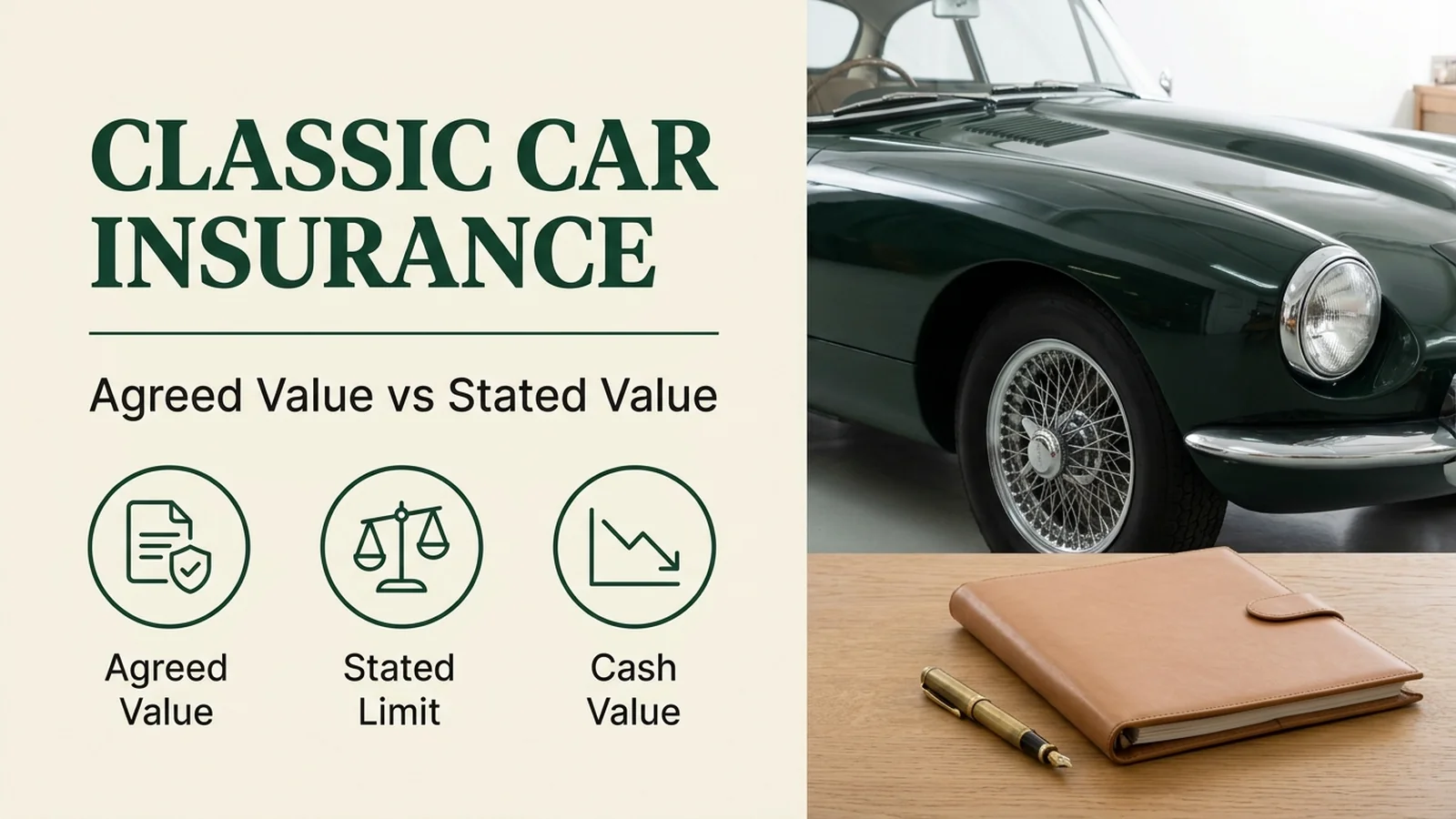
In classic car insurance, the loss-settlement clause attached to your policy determines what a physical-damage claim pays, even when a dollar number appears on the declarations page. In the California Department of Insurance Commercial Insurance Guide glossary, agreed value is a loss-valuation method where the insured and the insurer list an agreed-upon amount to be paid in case of loss, a method most common in property insurance when insuring valuable artwork, antiques, or classic autos, and a professional appraisal is usually required. By contrast, the Virginia State Corporation Commission Maximum Limit of Liability auto endorsement states in its opening notice that coverage is not provided on an agreed-value basis and that the limit of liability is the least of the amount shown in the Schedule or Declarations, actual cash value adjusted for depreciation and physical condition on a total loss, or the amount necessary to repair or replace the property with like kind and quality. The California Department of Insurance accident guide says that on a standard auto policy the company generally pays the lesser of the amount necessary to repair the vehicle or its actual cash value, and New York Regulation 64 as applied by the New York Department of Financial Services permits an automobile physical-damage total loss to be actual cash value or a specified dollar amount stated in the policy.
On the collector cars pages, auditing policy valuation, mileage, and garaging wording sits downstream of assembling identity and condition evidence on the classic car appraisal documentation checklist and separating registration certificates, workshop invoices, and transfer records on our provenance and documentation guide.
Agreed Value vs Stated Value: What Does Each Clause Pay?
Agreed value fixes a pre-loss valuation amount between the owner and the insurer before a claim happens, whereas a stated-value or maximum-limit-of-liability endorsement sets an upper ceiling while allowing the insurer to pay a lower depreciated actual cash value at the time of loss.
Reading the declarations page alone cannot tell those two contracts apart because both print a vehicle schedule with a dollar figure beside the VIN. On Virginia specimen personal-auto endorsement PP 13 58 12 20, titled Coverage for Damage to Your Auto (Maximum Limit of Liability), the top notice states directly that coverage is not on an agreed-value basis and that the amount shown in the Schedule or in the Declarations is not necessarily the amount the policyholder will receive when loss or damage occurs. Under its Limit of Liability clause, the insurer pays the least of three amounts:
- The amount shown in the Schedule or in the Declarations for the described property.
- The actual cash value of the stolen or damaged property, with an explicit adjustment for depreciation and physical condition in the event of a total loss.
- The amount necessary to repair or replace the property with other property of like kind and quality.
State regulations also recognize policies that commit to a fixed total-loss figure rather than open-ended market valuation. Under New York’s prompt-settlement rule (11 NYCRR 216.6(b)), actual cash value defaults to the lesser of repairing the property to its immediate pre-loss condition or replacing it with a substantially identical item (including sales taxes paid or payable), yet the same subsection states that it does not prevent an insurer from issuing a physical-damage policy where total-loss damages are a specified dollar amount. Applying Regulation 64 (11 NYCRR 216.7(c)(8)) specifically to motor vehicles, New York Office of General Counsel Opinion No. 01-03-11 confirmed that an automobile physical-damage total-loss payment may be either the original automobile’s actual cash value or a specified dollar amount stated in the policy.
| Valuation Clause or Term | What Is Set Before a Loss | Total-Loss Settlement Comparison | Depreciation and Condition Rule | Published Regulatory Basis |
|---|---|---|---|---|
| Pre-loss agreed value | Insured and insurer list an agreed-upon amount to be paid in case of loss; a professional appraisal is usually required. | Follows the agreed amount listed in the policy wording and endorsements. | California's classic-auto glossary entry defines the agreed-amount method; check your specific policy form for partial-loss repair terms. | California Department of Insurance Commercial Insurance Guide glossary |
| Maximum limit of liability (stated value or stated amount) | Schedule or Declarations lists a maximum dollar limit with a notice that coverage is not on an agreed-value basis. | Pays the least of the scheduled amount, actual cash value, or cost to repair or replace with like kind and quality. | On a total loss, actual cash value is adjusted for depreciation and physical condition. | Virginia SCC specimen endorsement PP 13 58 12 20 |
| Standard actual cash value (ACV) | No pre-loss dollar valuation is scheduled on the policy. | California generally pays the lesser of repair cost or actual cash value, New York permits a specified total-loss dollar amount in place of that measure, and Texas collision subtracts the deductible from repair cost or actual cash value. | Texas and Maine define actual cash value as replacement cost minus depreciation, the NAIC Glossary says that in most cases it is replacement cost minus depreciation, and California and Washington use pre-loss fair market value unless the policy defines it otherwise. | CA DOI, Texas TDI, Maine BOI, NAIC Glossary, 11 NYCRR 216.6(b), WAC 284-30-320 |
| Claim-time agreed value | Nothing is set before the loss; reached between claimant and adjuster during claim settlement. | Must be documented in the claim file and must accurately represent the actual cash value of a comparable vehicle in the principally garaged area. | Operates strictly as an actual-cash-value settlement figure rather than a pre-loss agreed-value endorsement. | Washington WAC 284-30-391 |

Two related terms across consumer insurance literature require careful separation when reading specimen contracts:
- Boat loss-settlement wording is separate from automobile physical-damage forms. In its Consumer Insight note on boat loss-settlement provisions, the National Association of Insurance Commissioners (NAIC) explains that agreed-amount boat coverage sets the boat’s value at purchase, pays that amount minus the deductible on a total loss, and pays partial-loss boat repairs on a replacement-cost basis minus the deductible so no depreciation is taken on a partial boat loss. Keep boat endorsements separate from automobile forms, and read the auto endorsement for its own partial-loss parts terms.
- Post-loss claim paperwork in states such as Washington uses the phrase “agreed value” in a completely different sense. Under Washington WAC 284-30-391, an agreed value reached between a claimant and an adjuster after a crash is a claim-file settlement number that must still represent the actual cash value of a comparable vehicle in the area where the car is normally kept.
When an insurer requests a pre-binding valuation report to underwrite agreed-value cover, organize the identity photos, chassis and engine stampings, and dated restoration invoices using our classic car appraisal documentation checklist.
How Do Insurers Calculate Actual Cash Value on a Total Loss?
The California Department of Insurance accident guide says a standard auto policy generally pays the lesser of the repair amount or actual cash value, Texas collision coverage pays for the repair or up to actual cash value minus the deductible, and Washington treats a vehicle as a total loss when the cost of parts and labor plus salvage value meets or exceeds, or is likely to meet or exceed, actual cash value.
Those payment and total-loss statements stay with the office that published them. State regulators define and calculate actual cash value through two closely related frameworks:
- Pre-loss fair market value through local comparable vehicles. Unless the policy defines the term otherwise, both California and Washington WAC 284-30-320 equate actual cash value with fair market value immediately prior to the loss. California defines fair market value as the price a reasonably knowledgeable buyer and seller, acting in their own best interest and free of undue pressure, are willing to pay, and the California consumer glossary notes that vehicle fair market value can be established from local private-party sales and dealer quotations for comparable cars.
- Current replacement cost minus depreciation. Texas and the Maine Bureau of Insurance glossary define actual cash value as replacement cost minus depreciation, the NAIC Glossary of Insurance Terms says that in most cases it is replacement cost minus depreciation, and Texas defines depreciation as lowering an item’s value due to use or wear and tear. For motor vehicles, Maine likewise points to local private-party sales and dealer quotations and notes that Kelly Blue Book serves only as a guide rather than the final word.
| Jurisdiction | Actual Cash Value Definition | Comparable Search Window and Radius | Sales Tax, Fees, and Dispute Mechanics |
|---|---|---|---|
| California (CA DOI guides) | Fair market value immediately preceding the loss unless the policy defines it otherwise, drawn from local private-party sales and dealer quotes. | Uses local area private-party sales and dealer quotations for comparable vehicles. | Most standard policies contain an appraisal provision for a disputed total-loss amount: either party can demand it, each party selects a competent appraiser, the appraisers select a neutral umpire, any two bind the amount, each party pays its own appraiser, and the umpire fee is shared. |
| Texas (TDI auto glossary) | Current cost to replace the property minus depreciation from use or wear and tear. | Collision pays repair cost or up to actual cash value, minus the policy deductible. | Depreciation explicitly reflects use or wear and tear at the time of claim evaluation. |
| Maine (Bureau of Insurance glossary) | Replacement cost of stolen or damaged property at the time of loss, less depreciation. | Local area private-party sales and dealer quotations; Kelly Blue Book is treated only as a guide and not the final word. | Separates local market quotations from generic price-guide averages on unusual or older vehicles. |
| New York (11 NYCRR 216.6 and OGC Opinion 01-03-11) | Lesser of pre-loss repair cost or replacement with a substantially identical item, unless the policy states a specified total-loss dollar amount. | Evaluates immediate pre-loss condition or a substantially identical replacement vehicle. | Includes sales taxes paid or payable on total-loss value when tax was paid on the original purchase; excludes title costs from actual cash value. |
| Washington (WAC 284-30-320, WAC 284-30-391, and WA OIC) | Fair market value immediately prior to loss; total loss triggers when parts and labor plus salvage meet or are likely to meet or exceed ACV. | Current data within 90 calendar days before or after the loss; if the listed methods find no comparable within a reasonable distance, the search may expand in 25-mile increments up to 150 miles until two or more comparables are located, and a search past 150 miles requires the first-party claimant's agreement. | Insurer owes ACV plus taxes, license fees, and government ownership-transfer fees; itemized dollar adjustments apply for options, mileage, and condition. |

Washington’s unfair-claims rules illustrate why standard actual-cash-value adjustment creates friction on rare or restored collector vehicles. Under WAC 284-30-320(3) and (4), a comparable motor vehicle must be the same make and model, of the same or newer model year, with similar body style, options, mileage, and overall condition established by data within 90 calendar days prior to or after the loss date, with itemized dollar additions or deductions for differences. When local listings are scarce, WAC 284-30-391 and the Washington Office of the Insurance Commissioner total-loss guide allow the insurer to expand its search in 25-mile increments up to 150 miles from where the car is normally parked until at least two comparable cars are located, and require the owner’s consent to search beyond 150 miles.
Taxes and transfer charges also follow state-specific definitions during an actual-cash-value payout. In Washington, the insurer must add taxes, license fees, and other government transfer fees to actual cash value. In New York, where the owner paid sales tax on the original vehicle purchase, Office of General Counsel Opinion No. 01-03-11 requires including sales tax on the total-loss settlement based on value at loss, while excluding title costs from actual cash value. If an owner disputes an actual-cash-value offer under a standard policy containing an appraisal clause, California’s guide outlines the two-appraiser-and-umpire procedure: each party hires and pays its own appraiser, those two select a neutral umpire whose fee is shared, and an amount signed by any two of the three settles the valuation.
How Do Collector Car Insurance Mileage Limits and Plate Rules Differ?
Collector car insurance mileage limits and pleasure-use warranties are private contract terms set by your policy endorsements, whereas statutory annual mile caps, radius limits, and commuting bans govern special historic, antique, classic, or collector license plates.
A special-plate statute and a policy mileage or pleasure-use sentence are different documents, and each limit is copied from the document that states it. The Nevada DMV classic plates rule says standard auto insurance is no longer accepted for these plates, requires the Declarations page showing Nevada insurance specifically designated for classic or antique vehicles, and states that the vehicle cannot be driven more than 5,000 miles per year and that general everyday transportation and commercial use are prohibited.
| State Registration Program | Vehicle Age and Eligibility | Statutory Mileage or Radius Limit | Commuting and Permitted Use Scope | Logbook, Insurance, or Second-Car Rule |
|---|---|---|---|---|
| Missouri Historic Plates (RSMo 301.131) | Over 25 years old, owned solely as a collector's item for exhibition and educational use. | Up to 1,000 miles per calendar year for personal use, plus repair trips within 100 miles of vehicle location; antique tour and event mileage is excluded from the 1,000-mile cap. | Exhibition, educational use, antique tours or events, repair trips within 100 miles, and capped personal driving. | Owner must keep a calendar-year personal-use mileage log inside the vehicle whenever driven on any state road. |
| Nevada Classic Plates (Nevada DMV) | Classic vehicle plates: an odometer certification and the insurance Declarations page are submitted when the plates are first obtained and at renewal. | Maximum 5,000 miles per year. | Prohibits general everyday transportation and commercial use of any kind. | Requires policy Declarations page proving Nevada insurance specifically designated for classic or antique vehicles; standard auto policies are rejected. |
| Virginia Antique Plates (Code of Virginia Section 46.2-730 and VA DMV) | More than 25 model years old before January 1 of the current calendar year. | Occasional pleasure driving may not exceed 250 miles from the owner's residence. | Club activities, exhibits, tours, parades, testing, repairs, selling, show transport, and capped pleasure trips; daily commuting to and from work is prohibited on antique plates (separate subsection F governs qualifying vintage plates for general transportation). | Vehicle must carry motor-vehicle liability insurance meeting Virginia statutory requirements. |
| Washington Collector Plates (RCW 46.18.220) | At least 30 years old, operated primarily as a collector vehicle, and in good running order. | No numeric annual mileage cap appears in RCW 46.18.220(4). | Restricted to club activities, exhibitions, tours, parades, and occasional pleasure driving. | After January 15, 2026, the applicant must show ownership and valid registration for a second vehicle used for daily driving, commuting, or business, plus liability or collector-vehicle insurance. |

Comparing the four state statutes shows why you must copy both your policy’s mileage sentence and your state’s plate statute rather than relying on a generic mileage rule of thumb:
- Check how personal driving, repair trips, and club tours are counted. Under Missouri RSMo 301.131, a historic vehicle over 25 years old may travel up to 1,000 miles per year for personal use and up to 100 miles to and from a repair facility, while miles driven in (and to or from) an antique auto tour or event do not count against the 1,000-mile personal limit, provided the owner keeps the calendar-year personal-use log inside the car on state roads.
- Verify whether commuting to work is barred even on short trips. Under Code of Virginia Section 46.2-730(D) and Virginia DMV antique vehicle rules, antique plates prohibit general daily transportation, explicitly naming daily travel to and from the owner’s place of employment, and cap occasional pleasure driving at 250 miles from the owner’s residence. Only vehicles meeting the separate conditions under subsection F for qualifying vintage plates may be used for general transportation.
- Confirm second-car registration proof. Under Washington RCW 46.18.220, collector plates carry no numeric annual mileage figure in subsection (4), but after January 15, 2026, applicants must submit proof of ownership and valid registration for a second vehicle dedicated to daily driving, commuting, or business alongside proof of liability or collector-vehicle insurance.
Keep registration certificates and in-car mileage logs filed separately from mechanical invoices and bills of sale, following the three-folder structure in our provenance and documentation guide.
Where Does a Policy Check Garaging and Storage Conditions?
Washington WAC 284-30-320(15) defines the principally garaged area as the place where the loss vehicle is normally kept, consistent with the applicable policy of insurance.
That definition follows the policy’s record of where the vehicle is normally kept. Read the declarations for that place, and read any storage sentence the policy actually prints before treating a building type as a condition. After a loss under an actual-cash-value form, Washington WAC 284-30-391 uses that principally garaged area for the comparable-vehicle search, within a reasonable distance not to exceed 150 miles.

The plate statutes quoted on this page do not state an enclosed-garage requirement, so match the policy’s storage sentence to the place the vehicle is kept:
- Read the garaging or storage sentence in the policy packet before the car moves to seasonal storage, a leased warehouse bay, or a driveway.
- Inspect pipes, lights, locks, and security checks against our storage facility checklist so the bay record sits beside the policy’s garaging address.
- If the policy’s storage sentence names an enclosed building, use our car cover vs enclosed storage guide to keep a fabric cover distinct from that building.
- Record the policy invoice separately from bay rent, transport, and maintenance on our collector-car total cost worksheet.
What Should You Verify Before Binding a Collector Policy?
Before binding or renewing coverage, transcribe the exact wording from your policy Schedule, Declarations, physical-damage endorsements, and state registration certificate into a single verification sheet so valuation, mileage, and garage or storage rules are never assumed from marketing summaries.
| Audit Item | Document to Inspect | Exact Clause or Threshold to Transcribe | Filing Cross-Check |
|---|---|---|---|
| 1. Pre-loss valuation basis | Policy Schedule, Declarations, and physical-damage endorsement form number | Verify whether the form lists a pre-loss agreed value (or NY specified total-loss dollar amount) versus a Maximum Limit of Liability notice paying the least of the scheduled figure, depreciated ACV, or repair cost. | Attach any required professional appraisal packet prepared with the appraisal documentation checklist. |
| 2. Deductible and total-loss tax treatment | Declarations deductible column and state settlement rules | Record the physical-damage deductible and check applicable state rules on sales tax and government transfer fees (such as NY sales-tax inclusion or WA tax and transfer-fee additions on ACV claims). | Enter the issued premium bill on the Insurance row of the collector-car total cost worksheet. |
| 3. Policy annual mileage and pleasure-use warranty | Collector-vehicle use endorsement and Declarations conditions | Copy the contract's annual mileage cap, permitted club or exhibition scope, and any exclusion for commuting to work, school, or errands. | Confirm odometer reading at policy inception and renewal so policy miles and state plate logs match. |
| 4. State collector or antique plate restrictions | State registration certificate and plate statute (e.g., MO RSMo 301.131, NV DMV, VA Section 46.2-730, WA RCW 46.18.220) | Record any statutory cap or condition: MO 1,000 personal miles plus in-car log and 100-mile repair radius; NV 5,000-mile cap and classic-designated insurance proof; VA 250-mile pleasure radius and commuting ban; WA after January 15, 2026, proof of a second vehicle for daily driving, commuting, or business. | Keep registration papers separate from workshop and sale records per provenance and documentation. |
| 5. Principally garaged address and storage warranty | Declarations garaging address and storage warranty endorsement | Confirm that the listed principally garaged address matches where the vehicle is normally kept and copy any enclosed-garage, locked-bay, or off-site storage notice requirement. | Pair the policy garaging line with room records on the storage facility checklist and car cover vs enclosed storage. |
| 6. Appraisal dispute and post-loss settlement clause | Policy Conditions section (Appraisal clause) | Verify whether the policy includes a two-appraiser-and-umpire dispute clause and distinguish pre-loss agreed value from any post-loss claim-file settlement agreement. | Retain dated condition photos and component invoices inside your collector cars archive folder. |
In addition to the sixteen state statutes, regulations, and department guides linked in the Sources section below, this comparison draws on the National Association of Insurance Commissioners (NAIC) Glossary of Insurance Terms for the general replacement-cost-minus-depreciation definition of actual cash value and the NAIC Consumer Insight boat insurance note for how marine agreed-amount partial-loss provisions differ from automobile physical-damage forms.