A lower monthly sticker can cost more if the contract will not refund the months you do not use. Compare car storage by the minimum term, the care that is included, and whether the place is one an insurer will accept. The dollar and pound figures below are copied from two facilities’ pages on 20 October 2026. They are not a quote for your car and not a market average. Your own amounts still go on the blank cost sheet.

Three places are not the same bill
A home garage, an enclosed storage unit, and a staffed store can all be “indoors.” The monthly comparison is about the contract, not the word indoor.
| Place | What the retrieved page actually lists | Dominant failure and how to avoid it |
|---|---|---|
| Historic Motor Sports, Candia, NH, annual line | $240 a month, paid in full by 1 November, no pro-rated refund; climate listed as 65–70 degrees year-round; battery tender access; access described as convenient from April through October | Leaving before 12 months while the cash for 12 is already paid. Count the months you will use before choosing this line. |
| Same facility, monthly line | $275 a month; five-month minimum stated as 1 November through 30 March; same climate line and battery tender access | Treating it as a one-month winter stay. The printed minimum is five months. |
| Equerry 55, Essex, The Stable | £250 plus VAT a month; three-month minimum and minimum charge; humidity targeted at 55 percent relative humidity; winter temperature around 10–12°C; battery conditioning; cover; checks at check-in | Dividing a one-month need by the £250 sticker. The minimum charge is three months. |
| Equerry 55, The Keep | £350 plus VAT a month; everything in The Stable plus an engine run to operating temperature every 60 days, weekly battery-conditioner and drip-tray checks, monthly tyre and fluid checks | Paying the higher line and still expecting a road drive every month. The printed interval is 60 days, not weekly. |
| Home garage | Hagerty’s eligibility page prefers an enclosed secure structure and names a private garage as one example. It prints no monthly fee. | A street, parking lot, temporary shelter or public garage. Those are on Hagerty’s automatic-decline list. |
Historic Motor Sports also prints “a constant temperature of 65º” in the introduction and “65-70 degrees” on the rate lines. Keep both sentences. They are not the same range. Equerry’s 55 percent relative humidity is that facility’s target. How to read a humidity figure is on the climate-controlled storage note, not a second specification invented here.
The sticker is not the cost per month you use
Effective printed cost per month used = (months you must pay × monthly sticker) / months you actually store the car.
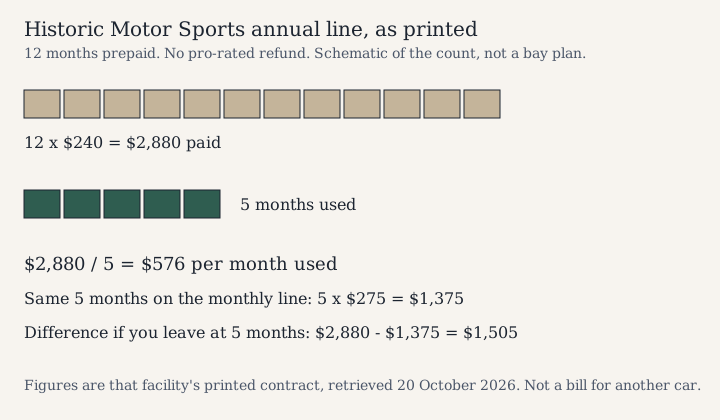
Historic Motor Sports’ annual line is 12 × $240 = $2,880, paid up front, with no pro-rated refund. If the car is there for 5 months, $2,880 / 5 = $576 for each month used. The monthly line for those same 5 months is 5 × $275 = $1,375, which is $1,505 less cash than the prepaid year. The annual sticker is $35 a month lower ($275 − $240). Over a full 12 months that gap is 12 × $35 = $420. The $420 appears only if you use the year you paid for.
Equerry’s minimum is 3 months. One month of use on The Stable is still 3 × £250 = £750 plus VAT on the printed page. £750 / £250 = 3, so the cash is three times the sticker when you use one month of a three-month minimum. The page says “plus VAT” and does not print the VAT rate, so this note does not turn £750 into a tax-inclusive total.
Rules of thumb
If the months you will store the car are fewer than the contract minimum, divide the minimum charge by the months used. The number on the rate card is not the monthly cost of a shorter stay.
If the place is a street, a parking lot, a temporary shelter or a public parking garage, Hagerty’s decline page lists it as an automatic decline. A private garage is on the preferred enclosed list. Those are coverage conditions, not a published percentage off the premium. The eligibility page also caps some carports at a $100k vehicle value and excludes carports in California and in Broward, Miami-Dade and Monroe counties in Florida. Carports in Florida and Louisiana must also be more than 5 miles from the coast or a coastal bay. No discount rate is printed on the pages read for this note.
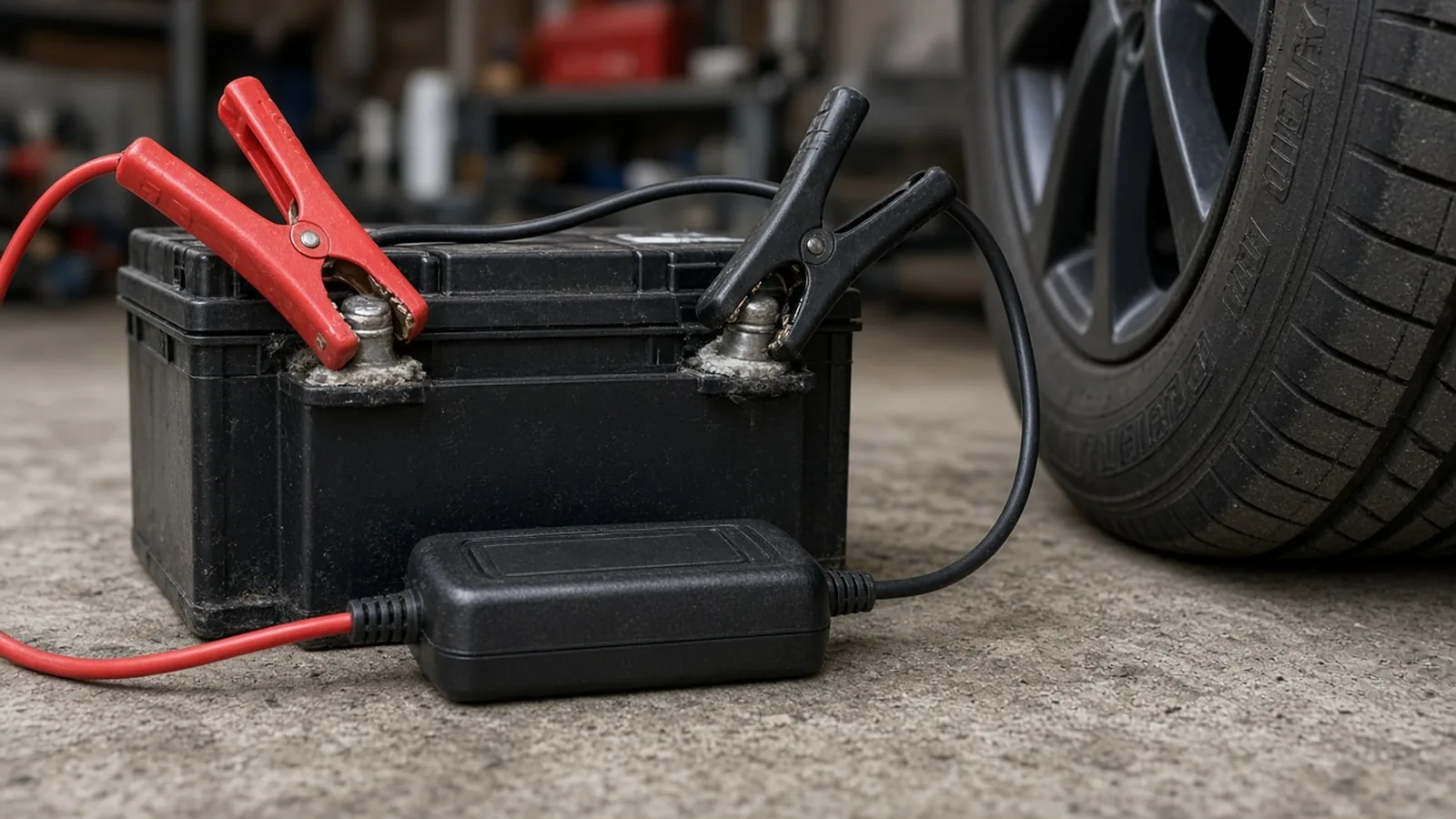
If a contract lists battery tender access and does not list an engine run, do not treat the tender as exercise. Historic Motor Sports’ retrieved rate card lists battery tender access and does not list a scheduled drive. Equerry’s Keep lists an engine run every 60 days and prices that plan at £350 plus VAT, £100 plus VAT a month above The Stable.
Battery care and a drive are different lines
A tender keeps a battery on charge. A drive or an engine run moves oil, brakes and seals. The two facilities above do not sell them as the same line.
On Equerry’s Keep, the engine-run interval is 60 days. A three-month minimum is about 90 days. 90 / 60 = 1.5, so one minimum term contains one full interval and half of the next. How many runs you actually get depends on the day the schedule starts. The page does not promise a run every month.
A home garage can meet the enclosed-structure preference and still have neither line unless you add them. The building, the electricity and a tender you buy are separate rows on the blank cost sheet. The storage checklist is where the room’s leaks, locks and readings go. This note does not fill those rows in for you.
What a concierge line still leaves out
Equerry says collection and return delivery are arranged and quoted separately. A higher storage plan does not, on that sentence, include the truck. Historic Motor Sports’ retrieved rate card does not list transport either. Movement stays its own file.
Insurance is also its own file. Hagerty’s decline list can make a cheap outdoor space unusable for that program even when the rent looks low. The pages read here do not state a premium credit for moving the car indoors. Write the premium from the policy, not from a storage brochure.
When this does not apply
This comparison does not price a daily-driver parking spot, a body-shop hold, or a trailer that is not the car’s usual place. Hagerty’s eligibility page discusses mileage and use separately from storage. A car that is driven to work is outside the storage lines above.
Method and sources
The $240 and $275 lines, the November payment, the no-pro-rate sentence, the five-month window, the 65º and 65–70 degree wording, and battery tender access are from Historic Motor Sports’ storage page. The £250 and £350 lines, VAT wording, three-month minimum, 55 percent relative humidity, 10–12°C, battery conditioning, and the 60-day engine run are from Equerry 55’s classic-car storage page. The enclosed-structure preference, the carport value cap, and the automatic-decline list are from Hagerty’s eligibility and decline pages. The products and quotients are arithmetic on those printed figures. Retrieved 20 October 2026. This note is not insurance, tax or investment advice.