
Check climate controlled car storage through a material-specific humidity specification, a temperature record, an identified airflow path and a moisture-removal calculation. A room thermostat and a dehumidifier’s headline capacity leave several of those questions unanswered.
The published figures below come from conservation guidance and an equipment sizing method. Their conditions matter: a range for a museum collection does not automatically become a specification for every collector car. Use this note alongside the storage-facility checklist when examining a room or comparing its written specification.
Which humidity and temperature figures can you check?
CCI Notes 1/1, fetched 19 October 2026, calls for temperature and relative humidity appropriate to the collection, avoiding extremes and excessive fluctuations. It supplies no universal RH target. Two more specific primary sources, also fetched 19 October 2026, provide the following comparisons.
| Published figure | Source and conditions | Dominant failure mode & prevention |
|---|---|---|
| Above 65% RH | CCI metal care, “High relative humidity”: surface moisture supports corrosion on most clean metals; corrosion generally accelerates above this threshold. | Corrosion: prevent damp exposure and investigate excursions; lower RH alone does not establish safety for every metal. |
| 40–55% RH | Same CCI page: moderate conditions for organic materials and metal/organic composites; adequate for most metals, with exceptions. | Organic parts can suffer physical damage when dried too far; identify the materials before choosing the range. |
| 30% RH or lower | Same CCI page: dry conditions ideal for metals, considered separately from organic components. | Applying metal-only dryness to a composite risks damage to its organic parts; keep the material distinction explicit. |
| RH set point within 45–55%, ideally ±5 percentage points about the chosen set point | NPS Museum Handbook, chapter 4, F.6, pp. 4:26–27: most NPS collections; selection depends on materials, space and local climate, with conservation input. Seasonal and climate exceptions are discussed there. | Moisture-driven dimensional changes in sensitive materials: record the chosen set point and permitted fluctuations separately. |
| 15–25°C / 59–77°F | Same NPS chapter, E.4, p. 4:22: most NPS collections in exhibit, storage and research spaces where human comfort matters. Keep temperature steady; unoccupied collections spaces may be cooler, above freezing. | Abrupt temperature changes stress materials and affect RH; review temperature alongside humidity. |
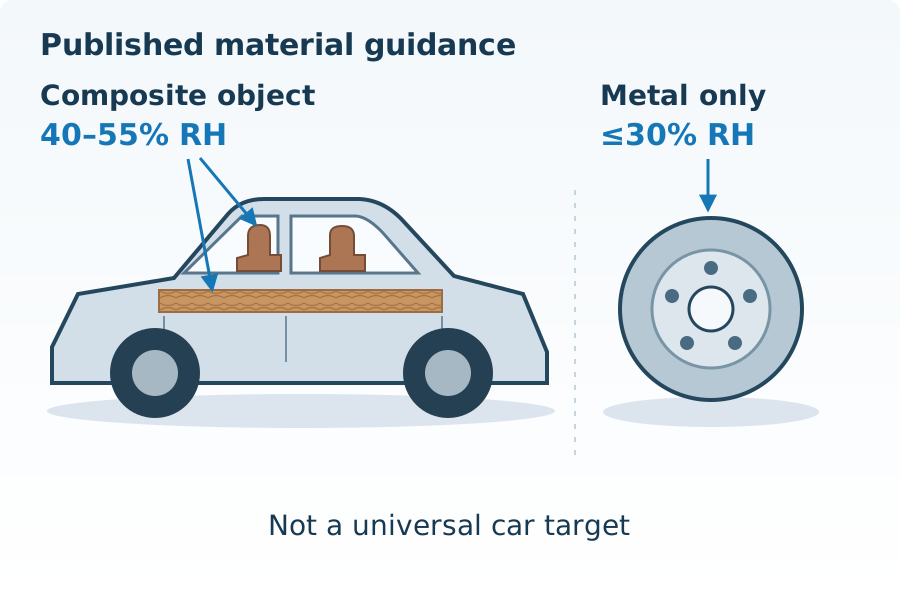
The NPS humidity interval describes where to choose a set point. Its fluctuation allowance is a separate quantity. CCI’s composite-object interval answers a different question about materials. Neither justifies averaging the figures into a new target.
A practical threshold rule follows directly from CCI: if RH exceeds 65% around clean metal surfaces, treat the excursion as increased corrosion risk and investigate the moisture source and controls. That threshold is not a promise that contaminated or already corroding metal is protected below it. A whole-car specification must account for the body, trim and observed condition together.
What does an air-change figure actually mean?
A facility’s airflow record should identify the edition of its design guidance and the air stream being counted. The 2015 ASHRAE museum chapter, fetched 19 October 2026, gives 6–8 air changes per hour in its discussion of system airflow. That passage does not identify this as an outdoor-air requirement.
The 2019 ASHRAE museum chapter, fetched the same day, instead explains that air-change rates vary with usage, occupancy and particular sources. Its operating goal is the minimum volume that maintains environmental conditions and avoids local problem areas; storage generally needs lower rates unless circumstances require more. These editions do not establish a single collector-car-room minimum.
Separate outside-air exchange from recirculation. ASHRAE’s 2017 ventilation chapter, fetched 19 October 2026, defines nominal outdoor-air changes using outdoor ventilation plus infiltration relative to interior volume. That measure excludes recirculation. A fan moving room air through a machine does not establish how much outside air enters through doors, leakage or ventilation.
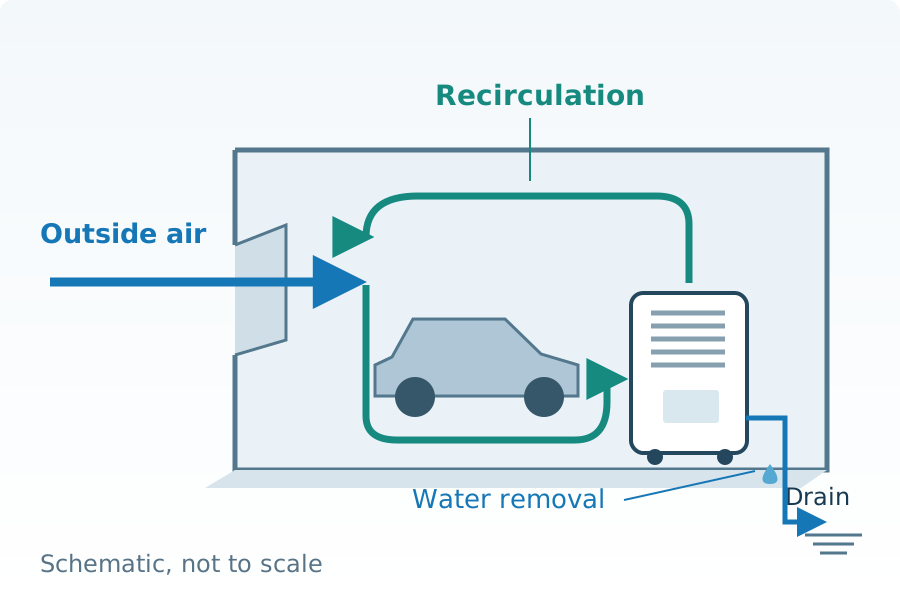
For a room comparison, put supply/recirculation flow and outside-air exchange on separate lines. Record whether each figure was measured, calculated or assumed, and what door-opening conditions apply. Otherwise an apparently precise ACH value cannot be used confidently in a moisture-load calculation.
Select dehumidifier capacity from a water load
Dantherm’s Selection Guide for Mobile Dehumidifiers, August 2021 edition, fetched 19 October 2026, gives the outside-air load on printed page 23:
W_air = ρ × V × n × (x_out − x_in)
Units: W_air, g/h water; ρ, kg/m³ air density; V, m³ air volume; n, h⁻¹ outside-air exchange; x_out and x_in, outside and desired inside moisture in g water/kg air. The guide approximates ρ as 1.2 kg/m³ at 15–25°C.
A published warehouse example
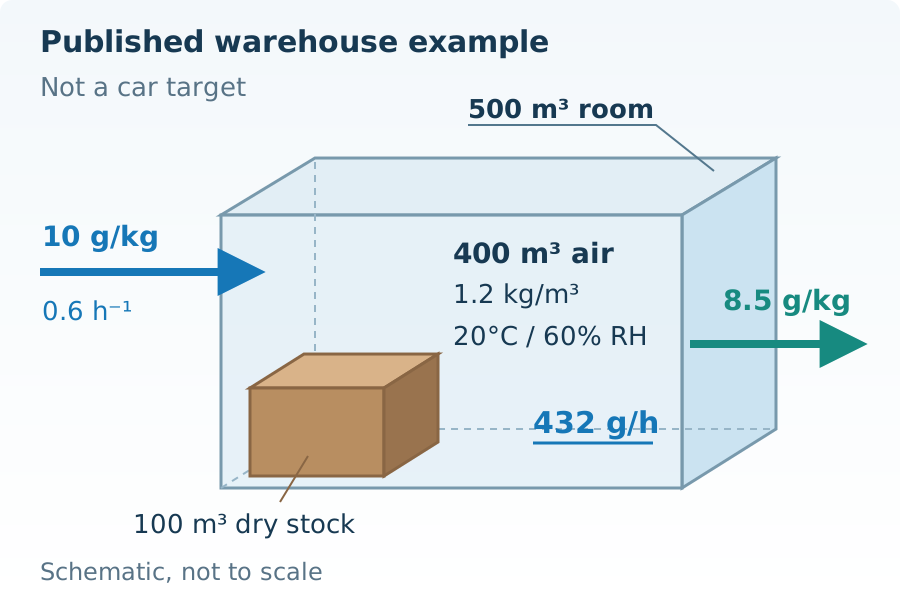
Example 7, pp. 26–27: a poorly insulated Danish 500 m³ room, 100 m³ completely dry goods, 0.6 h⁻¹ exchange; outside 10 g/kg at July 17°C/83% RH, inside 8.5 g/kg at 20°C/60% RH.
W_air = 1.2 × (500 − 100) × 0.6 × (10 − 8.5) = 432 g/h.
The 60% RH warehouse assumption is not a car-storage target. A car’s enclosing rectangular box is not solid dry stock.
Page 24 adds people, process and goods moisture. The preface selects capacity from temperature, desired RH and removal load, using a capacity curve.
For a collector-car room, replace every example input with documented room data. Retain a current manufacturer’s curve at the intended operating point with the calculation, and list any unmeasured inputs. A headline rating at a different temperature or RH leaves that comparison incomplete.
Keep a room record that can explain a failure
A useful specification and operating record should let someone reconstruct what happened when conditions departed from the plan:
- Materials and condition: what the car contains, any active deterioration, and why the selected guidance applies.
- Control settings: temperature range, RH set point, allowed fluctuation, any seasonal changes and the source for each choice.
- Measurements: sensor locations, readings, instrument checks and relevant door or weather events.
- Air and water: outside exchange, recirculation, load assumptions, operating-point capacity and condensate drainage arrangement.
- Response: who notices an excursion, what action follows and what the subsequent readings show.
CCI Notes 1/1, fetched 19 October 2026, calls for daily checks for leaks and condensation and daily recorded temperature/RH readings. It also calls for moving sensitive objects to a safer, more stable location during excessive fluctuations when controls are absent or failing. A record needs to connect those observations with action.
Put actual storage charges on the blank collector-car cost sheet. For the machine decision, use the equipment life-cycle note to separate purchase and installation, energy, maintenance and replacement. Include drainage work and instrument upkeep in the appropriate records; leave amounts blank until supported by a bill or written estimate.
The resulting comparison is a room specification with a stated material scope, traceable readings and a capacity calculation whose inputs can be checked. Missing measurements remain blanks to fill before selecting equipment.