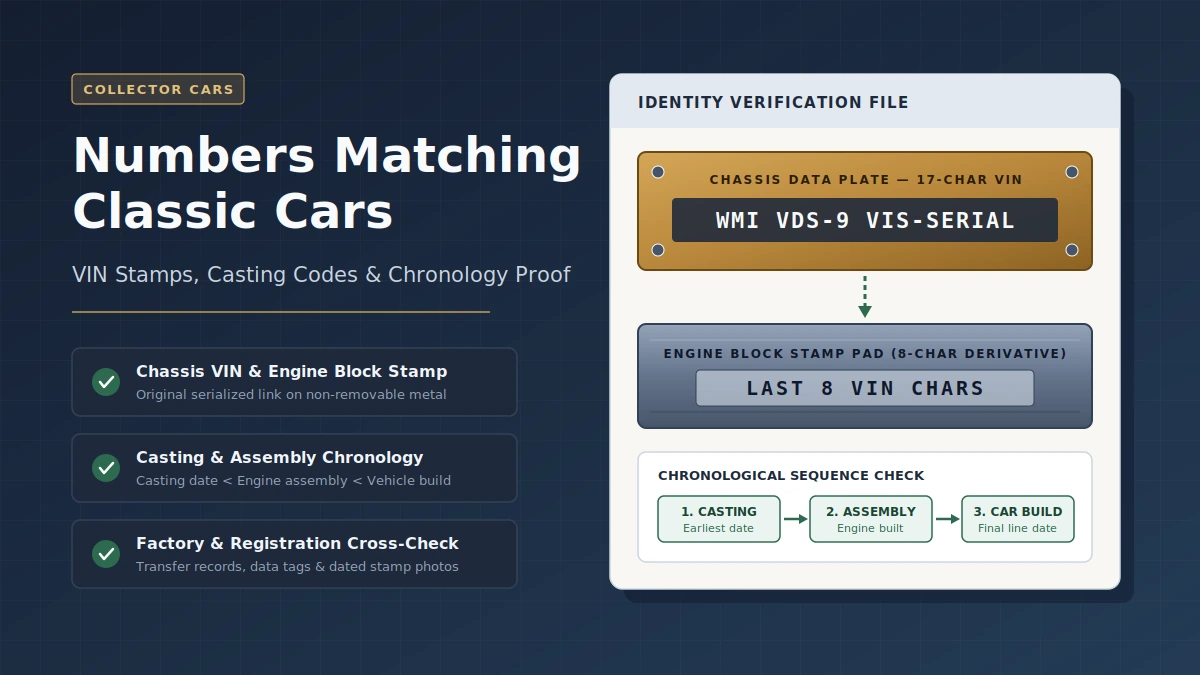
Numbers matching (also called number matching or matching numbers) means a collector car still has the same original major factory components it carried when new. At minimum, the original chassis number or Vehicle Identification Number (VIN) matches the engine block where the manufacturer stamped it and the data tags, verified through stampings, casting numbers, and chronological date codes.
Retaining numbers-matching major components helps define how collectible a classic car is because surviving examples with original drivetrains are rarer than cars fitted with later replacements, as summarized in Wikipedia’s number matching reference. Keeping physical stamp checks tied to your separate registration, service, and sale files ensures every originality claim rests on verifiable physical and documentary evidence.
Which components have to match on a numbers-matching classic car?
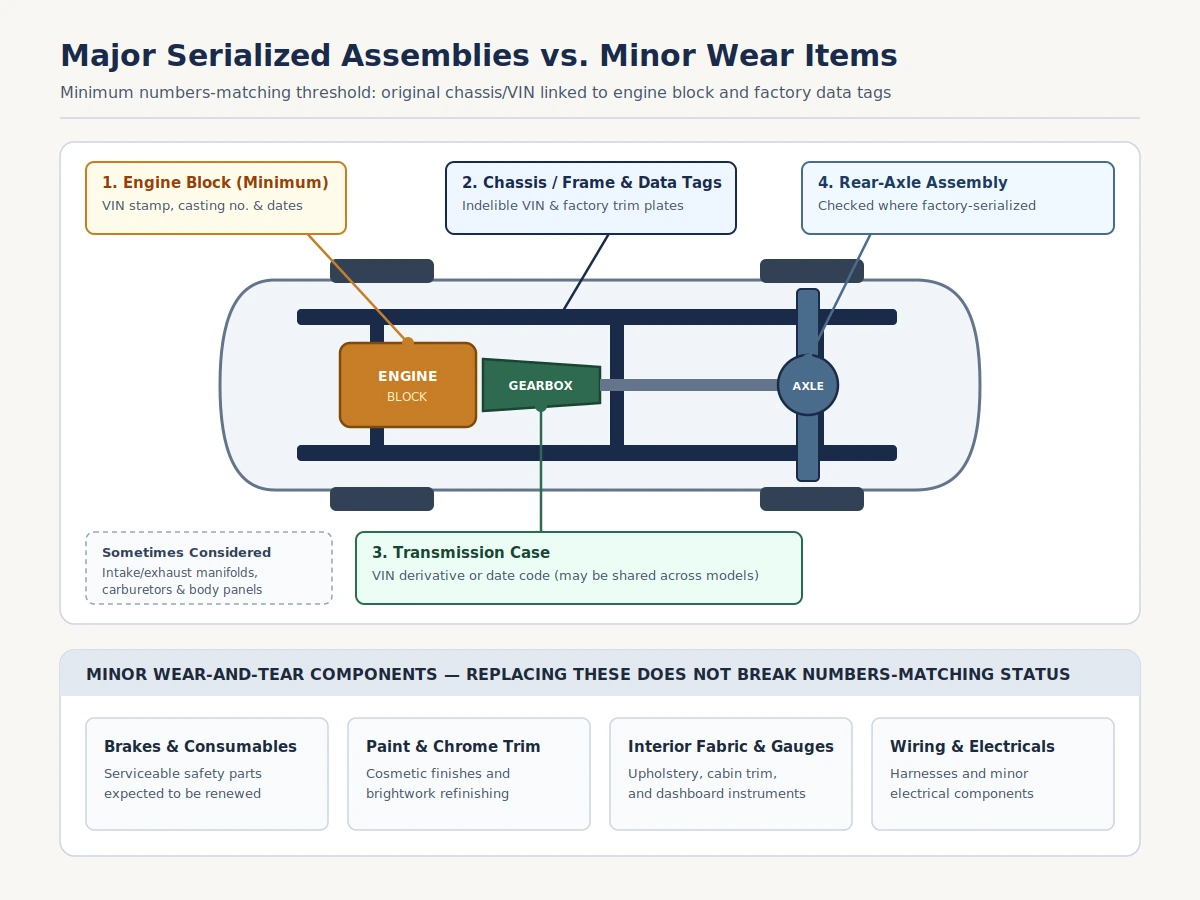
For a collector car to qualify as numbers matching, the widely accepted minimum requirement is that the original chassis number or VIN matches the engine block (where originally identified that way) and the factory data tags. Core major assemblies also include the transmission, rear-axle assembly, and frame, while routine wear-and-tear items stay outside the test.
Core major assemblies vs. secondary serialized parts
Major components carry dates, casting numbers, model numbers, VINs, stamped numbers, or codes that match the original factory parts installed on the vehicle when new. Beyond the engine, transmission, rear-axle assembly, and frame, collectors and marque specialists sometimes also inspect intake manifolds, exhaust manifolds, body panels, and carburetors when those castings carry factory codes or dates.
Because matching-numbers practices vary by manufacturer and country, not every major assembly carries a car-specific serial stamp. Transmissions and rear-axle assemblies were often shared across a range of models without a stamped link to the exact car in which they were originally installed.
Minor wear-and-tear components that stay outside the test
Routine maintenance and cosmetic renewal do not disqualify a numbers-matching vehicle. Parts such as interior fabric, paint, chrome trim, brakes, instruments, electrical components, and wiring are classified as minor components and generally do not affect numbers-matching status.
| Component tier | Specific parts | Typical factory identifier | Impact on numbers-matching status |
|---|---|---|---|
| Minimum threshold | Chassis or frame, engine block, factory data tags | Original chassis number or VIN and matching engine block stamp | Required baseline where the manufacturer serialized those parts |
| Core drivetrain | Transmission and rear-axle assembly | VIN derivative stamp, casting number, or date code | Expected when serialized; shared units may lack a car-specific stamp |
| Secondary assemblies | Intake manifolds, exhaust manifolds, carburetors, body panels | Casting numbers, model numbers, and casting date codes | Sometimes evaluated alongside the core drivetrain |
| Minor wear items | Interior fabric, paint, chrome trim, brakes, instruments, electrical parts, wiring | Service replacement parts | Generally do not break numbers-matching status |
When deciding whether to repair or replace worn surfaces and hardware, keep a clear boundary between servicing minor wear items and altering stamped core metal, as outlined in the restoration versus preservation guide.
How does numbers matching work on pre-1981 cars without standardized VINs?
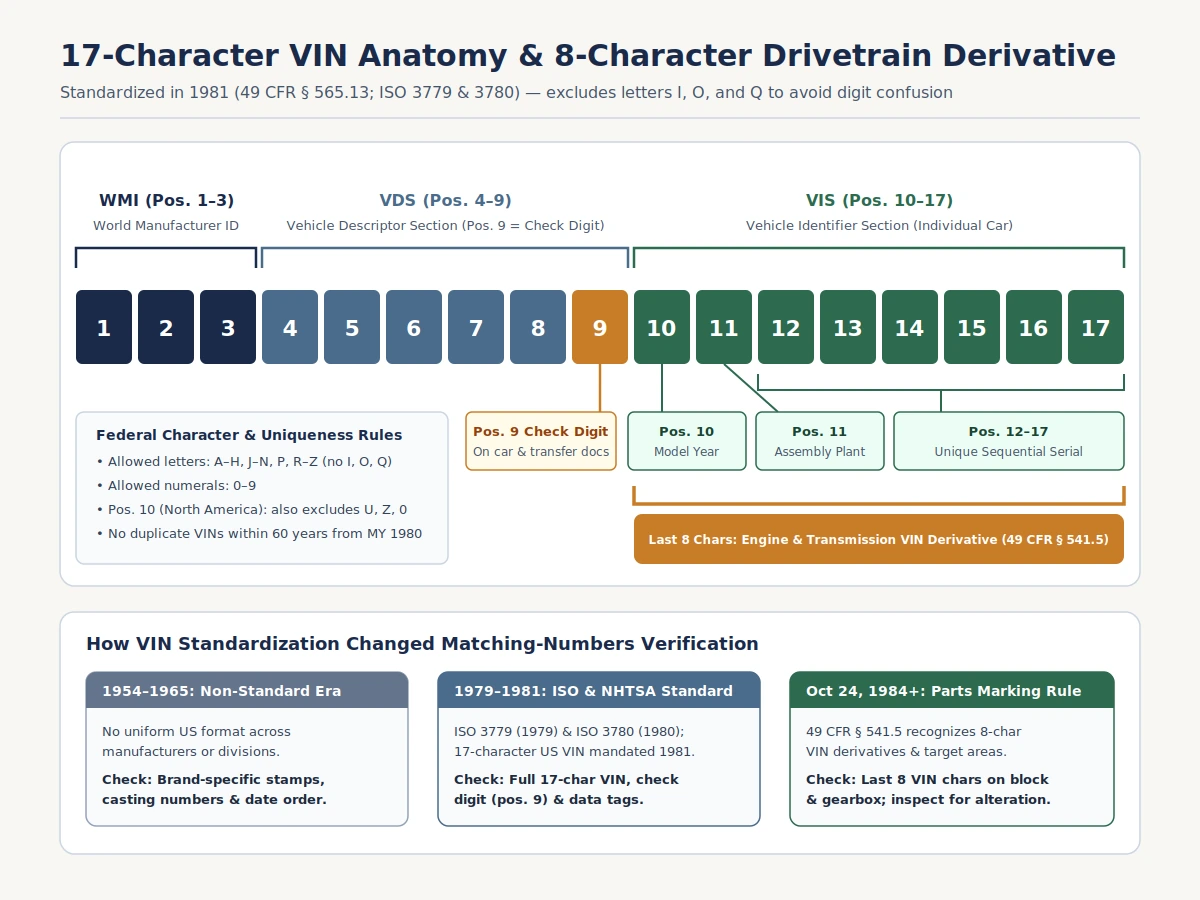
Before the National Highway Traffic Safety Administration (NHTSA) mandated the standardized 17-character VIN in 1981, manufacturers used non-uniform numbering systems and often left shared transmissions or rear axles unstamped. On pre-1981 classics, verifying numbers matching relies on manufacturer-specific chassis and engine stamping rules, casting numbers, data tags, and component date codes rather than a universal 17-character format.
A VIN—also called a chassis number or frame number—is a unique code incorporating a serial number used by the automotive industry to identify individual motor vehicles. As documented in Wikipedia’s VIN history, VINs were first used in 1954 in the United States, and from 1954 to 1965 there was no accepted format standard across manufacturers or even across divisions within the same company.
Modern VIN structure grew out of two International Organization for Standardization specifications: ISO 3779 (1979) and ISO 3780 (1980). In 1981, NHTSA standardized the US format to 17 characters for all on-road vehicles sold, codified in 49 CFR § 565.13, which requires that no two regulated vehicles manufactured within a 60-year period beginning with the 1980 model year share an identical VIN.
| Era or standard | Character length | Standardization level | Primary numbers-matching verification method |
|---|---|---|---|
| 1954 to 1965 (US early VIN era) | Variable by marque and division | No accepted standard across manufacturers or divisions | Manufacturer-specific chassis and engine stamps, data tags, and date codes |
| 1979 to 1980 (ISO 3779 and ISO 3780) | 17 characters (modern baseline) | International standard with regional implementations | Full chassis VIN matched to factory records and drivetrain codes |
| 1981 onward (NHTSA / 49 CFR § 565.13) | 17 characters | Mandatory US standard; unique across 60 years from 1980 model year | Chassis VIN, position 9 check digit, transfer documents, and data tags |
| October 24, 1984 onward (49 CFR § 541.5) | At least 8 characters (VIN derivative) | Federal major parts marking recognition for engines and transmissions | Last 8 VIN characters stamped in designated target areas on block and gearbox |
How do you check engine block stampings, casting numbers, and date codes?
To verify an engine block and drivetrain, compare the stamped VIN or 8-character VIN derivative in the manufacturer’s designated target area against the chassis VIN, inspect the metal surface for visible alteration, and confirm that casting dates precede the engine assembly date, which must precede the vehicle’s final build date.
Reading VIN segments and 8-character drivetrain derivatives
On standardized 17-character VINs, every character must belong to the allowed letters ABCDEFGHJKLMNPRSTUVWXYZ (excluding I, O, and Q to avoid confusion with numerals) or numerals 0123456789. The first three characters form the World Manufacturer Identifier (WMI), the fourth through ninth positions form the Vehicle Descriptor Section (VDS) with a mandatory check digit in position 9, and positions 10 through 17 form the Vehicle Identifier Section (VIS) identifying the individual car.
In North America, position 10 encodes the model year (additionally excluding U, Z, and 0), position 11 identifies the assembly plant in North America and China, and positions 12 through 17 serve as the unique sequential production number in the United States and China. Under 49 CFR § 541.5, manufacturers that were marking engines or transmissions with a VIN derivative consisting of at least the last 8 characters of the VIN on October 24, 1984 may continue using that derivative in place of the full VIN.
Inspecting target areas and date-code chronology
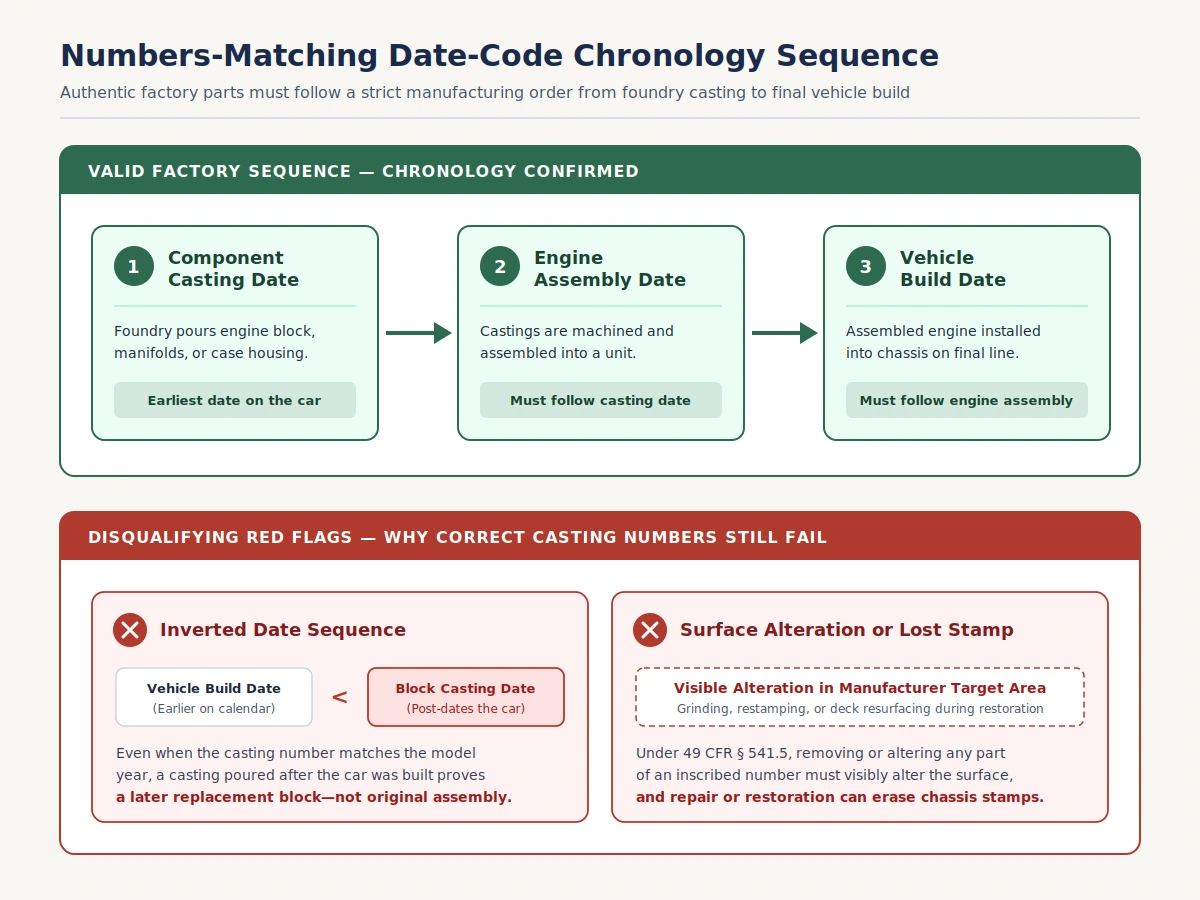
Under 49 CFR § 541.5, each original manufacturer installing or assembling covered major parts designates a specific target area for identifying numbers, and removing or altering any portion of an inscribed number must visibly alter the appearance of that section of the part. Checking the stamp pad under angled light helps reveal whether original metal has been ground or altered.
Even when a casting number matches the right model year, chronological order separates an original assembly from a later service replacement. Casting dates and stamped numbers on major components must be present and fall in strict order: component casting dates must precede the engine assembly date, and the engine assembly date must precede the build date of the vehicle.
Which factory and registration documents cross-verify a matching-numbers car?
Physical metal stampings should be cross-checked against manufacturer transfer documents carrying the VIN and position-9 check digit, written confirmation from the manufacturer, national registration records, replacement-engine receipts showing engine number and cylinder capacity, and dated photographs of the original chassis VIN stamp or plate.
Federal VIN rules under 49 CFR § 565.13 require the VIN—including the position-9 check digit—to appear on the vehicle itself and on any manufacturer transfer documents given to the first owner for purposes other than resale. The chassis VIN must also appear clearly and indelibly on a non-glazing part not designed to be removed except for repair, or on a permanently affixed plate or label.
In the United Kingdom, GOV.UK vehicle identification number guidance states that all registered vehicles must carry a unique, stamped-in VIN and registration number, and warns that chassis-stamped VINs can be lost during repair, restoration, or modification. When a vehicle’s identity is questioned in the UK, keeping its original registration number requires proving the original VIN; otherwise, the owner has to apply for a replacement identity number.
When an engine or chassis is legitimately replaced, GOV.UK V5C evidence rules specify clear paper trails: acceptable proof for an engine change includes a receipt for the replacement engine stating the engine number and cylinder capacity or written evidence from the manufacturer, while chassis or frame replacement documentation requires photographing the VIN stamp or plate on the old chassis or frame being replaced. Organizing those records alongside dated inspection photos prepares the dossier for valuation using the classic car appraisal documentation checklist.
How do you inspect a classic car step by step to confirm numbers matching?
Verify a classic car in five sequential checks: confirm permanent chassis VIN legibility and valid character format, transcribe engine block and drivetrain stamps in manufacturer target areas, inspect metal surfaces for alteration, test casting-to-assembly-to-build date chronology, and reconcile every physical reading against factory transfer and registration records.
| Step | Inspection target | Pass condition | Disqualifying red flag to log |
|---|---|---|---|
| Step 1 | Permanent chassis VIN plate or frame stamp | Clear, indelible characters on a non-glazing part; 17 valid characters (excluding I, O, and Q) on US cars from 1981 onward | Missing, obliterated, or lost chassis stamp following unrecorded repair or restoration |
| Step 2 | Engine block stamp pad and factory data tags | Original chassis VIN or 8-character VIN derivative matches engine block and data tags | Unrelated engine serial or blank pad where manufacturer serialization is expected |
| Step 3 | Designated target area metal surface | Consistent factory stamping appearance with no visible surface disturbance | Visible grinding, resurfacing, or alteration of any portion of the inscribed number |
| Step 4 | Casting numbers and component date codes | Casting dates precede engine assembly date, and engine assembly precedes vehicle build date | Block casting date post-dates the vehicle build date despite matching casting number |
| Step 5 | Transfer, manufacturer, and registration files | Physical readings align with manufacturer transfer papers, written confirmation, or V5C records | Replacement-engine receipt or registration entry contradicts a claimed original drivetrain |
Keep every transcription and photograph in your collector cars verification file, recording exact readings and any unresolved discrepancy rather than smoothing over gaps.
Frequently asked questions
What does numbers matching mean in plain terms?
Numbers matching means a collector car still retains the same original major factory components—at minimum its original chassis number or VIN matched to the engine block (where originally stamped by the manufacturer) and factory data tags—that were installed when the car was built new.
Do replacement brakes, paint, or wiring ruin a numbers-matching car?
No. Routine wear-and-tear items such as brakes, paint, interior fabric, chrome trim, instruments, electrical components, and wiring are minor components that generally do not affect numbers-matching status.
Why can a car with the right engine casting number still fail a numbers-matching check?
A casting number only confirms the part type or era; it does not prove the engine left the factory in that specific car. If the block’s casting date falls after the engine assembly date or after the vehicle’s build date, or if the VIN stamp in the target area does not match the chassis, the block is a replacement rather than the original factory unit.
How many characters appear on a stamped engine or transmission VIN derivative?
Under 49 CFR § 541.5, manufacturers that were stamping engines and transmissions with a VIN derivative on October 24, 1984 may mark those parts with at least the last 8 characters of the 17-character VIN rather than the full string.
What happens if a chassis VIN stamp is lost during restoration?
Because chassis VINs are stamped directly into structural metal, they can be erased during repair, restoration, or modification. Under UK registration rules, keeping the original registration number requires proving the vehicle’s original VIN; if the original VIN cannot be proven, the owner has to apply for a replacement identity number, which is why photographing old chassis stamps and preserving manufacturer evidence before metalwork is essential.
Sources
- Number matching — Wikipedia
- Vehicle identification number — Wikipedia
- 49 CFR § 565.13 — General VIN requirements (Legal Information Institute)
- 49 CFR § 541.5 — Requirements for passenger motor vehicles (Legal Information Institute)
- Vehicle registration: Vehicle identification number — GOV.UK
- Change vehicle details on a V5C: What evidence to give — GOV.UK