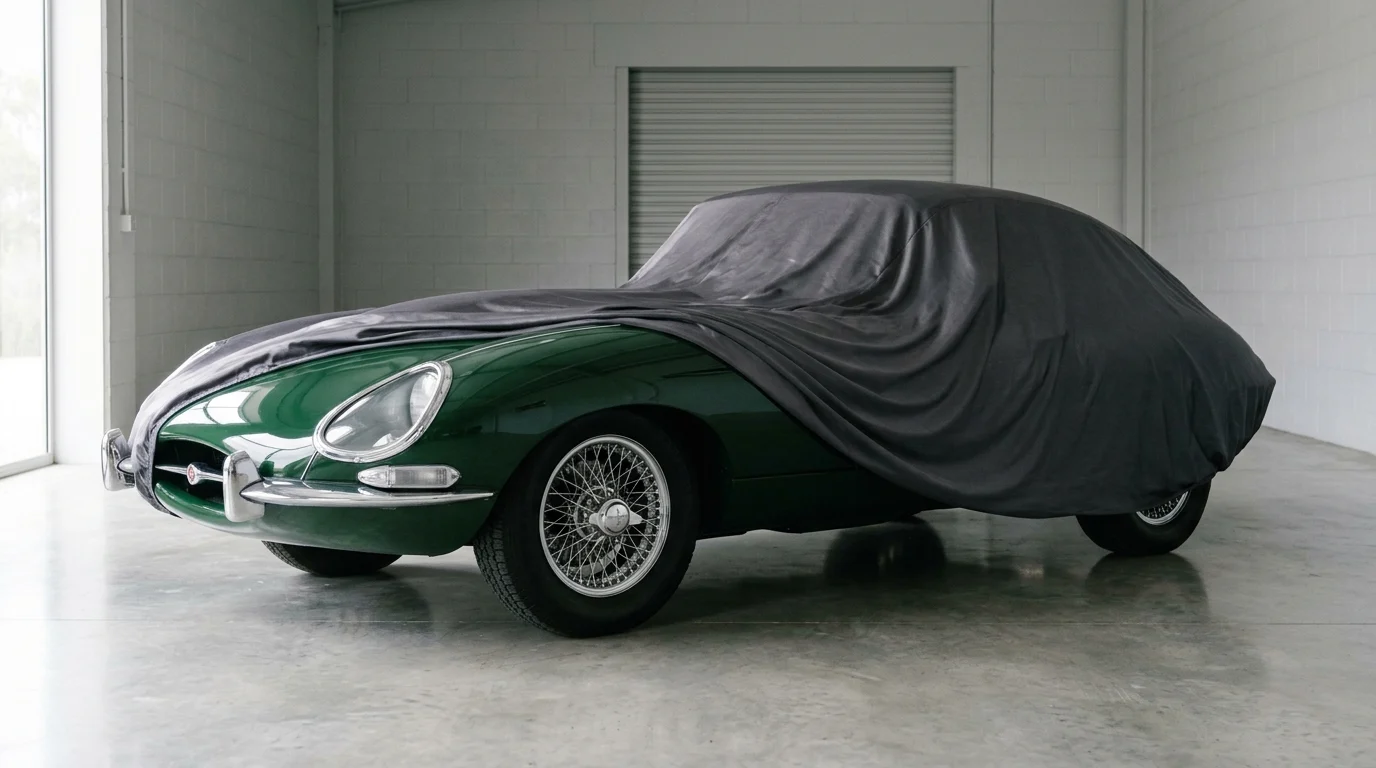
Evaluating a car cover, a breathable car cover, or a classic car storage cover alongside an enclosed bay starts with whether moisture becomes trapped beneath the fabric rather than how thick the fabric feels. Keep your floor moisture observations, cover inspection notes, and bay logs together on the ownership costs shelf alongside our climate-controlled car storage humidity guide, our collector-car storage facility checklist, and our monthly car storage cost comparison.
A breathable car cover is vapor-permeable (letting moisture vapor pass through the fabric instead of pooling against the paint), whereas a waterproof sealed cover blocks both liquid water and vapor and is wrong inside an enclosed garage because overnight temperature drops condense humidity on the underside of the cover directly against the paint and rubber seals; in a warm or humid climate that trapped moisture can lead to rust at panel seams and mold within weeks, while white haze and bubbling clear coat along door edges are signs of damage to watch for. In slabs below grade, moisture vapor in the soil moves upward into the slab; in slabs on grade, moisture within the slab evaporates through the surface (creating a gradient drier at the surface and wetter toward the bottom), and when a covering seals the surface so moisture can no longer escape, moisture equalizes throughout the slab. Putting an indoor dust cover outside traps rain moisture against the paint and mildews fast, whereas using a fully sealed weatherproof cover inside an enclosed garage traps condensation against the paint; a hardware-store tarp does not breathe and its edges rub against paint in wind, while stiff outdoor-cover seams can scuff clean paint indoors.
Why Moisture Trapped Under a Car Cover Matters More Than Fabric Thickness
Comparing a cover and an enclosed building requires checking how ground moisture, residual vehicle heat, and overnight dew-point swings interact around the vehicle skirt.
| Storage Option | Primary Environment | Governing Moisture and Surface Behavior |
|---|---|---|
| Indoor breathable dust cover | Enclosed garage or storage bay | Car cover air permeability (breathability) for indoor and canopy storage is verified by the ASTM D737 standard, whereas outdoor full-weather covers use ASTM G154 to rate resistance to sustained ultraviolet (UV) exposure; without that rating, fabric breakdown can lead to dye transfer, fiber shedding, and clear-coat abrasion. |
| Outdoor multi-layer weather cover | Open driveway or carport | Hagerty UK notes that breathable outdoor car covers cost from £55 (Halfords) or £175+ for custom-fitted covers (Hamilton Classic or Specialised Covers), but warns that the underside of the car remains exposed to damp air and condensation can still creep in beneath the cover, so it is worth airing the car occasionally rather than leaving it under a cover for months. |
| Sealed waterproof cover or tarp | Misapplied indoors or over damp slab | Even inside a garage, a recently driven car releases moisture for hours while an unheated garage warms and cools across the dew point every night; a non-breathable cover or plastic drop sheet condenses that vapor on its underside against the clear coat and chrome, causing haze, spotting, and hidden rust, while garage dust (grit, pollen, brake dust, and fibers) forms an abrasive film. |
| Active-airflow storage capsule | Powered indoor bay or outdoor shield | For classic cars without a garage, Hagerty UK compares pop-up portable garages (from less than £300 to £700 or more, which do not protect from humidity without power and a dehumidifier), the double-skin inflatable Carcoon (£539 Mini size to almost £800, using carbon-filtered continuous airflow), the inflatable PVC Outdoor Car Shield (refreshed five times an hour, from £619, or £2,499 Ultimate rigid version), and anchored carports (from £1,500). |
| Enclosed climate-controlled bay with breathable cover | Permanent storage structure | Equerry 55 (Essex, UK) pairs enclosed climate-controlled storage with a breathable indoor cover: The Stable (£250 plus VAT per month, three-month minimum term) targets 55 percent relative humidity and ten to twelve degrees Celsius winter temperature with battery conditioning and a breathable indoor cover, while The Keep (£350 plus VAT per month) adds TyreDox cushions, a drip tray, weekly battery/drip checks, monthly tire/fluid checks, and an engine run every sixty days. |
The Greenhouse Condensation Cavity Over Bare Concrete
- Slab-on-grade moisture vapor transmission occurs in all climates because the ground below any slab maintains moisture content year-round, and garage temperature differentials from cold nights, hot sun, and vehicle heat drive vapor transmission aggressively.
- A standard 4-inch concrete slab remains permeable to water vapor throughout its service life (causing trapped vapor to trigger osmotic blistering, alkaline hydrolysis, or mold); a freshly placed 4-inch slab with a water-to-cement ratio of 0.50 can take 60 to 90 days to reach equilibrium RH levels, while two-component epoxy moisture mitigation coatings are typically rated up to 95–99% RH.
- White mineral deposits on a concrete floor surface, called efflorescence, form when moisture carries dissolved salts from the soil or concrete to the surface where they crystallize as water evaporates, signaling active moisture movement through a slab without vapor protection.
- Canadian Conservation Institute (CCI) metal-care guidance states that above 65% RH surface moisture supports and accelerates corrosion on most clean metals, 40–55% RH is recommended for organic materials and metal/organic composites, and 30% RH or lower is ideal for metal-only objects (but risks damaging organic components), while NPS Museum Handbook Chapter 4 specifies a 45–55% RH set point (±5 percentage points) and 15–25°C / 59–77°F.
Concrete Slab Vapor Transmission and Under-Slab Vapor Retarder Thresholds
Before selecting a cover or sealing a garage floor, verify whether the concrete slab has an under-slab vapor retarder and measure active vapor emission.
Building Code Gaps in Detached Garages and Sub-Slab Membrane Specs
- The International Residential Code (IRC) Section R506.2.3 requires a minimum 6-mil polyethylene vapor retarder (or equivalent) under concrete floors in conditioned and semi-conditioned spaces such as attached garages, while many local jurisdictions require 10-mil or 15-mil.
- For unheated detached garages used purely for vehicle storage, building code vapor barrier requirements are often reduced or absent, whereas heated or conditioned garages should use a minimum 10-mil polyethylene barrier, with 15-mil or Class A membrane for heated floors (Class A meeting ASTM E1745).
- For a full-size two-car garage (20×20), a 4-inch concrete slab uses approximately 5 cubic yards of concrete, and adding an under-slab vapor barrier adds roughly $80–200 in materials.
- The ASTM standard for under-slab vapor retarders is ASTM E-1745-09 (Standard Specifications for Water Vapor Retarder Used in Contact with Soil or Granular Fill Under Concrete Slabs), which evaluates materials by water vapor permeance under ASTM E-96 (B) (ASTM E-154 Section 7) at 73.4°F and 50% RH, tensile strength under ASTM D-882 (ASTM E-154 Section 9), and puncture resistance under ASTM D-1709 Method B.
- While older specifications often cited a general permeance threshold of 0.3 perms, ASTM E1745 requires an under-slab vapor retarder to have a water vapor permeance of 0.1 perms or less, and ASTM E1643 details under-slab vapor retarder selection, installation, and inspection.
- In concrete slab construction, Pro Tool Reviews notes that when using vapor barriers, a 4-inch (4″) layer of damp, compactible fill is placed over a polyethylene barrier, temperatures should be kept between 50° and 70°, and warns that non-breathable epoxies allow moisture to freeze under the coating and cause more delamination.
Quantitative Slab Moisture Tests and Building Envelope Airflow Physics
Standard test protocols distinguish surface evaporation rates from internal slab relative humidity and airborne moisture infiltration:
- The two primary US concrete slab moisture measurement standards are ASTM F1869 (Standard Test Method for Measuring Moisture Vapor Emission Rate of Concrete Subfloor Using Anhydrous Calcium Chloride) and ASTM F2170 (Standard Test Method for Determining Relative Humidity in Concrete Floor Slabs Using In-situ Probes), with ASTM F2170 favored since 2002.
- For epoxy or coating projects, a moisture vapor barrier is needed when concrete moisture vapor emission test results exceed 3 lbs/1,000 sq ft/24 hours per the ASTM F1869 calcium chloride test, when in-slab relative humidity exceeds 75% per the ASTM F2170 in-situ probe test, or when the building lacks a polyethylene vapor retarder beneath the slab.
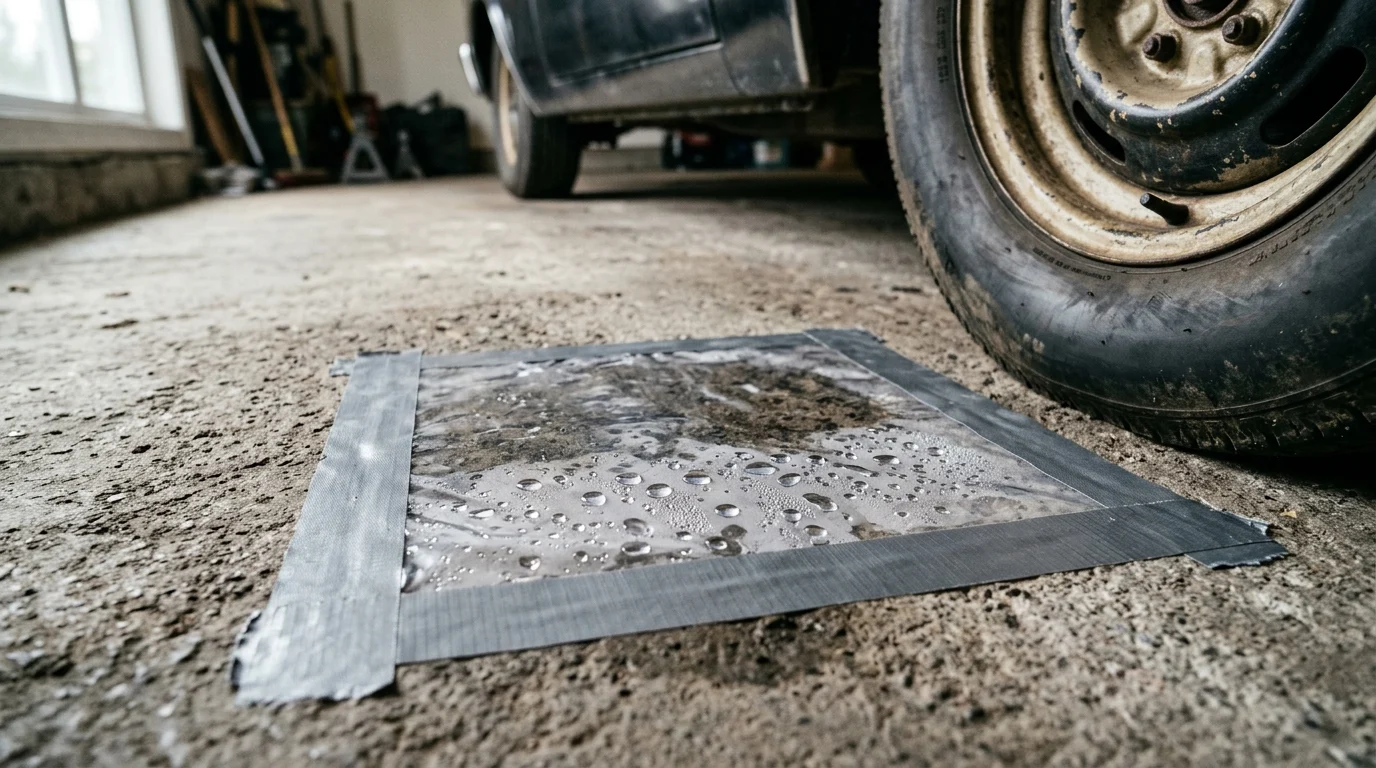
- Under ASTM F1869, anhydrous calcium chloride is sealed under a plastic dome on the concrete surface for a 60 to 72-hour period; under ASTM F2170, relative humidity probes are inserted into holes drilled to a depth of 40 percent of the slab thickness (with 75 to 85 percent RH typical coating limits); under ASTM D4263, a plastic sheet is taped for 16 to 24 hours; and most coating manufacturers specify a minimum cure time for new concrete, typically 28 days at a minimum, before coating.
- Four physical forces drive moisture into and through building assemblies: gravity, capillary suction through microscopic pores, water vapor diffusion from high to low vapor pressure, and airborne movement of water vapor; water vapor permeance is tested under ASTM E96 Method A (dry cup / desiccant) or Method B (wet cup / water).
- Moisture carried by air movement can be up to 100 times greater than water vapor diffusion: over a heating season in a cold climate, a 1.2 x 2.4-m (4 x 8-ft) gypsum board sheet passes up to 285 ml (9.6 oz) of water by diffusion, whereas a 25-mm (1-in.) hole allowing airflow can add up to 28 L (7.5 gal) of water.
- To qualify as a vapor retarder under ASTM E-96, a material must have a permeance rating no greater than 1.0 perm (while low-perm facings typically have a rating of 0.02 perms), and to qualify as an air barrier under ASTM E 2178 it must have an air permeance not exceeding 0.004 cfm/ft2.
- Exposed vapor retarder facings and insulation composites in return air plenums require an ASTM E84/UL-723 Flame Spread and Smoke Developed rating of 25/50, and metal-building vapor retarders should be rated for service temperatures from at least 0 F to 140 F, with 80 to 85 percent light reflectivity available with most vapor retarders.
Indoor Breathable Car Covers vs. Outdoor Multi-Layer Classic Car Storage Covers
Matching a cover to its storage setting prevents both trapped condensation indoors and rapid fabric breakdown or paint chafing outdoors.
Indoor Dust Cover Weaves, Outdoor Hydrostatic Ratings, and Custom Fit
Published manufacturer comparisons separate lightweight indoor dust covers from heavy multi-layer weather shells and active-airflow capsules:
- In JK Cover’s OEM comparison, indoor car covers weigh 1–3 kg, take 1 minute to install, last 3–5 years, and cost $20–$90, whereas outdoor multi-layer waterproof covers weigh 3–7 kg, require wind straps and buckles, block 90%+ of UV radiation, last 2–4 years, and cost $60–$250.
- Across 50+ fabric grades on the market, JK Cover’s factory test data accumulated over 15 years shows budget covers use 190T–420D polyester with unsealed seams and fail at a 500–1,000mm (< 1,000mm) water column test, whereas premium outdoor covers use 600D–1680D Oxford or multi-layer fabrics with taped seams, 8–10 stitches per inch, and a 3,000mm+ water column rating.
- CarCover.com compares three indoor vehicle protection tiers: Black Satin (4BL) (4-layer satin-stretch with plush lining, lifetime warranty), Bronze Shield 2L (2-layer lightweight knit, 3 years warranty), and the Inflatable Bubble (1CST) (sealed walk-around capsule with continuous filtered fan airflow that blocks dust, humidity, condensation, and pests, 2 years warranty).
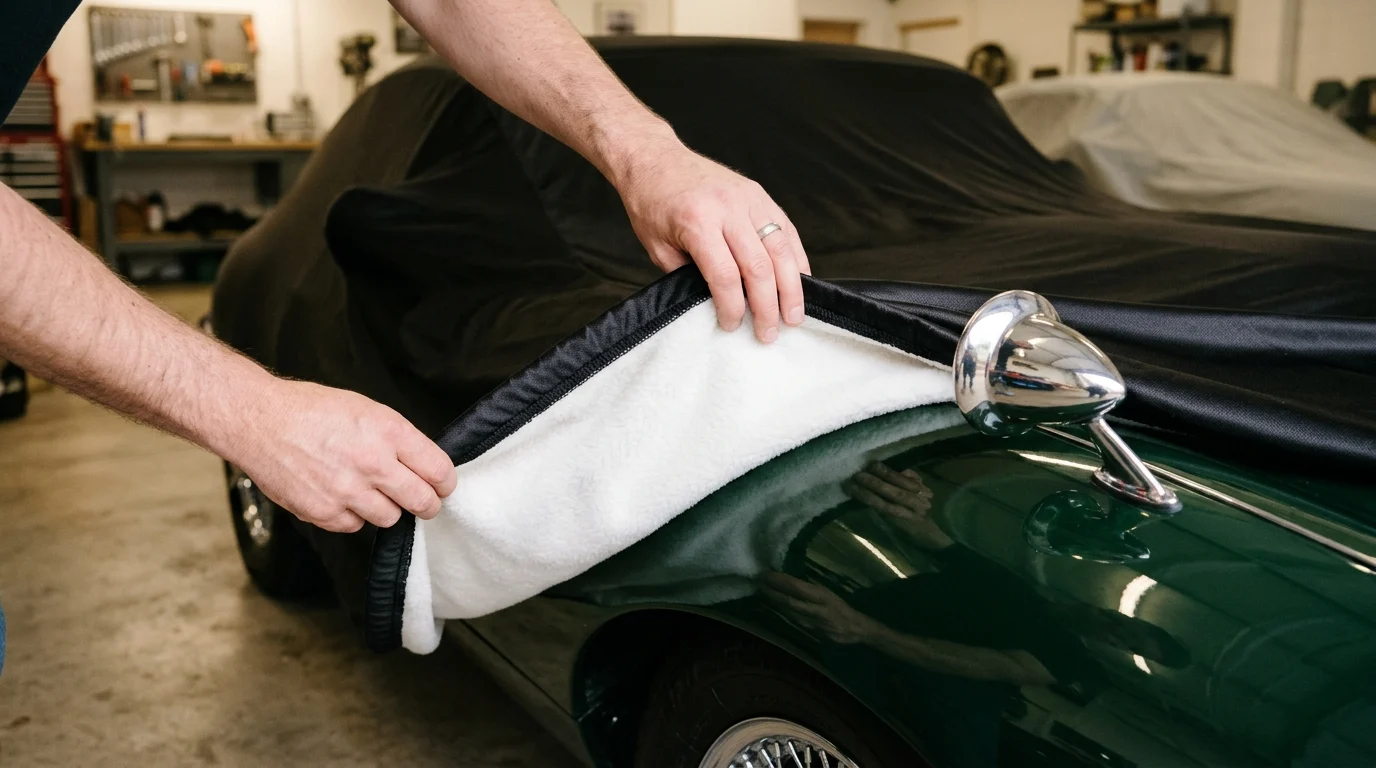
- In DaShield’s classic-car cover comparison, the California Car Cover Plushweave is a 100% cotton indoor cover with an added cotton fleece lining and a 3M Scotchgard water-repellency treatment, priced at roughly $360 with a 2 years warranty.
- In DaShield’s classic-car cover comparison, the Covercraft Dustop uses a 4-layer ultrasonically laminated non-woven polypropylene custom-fit indoor construction (
$159, 4 years warranty), the outdoor DaShield Ultimum Series uses a waterproof multi-layer shell with built-in ventilation panels, fleece liner, and under-body wind-lock strap (from $209.99, lifetime warranty), and the universal Budge Duro uses a 3-layer polypropylene construction ($90, 5 years warranty). - CarCovers.com lists its outdoor AllGuard Weatherproof Max cover (water-resistant UV-treated outer shell with a microporous film, soft fleece liner, and elastic front and rear hems) from $169.99 and its Platinum Shield cover for snow, storms, and damp from $199.99.
- For any car storage period longer than one month, a custom-fit cover with an elastic hem that seats against the sill or rocker panel is required instead of a universal cover, because a loose universal-fit cover shifts with wind or indoor HVAC and bay-door air movement, dragging fabric across the paint and turning unwashed grit into sandpaper on the clear coat.
Surface Preparation, Silicone Wax Bonding, Laundry Care, and Mechanical Boundaries
Even a custom-fit breathable cover requires clean paint, periodic edge-lift inspections, and separate mechanical layup protections:
- Pre-storage and monthly car-cover protocol requires washing and drying the car completely, skipping the cover immediately after a silicone-based wax (which can bond to the cover), lifting one edge every 30 days to check for trapped moisture or stiff/cracked inner lining, and using separate rodent protection because a cover does not stop rodents entering through wheel wells and vents.
- When washing a classic car cover on a cold, gentle cycle, never use fabric softener—because fabric softener coats the fibers and reduces breathability—and air dry flat rather than using a heated dryer that can shrink or distort the fabric.
- In our winter car storage guide, starting a cold engine for a 5-to-10-minute garage idle condenses approximately one gallon of acidic combustion water per gallon of gasoline burned into the cold crankcase sump and exhaust mufflers; without a 20-to-30-minute road load to raise sump oil temperature above 180°F to 212°F (82°C to 100°C), that moisture remains trapped, while house mice (Mus musculus) penetrate apertures down to 1/4 inch (6.35 mm) and require 1/4-inch Type 304/316 stainless mesh (0.025–0.028 in wire).
- In our 4-post storage lift guide, stacking two cars in an enclosed bay requires a 4.0 to 4.25-inch minimum 3,000 PSI concrete slab (28-day cure, 12.5 to 22.9 PSI static baseplate bearing pressure) and overlapping 36-to-45-inch by 38-to-42-inch polypropylene or galvanized steel drip trays between the runways so upper-vehicle motor oil, glycol coolant, DOT 3/4 brake fluid, or road water cannot drip onto the lower car’s clearcoat or convertible fabric top.
Enclosed Storage Facilities, Collector Insurance Eligibility, and Bay Protocols
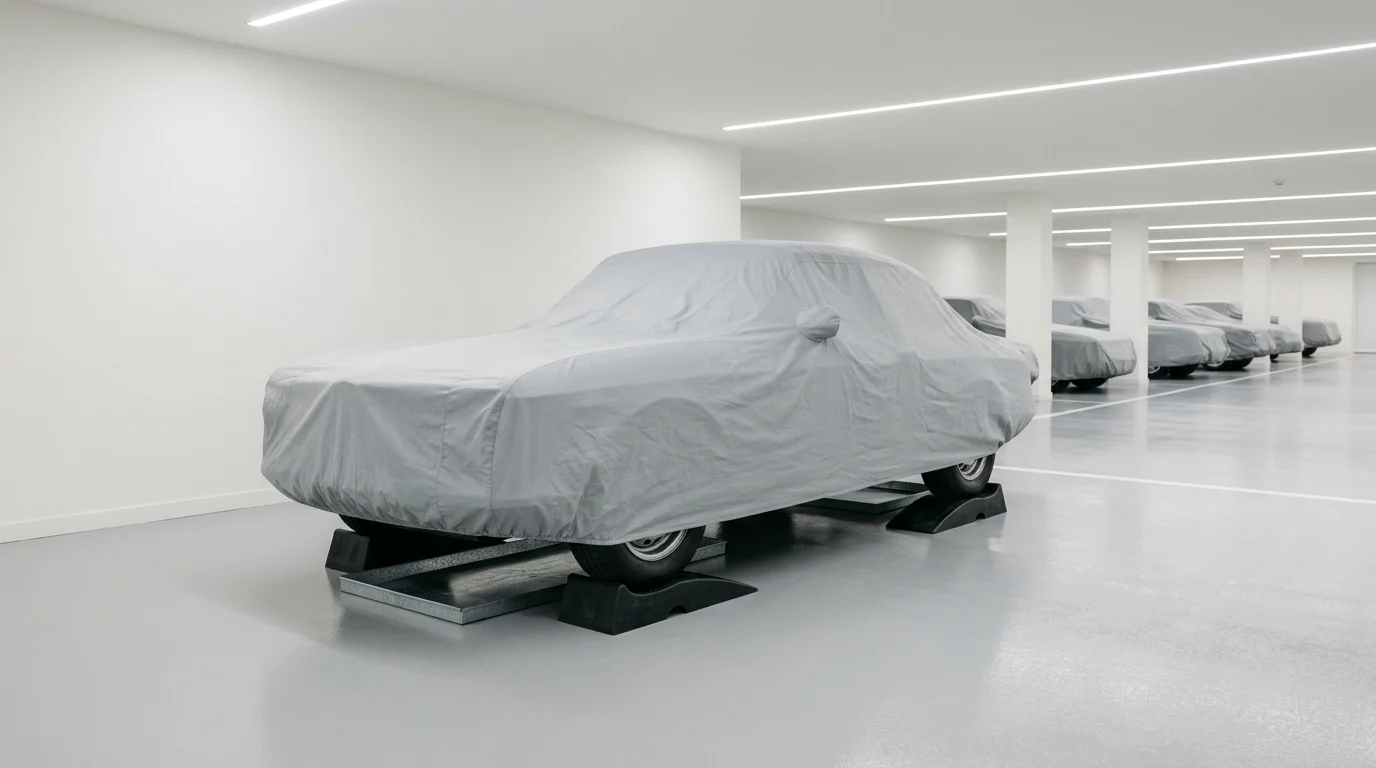
A fabric cover protects against dust or sunlight, but collector-car insurers underwrite the permanent structure where the vehicle is kept.
Collector Insurance Storage Rules and Homeowners Policy Exclusions
Underwriting guidelines separate enclosed masonry or steel buildings from carports, driveways, and temporary fabric shelters:
- Under Hagerty’s US collector vehicle eligibility guidelines (general mileage 3,500 or less, mileage up to 7,500 may be considered), Hagerty prefers storage in an enclosed, secure structure (private garage, pole barn, car condo, or storage unit); carports may be considered up to a $100k maximum vehicle value in all states except CA and FL (Broward, Miami-Dade & Monroe counties) and must be more than 5 miles from the coast or coastal bay in FL and LA.
- Hagerty’s US eligibility guidelines state that private limited-access parking garages with 24 hour security may be considered (except in CA) and that driveways may be considered up to a $50,000 maximum vehicle value (except in CA, CO, FL, or HI, or within 50 miles of the coast in LA), while classifying temporary canvas or plastic storage facilities (tents, domes, or igloos), streets, parking lots, and public parking garages as unacceptable storage.
- Hagerty’s top-five decline guide confirms that temporary shelters, parking lots, street parking, and public parking garages result in an automatic decline, that CA, HI, FL, CO, and LA (within 50 miles of the coast) have restrictions against any outdoor parking, and that 90s and newer vehicles are declined at 5,000 miles per year or more.
- Homeowners and renters insurance policies do not cover car damage or theft in a home garage or driveway, and off-premises personal property coverage in an external storage unit (usually capped around 10%, such as $2,500 on $25,000 of belongings) is still not likely to cover motor vehicles even when immobile under a car cover, requiring a dedicated comprehensive auto insurance policy.
Enclosed Facility Benchmarks, Humidity Load Boundaries, and Contract Math
Published facility pages show how enclosed storage bays pair environmental controls with indoor covers, while our sibling guides cover dehumidifier sizing and contract math:
- RecNation Storage operates across 70 locations in eight states; monthly vehicle storage rates (checked October 2026) run about $57 to $183 per month for outdoor uncovered spaces, $99 to $351 for canopy spaces, and $114 to $216 for most indoor garage sizes.
- Historic Motor Sports (Candia, NH) operates a 5,200 square foot climate-controlled classic car storage facility (maintaining 65º in the intro and 65-70 degrees year-round on the rate lines, with 16 surveillance cameras and battery tender access) at $240/month annual prepaid (paid in full by November 1st, no pro-rated refunds) or $275/month seasonal (five-month minimum, November 1st – March 30th).
- In our monthly storage cost comparison, effective monthly cost is (months you must pay × monthly sticker) / months you actually store the car, so Historic Motor Sports’ 12 × $240 = $2,880 prepaid annual line costs $576 per month if used for 5 months versus 5 × $275 = $1,375 on the monthly line (a $1,505 cash difference, whereas a full 12-month stay saves 12 × $35 = $420), and Equerry’s 3-month minimum costs 3 × £250 = £750 plus VAT.
- In our climate-controlled storage specification, the 2015 ASHRAE museum chapter mentions 6–8 air changes per hour for system airflow while ASHRAE’s 2017 ventilation chapter separates outside-air exchange from recirculation, and Dantherm’s outside-air moisture load formula W(air) = ρ × V × n × (x(out) − x(in)) uses ρ = 1.2 kg/m³ at 15–25°C (yielding 432 g/h in a 500 m³ room with 100 m³ dry goods and 0.6 h⁻¹ exchange between 10 g/kg at 17°C/83% RH and 8.5 g/kg at 20°C/60% RH).
Ground Vapor Barrier, Car Cover Breathability, and Storage Room Humidity Checklist
Work through these verification steps before fitting a cover or placing a classic car into seasonal layup, and file the completed entries with your collector-car cost sheet and storage facility checklist:
- The Plastic Sheet Test (ASTM D4263) is a qualitative concrete moisture screening check in which a clear plastic sheet is taped down to the slab for 24 hours; visible condensation or darkening of the concrete signals active moisture vapor transmission (MVT).
- For epoxy or coating projects, a moisture vapor barrier is needed when concrete moisture vapor emission test results exceed 3 lbs/1,000 sq ft/24 hours per the ASTM F1869 calcium chloride test, when in-slab relative humidity exceeds 75% per the ASTM F2170 in-situ probe test, or when the building lacks a polyethylene vapor retarder beneath the slab.
- Car cover air permeability (breathability) for indoor and canopy storage is verified by the ASTM D737 standard, whereas outdoor full-weather covers use ASTM G154 to rate resistance to sustained ultraviolet (UV) exposure; without that rating, fabric breakdown can lead to dye transfer, fiber shedding, and clear-coat abrasion.
- For any car storage period longer than one month, a custom-fit cover with an elastic hem that seats against the sill or rocker panel is required instead of a universal cover, because a loose universal-fit cover shifts with wind or indoor HVAC and bay-door air movement, dragging fabric across the paint and turning unwashed grit into sandpaper on the clear coat.
- Pre-storage and monthly car-cover protocol requires washing and drying the car completely, skipping the cover immediately after a silicone-based wax (which can bond to the cover), lifting one edge every 30 days to check for trapped moisture or stiff/cracked inner lining, and using separate rodent protection because a cover does not stop rodents entering through wheel wells and vents.
- Canadian Conservation Institute (CCI) metal-care guidance states that above 65% RH surface moisture supports and accelerates corrosion on most clean metals, 40–55% RH is recommended for organic materials and metal/organic composites, and 30% RH or lower is ideal for metal-only objects (but risks damaging organic components), while NPS Museum Handbook Chapter 4 specifies a 45–55% RH set point (±5 percentage points) and 15–25°C / 59–77°F.
Sources
- SlabCalc — Vapor Barrier for Garage Floors: What You Need to Know
- PolyTitan Coatings — Moisture Vapor Barrier: When Is It Necessary Under Epoxy?
- The Construction Specifier — Moisture Measurement in Concrete Floor Slabs (Jason Spangler)
- The Construction Specifier — Using Vapor Retarders to Manage Airflow and Reduce Moisture (Ted Winslow)
- Metal Architecture — Vapor Retarder Basics: How to Choose the Proper Vapor Retarder
- Americover — Underslab Vapor Barriers and Under-Slab Water Vapor Retarder Specifications
- ConcreteMoisture.com (Wagner Meters) — Understanding the Influence of Vapor Retarders (Jason Spangler)
- Floor Repair Authority — Floor Moisture Problems: Vapor Barriers and Moisture Mitigation
- Keas Concrete Coatings — What Is Moisture Vapor Transmission in Concrete Floors?
- Pro Tool Reviews — How To Avoid Defects In Concrete Slabs
- RecNation Storage — Should You Cover a Car in Storage? Indoor vs Outdoor Cover Guide
- CarCovers.com — Indoor vs Outdoor Car Cover: Which One Actually Fits Your Situation?
- CarCover.com — Best Indoor Car Covers
- DaShield Cover — Best Classic Car Covers
- JK Cover — Indoor vs Outdoor Car Covers: The Complete Comparison
- Hagerty UK — Ways to Cover Your Classic Car When You Do Not Have a Garage (Nik Berg)
- Hagerty Insurance Agent Business Center — Eligibility Guidelines and Top Reasons for Declines
- Hagerty — Your Guide to Classic Car Storage Insurance
- Historic Motor Sports — Climate Controlled Classic Car Storage (Candia, NH)
- Equerry — Classic Car Storage Plans and Preservation (Essex, UK)
- Canadian Conservation Institute — Caring for Metal Objects and General Precautions for Storage Areas
- National Park Service — Museum Handbook: Museum Collections Environment
- ASHRAE — HVAC Applications (Museums, Galleries, Archives, and Libraries) and Fundamentals (Ventilation and Infiltration)
- Dantherm — Selection Guide for Mobile Dehumidifiers
- IGA Funds — Climate Controlled Car Storage, Storage Facility Checklist, Monthly Car Storage Cost Comparison, Winter Car Storage, and Storage Lift Notes