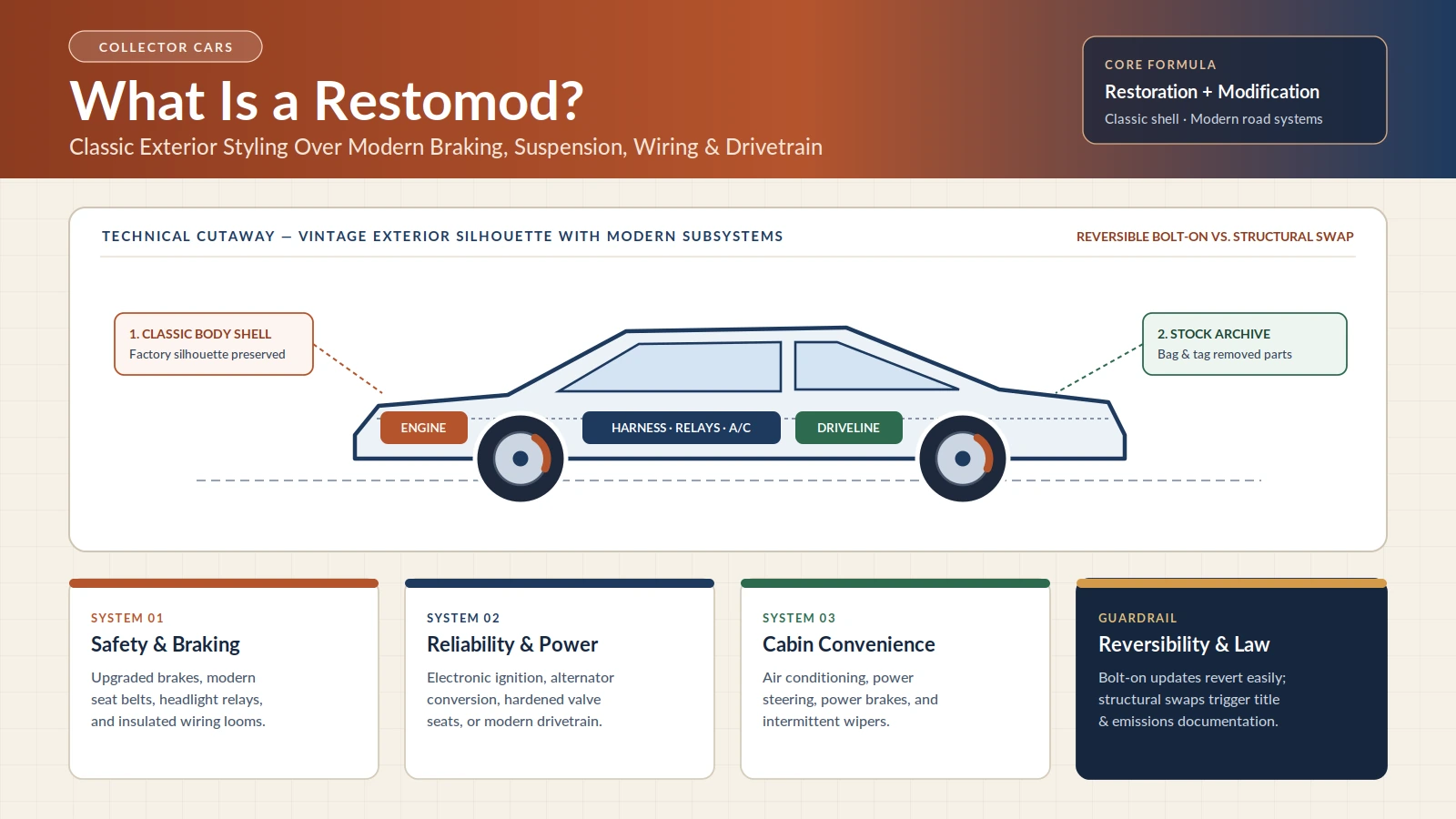
A restomod (short for resto-modification) is a non-original restored classic car that retains vintage exterior styling while modernizing its engine, transmission, suspension, brakes, tires, wiring, or cabin features for dependable everyday road use. When built with bolt-on upgrades rather than permanent structural cuts, a restomod can revert back to stock condition.
Unlike a factory-correct rebuild that aims to match showroom delivery, a restomod prioritizes modern reliability, stopping power, and comfort beneath a classic silhouette through resto-modification. Setting clear boundaries before work starts protects both the car and its paperwork alongside our broader restoration versus preservation guide.
How does a restomod differ from factory restoration and preservation?
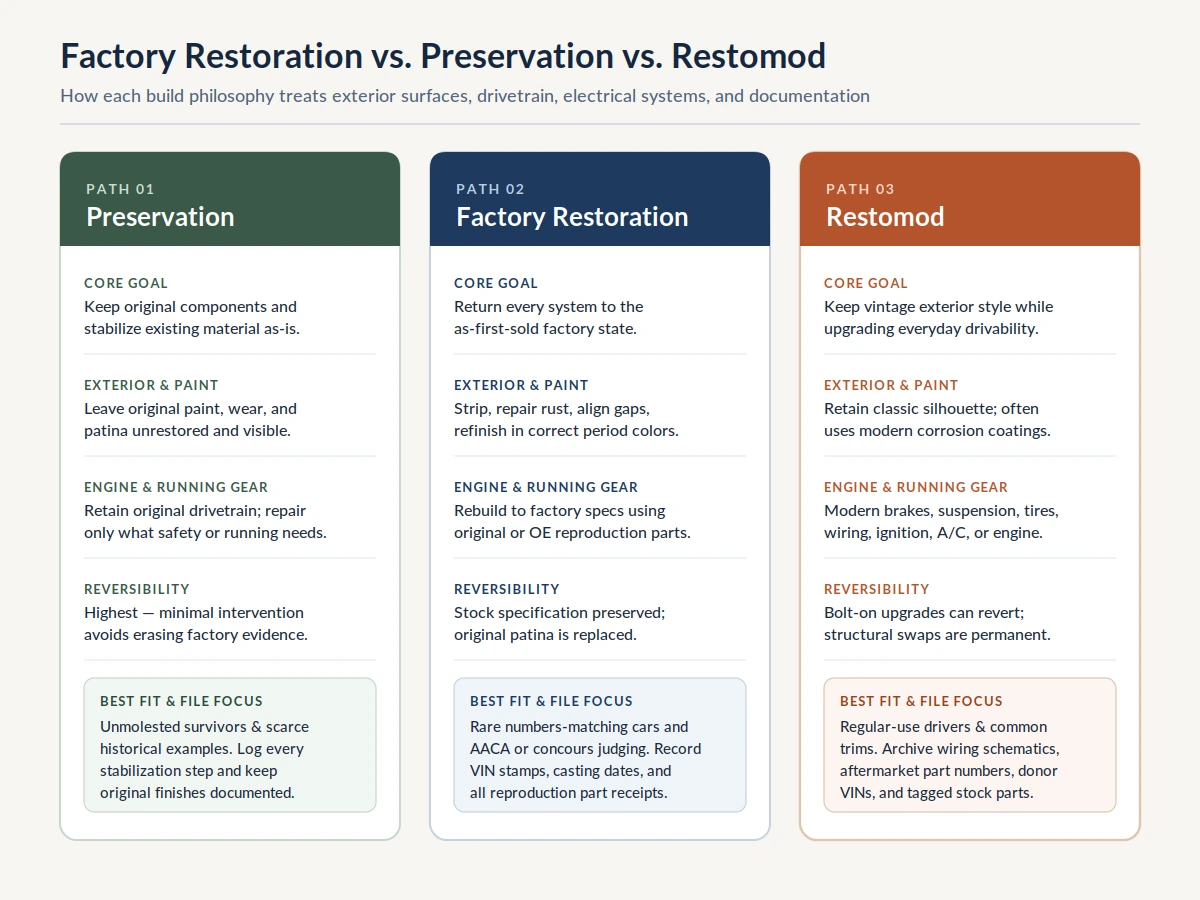
A factory restoration returns every system to the condition in which the car was first sold, preservation keeps original components and surface wear intact, and a restomod retains classic exterior styling while upgrading mechanical and electrical systems beyond original factory specification. Installing a non-original engine classifies the vehicle as modified rather than restored even when most remaining parts are stock.
In road-vehicle restoration terminology, stock condition describes an unmodified vehicle remaining in the exact configuration in which it left the factory. Traditional restoration removes, replaces, or repairs worn components to bring a vehicle back to like-new or better factory specification using original or reproduction parts and techniques. Judging bodies such as the Antique Automobile Club of America (AACA) evaluate an antique restoration against the same state a dealer could have prepared for delivery to its first buyer.
Preservation follows the opposite discipline: keeping original components intact and leaving body and paint unrestored in as-is condition to retain original patina. A restomod intentionally departs from both stock restoration and preservation by fitting updated drivetrains, running gear, wiring, or cabin amenities under a vintage body shell. Once a vehicle receives an engine swap for a different model than originally fitted, it qualifies as modified rather than restored—a boundary closely tied to numbers-matching verification.
| Build path | Core objective | Exterior and paint treatment | Drivetrain and running gear | Reversibility and identity |
|---|---|---|---|---|
| Preservation | Keep original factory components intact | Original paint, wear, and patina left unrestored as-is | Original mechanicals maintained with minimal intervention | Highest originality; avoids removing factory finishes |
| Factory restoration | Return vehicle to as-first-sold dealer state | Stripped, repaired, and refinished to factory color and finish | Rebuilt to factory specification using original or reproduction parts | Matches stock specification; replaces aged surface patina |
| Restomod | Combine vintage exterior look with modern usability | Original exterior lines retained, paired with modern corrosion coatings | Updated engine, transmission, brakes, suspension, tires, or electronics | Bolt-on updates can revert to stock; structural swaps are permanent |
How is a restomod different from custom restyling, hot rods, and tribute cars?
A restomod preserves original exterior styling while updating hidden mechanicals and cabin usability, whereas custom restyling reshapes exterior sheet metal beyond showroom design, hot rods prioritize maximum engine output in the lightest possible frame, and replica or tribute builds imitate a different model or rarer factory trim.
By contrast, a custom car alters performance, aesthetics, or both to push styling beyond the showroom floor. Traditional 1950s kustom builders swapped trim and panels from other vehicles and cut, welded, and reshaped exterior sheet metal to lower the car’s profile—altering the factory silhouette itself rather than preserving it.
Hot rods emerged from a different priority: installing the most powerful engine available into the lightest possible frame and body combination. Replica, re-creation, and tribute builds modify a vehicle to appear like another car entirely or like a rarer, more desirable trim of the same model. A restomod stays visually faithful to the classic body’s factory proportions while focusing its modifications on braking, handling, electrical safety, and everyday drivability.
| Build style | Exterior sheet metal | Primary engineering focus | Typical departure from factory stock |
|---|---|---|---|
| Restomod | Original classic exterior styling preserved | Everyday drivability, safety, reliability, and comfort | Modernized brakes, suspension, wiring, ignition, HVAC, or drivetrain |
| Custom car (restyling) | Altered through panel swaps, cutting, and rewelding | Visual self-expression beyond showroom styling | Permanent exterior body reshaping and custom trim |
| Hot rod | Stripped down or weight-reduced for minimal mass | Maximum engine output in the lightest frame and body | High-output powertrains prioritized over cabin convenience |
| Replica or tribute | Styled to mimic another vehicle or rarer trim | Recreating the look of a scarce or famous variant | Visual conversion that must be disclosed honestly on sale |
Which mechanical, safety, electrical, and comfort upgrades define a restomod?
Restomod upgrades cluster into four functional groups: safety improvements such as seat belts, upgraded brakes, and headlight relays; reliability and usability updates such as electronic ignition, alternators, and modern wiring insulation; modern cabin conveniences such as air conditioning and power steering; and emissions updates such as hardened valve seats or catalytic converters.
Safety, braking, and electrical upgrades
Owners pursue restomod work primarily to improve vehicle safety, reliability, driving performance, and everyday convenience. On the safety side, common modifications install modern seat belts, stronger brake systems, and electrical relays that reduce heavy electrical current flowing directly through vintage dashboard light switches.
Wiring insulation deserves particular attention on older classics. Vehicles old enough to carry original rubber or fabric-based electrical wiring insulation pose an active fire risk and should be rewired with modern insulated harnesses. On the exterior shell, many owners also replace period enamel or cellulose finishes—which offer weaker corrosion protection—with modern paints, underseals, and anti-rust treatments to protect restored sheet metal.
Usability, convenience, and emissions updates
Everyday usability upgrades target vintage systems that demand frequent adjustment or struggle in modern traffic. Typical changes include fitting intermittent windshield wipers, replacing a dynamo with an alternator for steady charging, and swapping mechanical contact breaker points for electronic ignition.
For cabin comfort, restomods frequently add air conditioning, power steering, power brakes, power windows, or modern audio and multimedia hardware that were unavailable when the car was built. Emissions and fuel-compatibility upgrades include machining hardened valve seats so older cylinder heads can run standard unleaded gasoline, or retrofitting catalytic converters where appropriate.
| Upgrade category | Common restomod modifications | Primary engineering goal | Reversibility profile |
|---|---|---|---|
| Safety and electrical | Seat belts, upgraded brakes, headlight relays, modern insulated wiring | Stronger stopping, lower switch current load, reduced wiring fire risk | Reversible on factory mounts except where structural anchors are added |
| Reliability and usability | Electronic ignition, alternator conversion, intermittent wipers, modern tires | Dependable cold starts, steady charging, predictable wet-weather use | Bolt-on reversible when removed factory parts are retained |
| Modern convenience | Air conditioning, power steering, power brakes, power windows, modern audio | Everyday driving comfort in modern traffic and climates | Moderate complexity; dash or firewall cuts reduce reversibility |
| Emissions and coatings | Hardened valve seats for unleaded fuel, catalytic converters, modern paints | Compatible fuel operation, lower tailpipe emissions, corrosion resistance | Valve seats and modern paint coatings are effectively permanent |
Where is the line between reversible upgrades and permanent structural changes?
Reversible upgrades bolt onto existing factory mounting points so the vehicle can return to stock condition at any time, whereas permanent changes cut structural sheet metal, alter suspension or steering geometry, or install a non-original engine family—crossing legal thresholds that can void historic exemptions and trigger emissions or registration inspections.
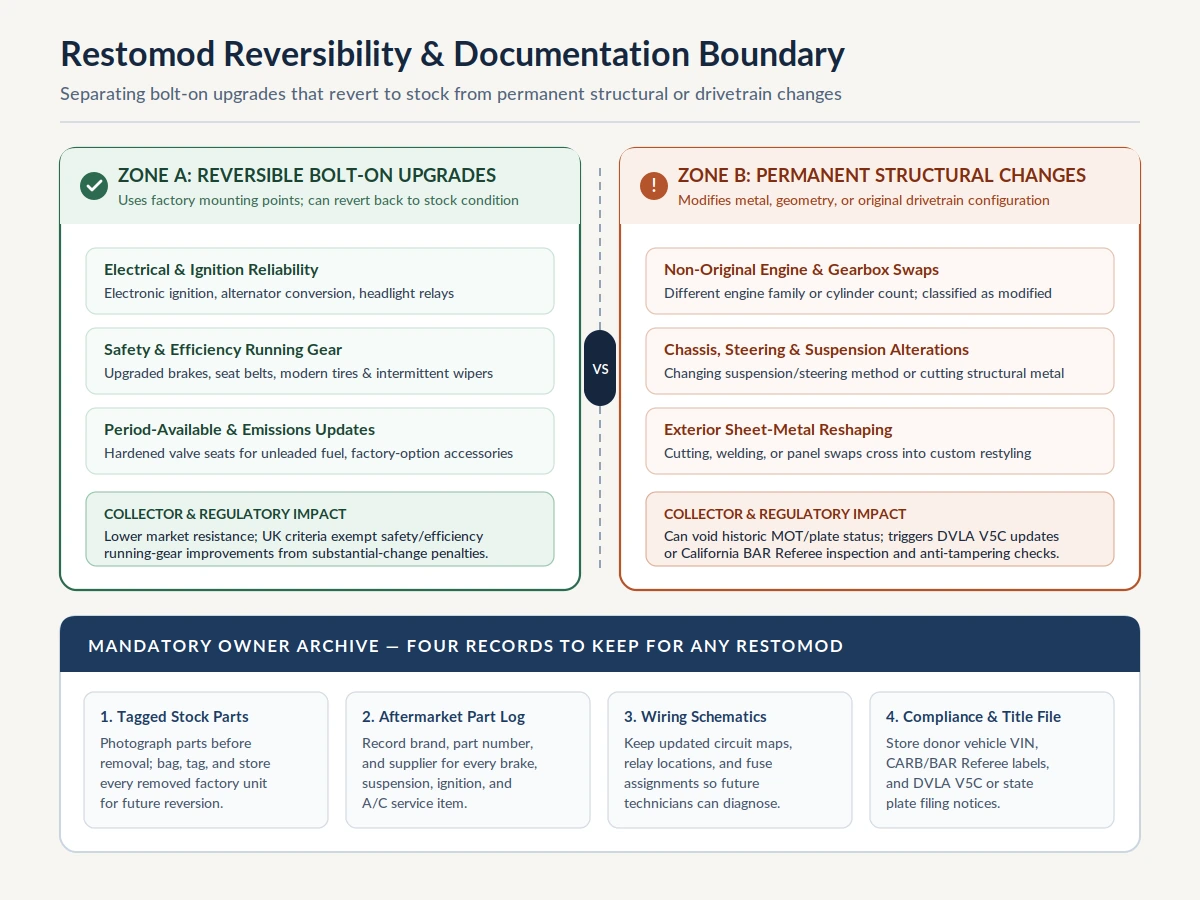
Bolt-on upgrades vs. major drivetrain and chassis swaps
Collector acceptance depends heavily on reversibility. Upgrades that can revert easily to original stock condition—or features that were available as factory options when the car was first sold—draw far less market resistance than major mechanical alterations.
By contrast, major alterations such as non-original engine swaps or gearbox transplants push a build closer to hot rodding and permanently alter factory configuration unless original mounts and assemblies remain untouched. Keeping removed factory parts labeled and stored is what makes reversibility real rather than theoretical.
Historic registration, MOT exemption, and emissions rules
Regulators draw sharp statutory lines between reversible safety updates and structural modifications, as detailed in our historic vehicle registration rules overview. Under UK Department for Transport historic MOT exemption criteria, a vehicle of historical interest qualifies for MOT exemption if it was built or first registered more than 40 years ago and has undergone no substantial changes in the previous 30 years.
The UK guidance illustrates how technical authorities separate acceptable upgrades from substantial changes:
- Chassis or frame: Replacing a frame with one of the same pattern as the original does not count as a substantial change.
- Axles and running gear: Changing the type or method of suspension and steering is a substantial change, except where axles and running gear are changed to improve efficiency, safety, or environmental performance.
- Engine: Alternative cubic capacities of the same basic engine or alternative original-equipment engines are exempted, whereas changing cylinder count typically indicates a non-original engine.
- Preservation exceptions and notification: Changes needed because original-type parts are no longer reasonably available are exempted, and owners remain legally required to notify DVLA of changes—such as an engine replacement—that alter V5C registration certificate details.
In the United States, emissions and registration categories apply similar distinctions. The California Bureau of Automotive Repair engine change rules separate a factory-matched replacement engine from an engine change (installing an engine different from the one originally fitted). State and federal anti-tampering laws—including California Vehicle Code section 27156 and Title 16, Section 3362.1 of the California Code of Regulations—prohibit unauthorized modifications to certified emission control configurations. Using an identical drivetrain and emissions configuration or a CARB-exempted engine package prevents compliance obstacles; vehicles with engine changes must pass an initial BAR Referee inspection, carry a BAR Referee label inside the engine compartment, and benefit from presenting the donor vehicle VIN at inspection.
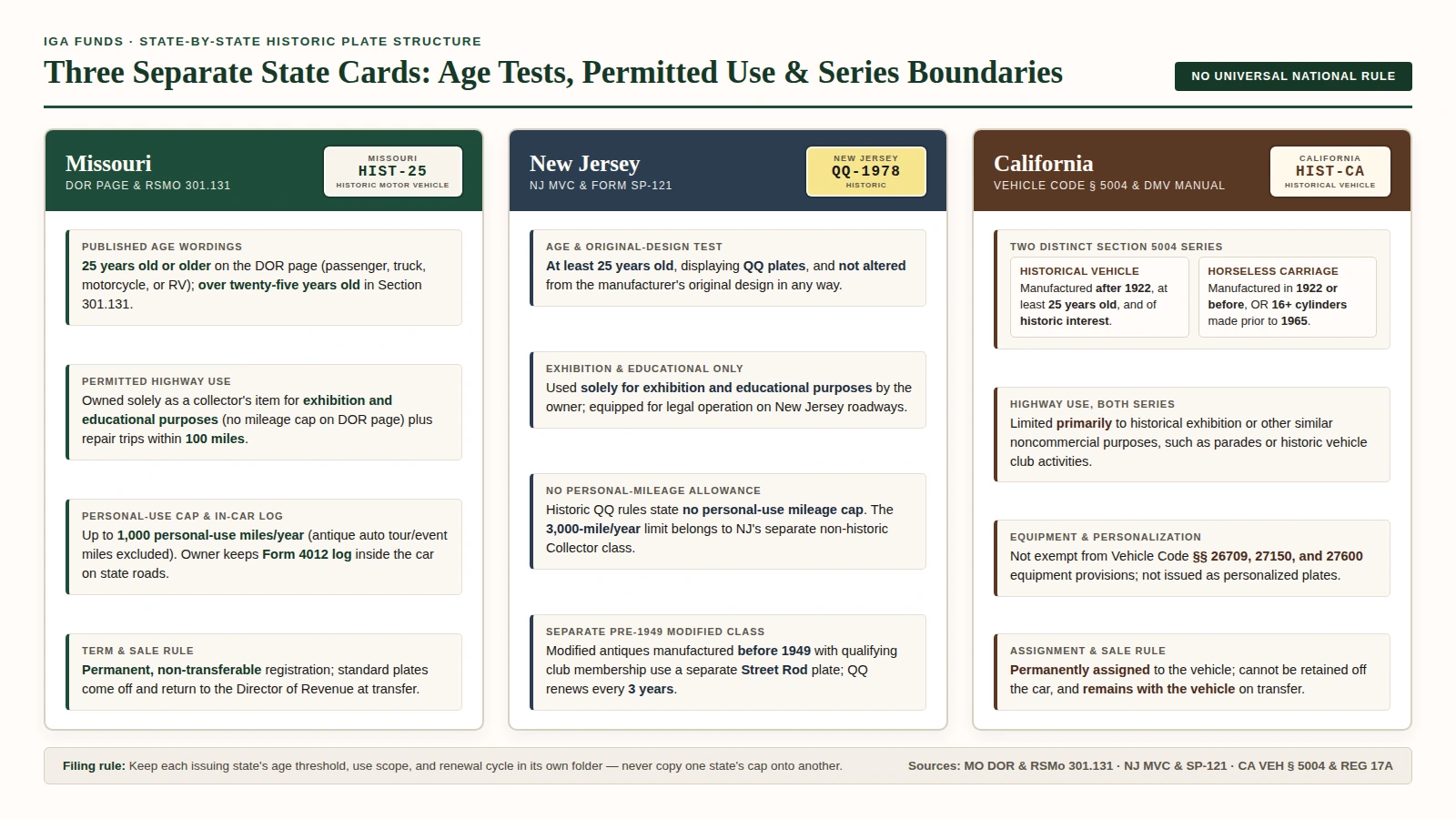
State plate rules also separate stock classics from modified builds. The New Jersey Motor Vehicle Commission limits standard Historic plates to vehicles at least 25 years old used solely for exhibition and educational purposes, while placing modified antique automobiles manufactured before 1949 into a separate Street Rod plate category requiring club or National Street Rod Association affiliation.
| Jurisdiction or authority | Statutory rule or threshold | Upgrades generally accepted or exempt | Changes triggering inspection or reclassification |
|---|---|---|---|
| UK Department for Transport (VHI / MOT) | Built or first registered over 40 years ago; no substantial changes in last 30 years | Same-pattern frame replacement; running-gear upgrades for safety, efficiency, or environmental performance; same-family or alternative OE engines | Altered suspension or steering type outside exemptions; non-OE engine with different cylinder count; unnotified V5C engine changes |
| California BAR (Smog / Engine Changes) | California Vehicle Code section 27156 and Title 16, Section 3362.1 anti-tampering rules | Factory-matched replacement engine; identical configuration; CARB-exempted engine package | Non-original engine change requiring initial BAR Referee inspection, engine-bay BAR Referee label, and donor VIN record |
| New Jersey MVC (Plate Classes) | Historic plate minimum age 25 years (exhibition and educational use) | Unmodified historic vehicles meeting exhibition use rules | Modified antique vehicles manufactured before 1949 routed to Street Rod plates with club affiliation |
What drives restomod project scope compared with a factory restoration?
Both a factory restoration and a restomod share heavy foundational work—disassembly, rust repair, frame alignment, and refinishing—but their scope diverges in parts sourcing and integration labor. Factory restorations incur major effort hunting scarce original parts or fabricating orphan components from scratch, whereas restomods shift labor toward structural frame upgrades, full rewiring, subsystem integration, and emissions compliance.
The structural foundation drives baseline effort on either path. A vehicle’s frame must be inspected for straightness, twisting, alignment, stress fractures, collision damage, mounting-point condition, and hidden internal rust caused by water and mud trapped inside frame rails. Repairing severe frame corrosion is labor-intensive, though popular classic models have dedicated suppliers offering aftermarket replacement frames.
Outsourcing and completeness create the next major scope divide. Specialized tasks—machining, metalwork, paint, upholstery, or electrical integration—frequently have to be farmed out to specialty shops with dedicated equipment. Buying an incomplete or stalled project adds hidden scope if essential trim, brackets, or mechanical parts are missing, and sourcing components for rare or orphan models can become impossible without fabricating parts from scratch.
On a restomod specifically, updating electrical insulation from aging rubber or fabric wiring to a modern harness, integrating non-factory accessories, and meeting emissions Referee or registration paperwork add engineering verification steps that a stock rebuild does not face.
How should you choose between factory restoration and a restomod—and what records should you keep?
Choose factory restoration or preservation for scarce production variants and stored collector pieces where originality defines historical identity, and reserve restomod upgrades for regularly driven classics or common trim platforms where reversibility and thorough documentation protect long-term serviceability.
Market expectations follow how a car is used and how rare it is. Non-original upgrades are far more acceptable on a classic driven regularly on modern roads than on a stored collector piece where strict factory originality takes priority. Modifying an ultra-rare variant—such as a one-of-three factory configuration—risks strong pushback from enthusiasts who view permanent changes as compromising historical originality.
Whichever level of modernization you select, disciplined documentation prevents future troubleshooting dead ends and protects resale transparency. During disassembly, photograph components before removing them, then bag and tag every removed factory part so you know exactly where it belongs if a future owner wants to revert to stock. Maintain your build file alongside your core provenance and documentation records and prepare it for future valuation with our classic car appraisal documentation checklist.
Before handing a restomod to a workshop or accepting a completed build, assemble four core archive items:
- Aftermarket parts specification list: Exact brand, part number, and supplier for every upgraded brake, suspension, ignition, alternator, cooling, and air-conditioning component so wear items can be reordered without guesswork.
- Updated wiring schematics: Complete harness routing, relay circuits, fuse ratings, and ground points replacing the original factory diagram.
- Removed factory parts inventory: Pre-removal photographs plus a labeled box-and-tag log of every original engine, ignition, brake, and trim component retained for potential reversion to stock.
- Compliance and registration paperwork: Donor vehicle VIN records, CARB-exempt package documentation, BAR Referee inspection labels, or DVLA V5C and state registration updates tied to the vehicle’s chassis identity.
Frequently asked questions
What does restomod mean?
Restomod is a contraction of restoration and modification. It refers to a classic car that preserves its vintage exterior styling while incorporating modern mechanical, safety, electrical, or cabin upgrades—such as updated brakes, suspension, tires, ignition, wiring, air conditioning, or a modern drivetrain—for dependable everyday driving.
Is a restomod still considered a restored classic car?
No. Strict automotive restoration returns a vehicle to the exact configuration in which it was first sold using original or reproduction parts. A car that retains restored bodywork but receives modernized mechanicals or a non-original engine swap qualifies as a restomod or modified vehicle rather than a factory restoration.
Can a restomod be converted back to factory stock?
Only if the upgrades were engineered to be reversible. Bolt-on improvements that use existing factory mounting points—such as electronic ignition, an alternator conversion, headlight relays, or bolt-on brake upgrades—can be reversed to stock when the original removed parts are photographed, bagged, tagged, and stored. Cutting sheet metal, altering frame geometry, or swapping to a different engine family makes reversion difficult or impractical.
Does a restomod qualify for historic vehicle registration or MOT exemption?
Eligibility depends on the jurisdiction and the depth of the modifications. In the UK, vehicles over 40 years old remain MOT-exempt only if they have had no substantial changes in the previous 30 years—exempting running-gear upgrades made for safety, efficiency, or environmental performance, but excluding altered suspension methods or non-original engine cylinder counts. In US jurisdictions such as California and New Jersey, non-original engine swaps trigger BAR Referee emissions inspections under anti-tampering laws, and modified antique vehicles manufactured before 1949 are separated from standard Historic plates into Street Rod classes.
What is the difference between a restomod and a custom car?
A restomod preserves the classic car’s original exterior silhouette and styling lines while upgrading underlying mechanical, electrical, and comfort systems. A custom car alters exterior aesthetics, performance, or both—often swapping panels and cutting, welding, or reshaping factory sheet metal to move styling beyond the original showroom design.