Selecting how to apply a fuel stabilizer, prevent ethanol fuel phase separation, and evaluate storing car with full tank vs empty depends on expected layup duration, fuel ethanol content, and whether the engine uses a vented carburetor float bowl or sealed fuel injection. This selection guide expands the seasonal fuel baseline in our winter car storage fuel, battery and tire guide, pairs with the bay humidity checks in our collector-car storage facility checklist, and aligns with the conservation records described in our restoration versus preservation guide on the ownership costs shelf.
When storing gasoline for a long period of time is unavoidable, the tank should be full to prevent condensation of water from the air and the addition of a fuel stabilizer should be considered. Clean and fresh fuel can begin to deteriorate in as little as 30 days. STA-BIL directions state to use STA-BIL only with fresh fuel, keep the gas can or tank 95% full to avoid condensation build-up in the tank during storage, and run the engine for 5 minutes after adding the product. After adding stabilizer, Mike’s Carburetor Parts advises running the engine for 5–10 minutes so the treated fuel reaches the carburetor bowl(s), fuel pump, and fuel lines. If storage is expected to exceed 6 months, Mike’s Carburetor Parts states it is safest to drain the carb bowl using the drain plug or by running the engine with the fuel shutoff closed, because even stabilized fuel can evaporate in the small bowl, leaving varnish. For long-term (>1 Year) storage when the vehicle will not be driven for a year or more, Mike’s Carburetor Parts recommends draining the fuel tank and carb completely and fogging the engine cylinders with fogging oil to prevent corrosion.
Storing a Car With a Full Tank vs. Empty: Scenario & Selection Matrix
Evaluating storing car with full tank vs empty requires separating the main fuel tank from the carburetor float bowl across each storage horizon.
| Storage Scenario | Tank & Carburetor Protocol | Governing Threshold or Mechanism |
|---|---|---|
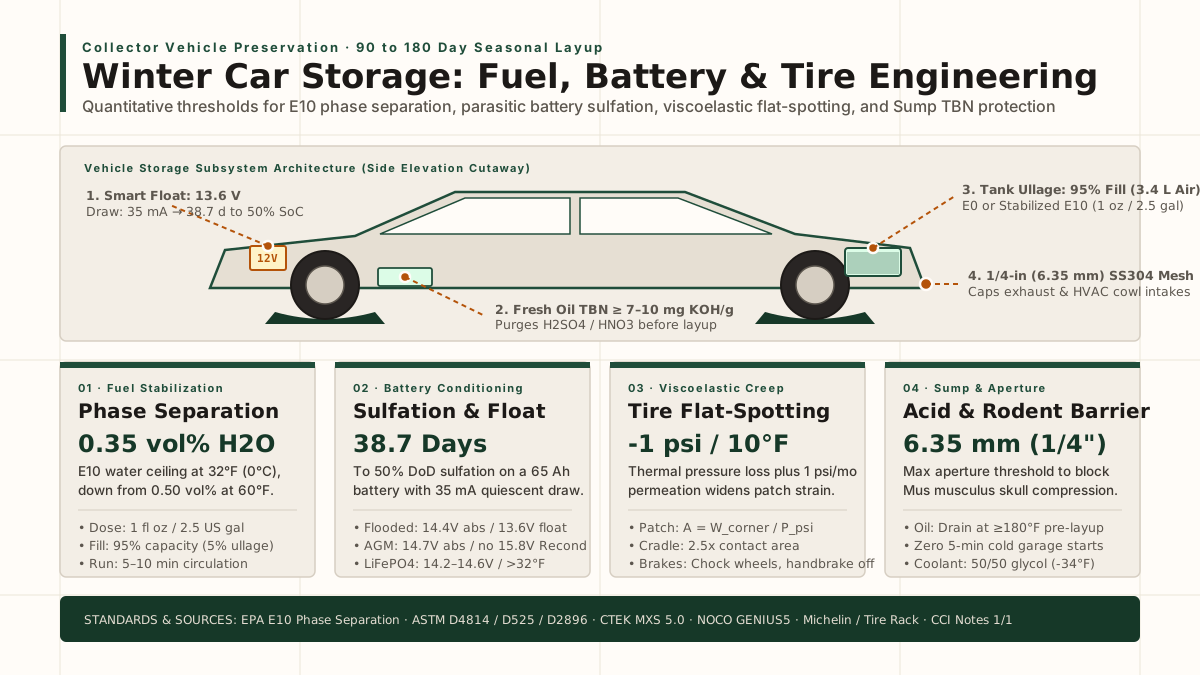
| Seasonal tank storage | Keep tank full with fresh stabilized fuel and circulate through the engine | In an 18-gallon (68 L) tank, a 95% fill reduces the moist breathing air volume from 51.0 liters (at 25% fill) to 3.4 liters, cutting diurnal tank-wall condensation by more than 93%. |
| Carbureted layup beyond mid-year | Keep main tank full with stabilized fuel and isolate and drain the carburetor bowl | If storage is expected to exceed 6 months, Mike’s Carburetor Parts states it is safest to drain the carb bowl using the drain plug or by running the engine with the fuel shutoff closed, because even stabilized fuel can evaporate in the small bowl, leaving varnish. |
| Multi-year carbureted layup | Drain both the fuel tank and the carburetor completely and fog cylinders | For long-term (>1 Year) storage when the vehicle will not be driven for a year or more, Mike’s Carburetor Parts recommends draining the fuel tank and carb completely and fogging the engine cylinders with fogging oil to prevent corrosion. |
| Untreated small engine fuel | Drain untreated gasoline into an approved container and run until fuel starvation | If gasoline in the small engine has not been treated with a fuel stabilizer, Briggs & Stratton states that it must be drained into an approved container and the engine run until it stops from lack of fuel. |
| Prolonged fuel volatility limit | Replace fuel rather than relying on additives for ignitability past one year | Any gasoline stored for more than 12 months will tend to lose volatility (ignitability), and no additive, STA-BIL brand included, will prevent volatility loss in fuel. |
Worked Tank Headspace Ullage & Condensation Physics
Because the solubility of water in both gasoline and air decreases with a decrease in temperature, water can enter a fuel system through condensation when atmospheric temperature changes. When storing gasoline for a long period of time is unavoidable, the tank should be full to prevent condensation of water from the air and the addition of a fuel stabilizer should be considered.
- Quarter-full tank headspace volume: In an 18-gallon (68.1 L) fuel tank at 25% fill (4.5 US gal / 17.0 L fuel), the tank contains 51.1 liters (13.5 US gal) of breathing headspace air across 75% of the exposed upper steel tank walls.
- Near-full tank thermal expansion ullage: In an 18-gallon fuel tank at 95% fill (17.1 US gal / 64.7 L fuel), the tank leaves 3.4 liters (0.9 US gal, or 5% ullage) for thermal expansion, which cuts the moisture-bearing air volume by 93.3%.
- Storage room relative humidity bands: Above 65 percent relative humidity corrosion speeds up, a moderate band of 40 to 55 percent relative humidity is described for composite collections, and dry environments of 30 percent relative humidity or lower are described as ideal for metals.
Isolating and Draining the Carburetor Float Bowl
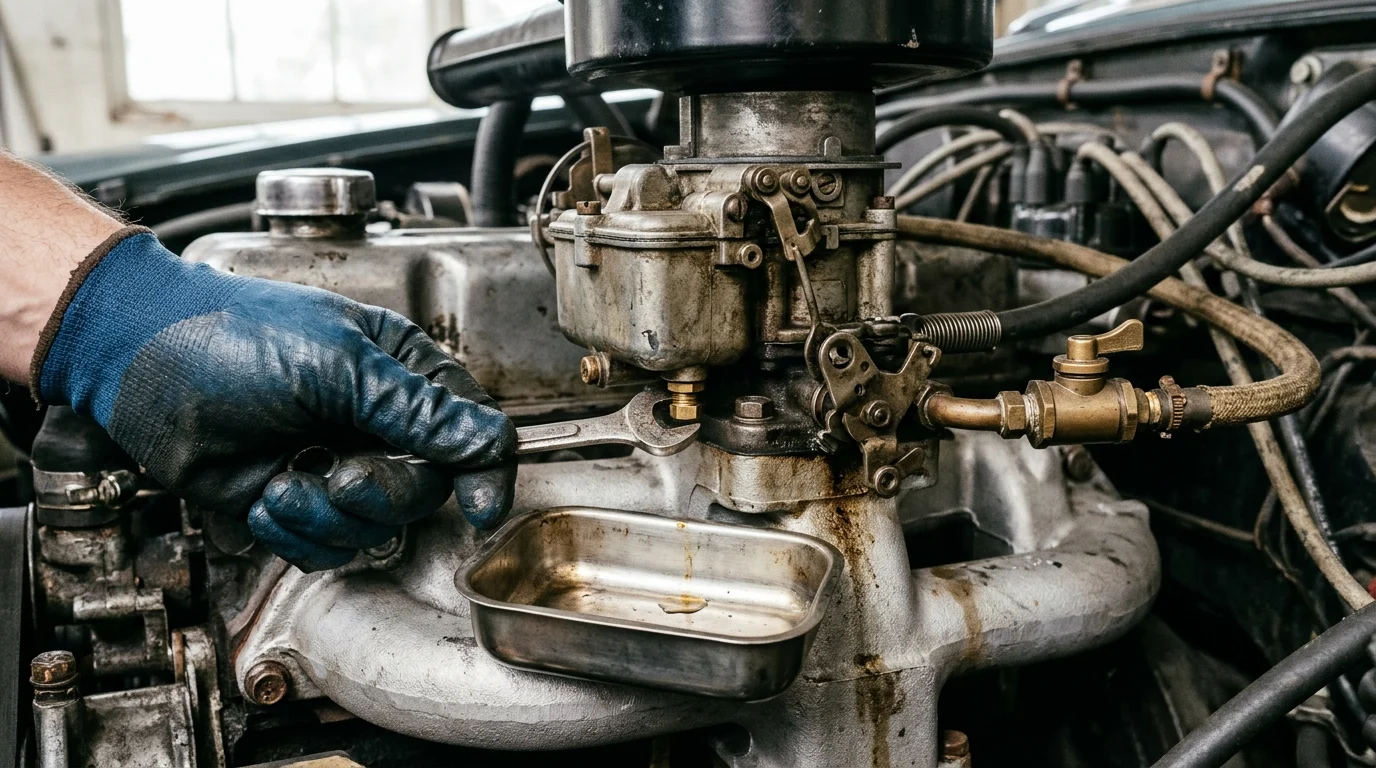
After adding stabilizer, Mike’s Carburetor Parts advises running the engine for 5–10 minutes so the treated fuel reaches the carburetor bowl(s), fuel pump, and fuel lines. If storage is expected to exceed 6 months, Mike’s Carburetor Parts states it is safest to drain the carb bowl using the drain plug or by running the engine with the fuel shutoff closed, because even stabilized fuel can evaporate in the small bowl, leaving varnish. For long-term (>1 Year) storage when the vehicle will not be driven for a year or more, Mike’s Carburetor Parts recommends draining the fuel tank and carb completely and fogging the engine cylinders with fogging oil to prevent corrosion. If gasoline in the small engine has not been treated with a fuel stabilizer, Briggs & Stratton states that it must be drained into an approved container and the engine run until it stops from lack of fuel.
Fuel Stabilizer Dose Timing, Circulation & Manufacturer Specifications
For both oxygenated and conventional gasolines, gumming can occur during long storage and is detrimental to any engine. Clean and fresh fuel can begin to deteriorate in as little as 30 days.
ASTM Oxidation Stability, Gum Formation & Seasonal Volatility Standards
Standard laboratory methods track how motor gasoline oxidizes, forms induction-system gum, and shifts volatility across seasonal blends:
- Accelerated oxidation induction period: Under ASTM D525-12a, the induction period may be used as an indication of the tendency of motor gasoline to form gum in storage, covering the stability of gasoline in finished form only under accelerated oxidation conditions.
- Potential gum test reference: Under ASTM D525-12a, for measurement of oxidation stability of gasoline by measurement of potential gum, refer to Test Method D873 or IP Test Method 138.
- Jet evaporation gum effects: Under ASTM D381-22 Standard Test Method for Gum Content in Fuels by Jet Evaporation, it has been proved that high gum can cause induction-system deposits and sticking of intake valves.
- High-ethanol gum limits: Under ASTM D5798-11 for E85, maximum unwashed gum (mg/100 mL) is 20 and maximum solvent-washed gum (mg/100 mL) is 5.
- Seasonal volatility and water tolerance: ASTM D4814-24a provides for variation of the volatility and water tolerance of automotive fuel in accordance with seasonal climatic changes, with maximum vapor pressure limits specified for May 1 through September 15.
- Oxygenate mass and volume determination: Test Method D4815 provides a procedure for determining oxygenate concentration in mass percent and includes procedures for calculating mass oxygen content and oxygenate concentration in volume percent.
- Winter versus summer vapor pressure: The main difference between winter- and summer-grade gasoline is vapor pressure: during winter months vapor pressure must be high enough for the engine to start easily, while summer gasoline has lower vapor pressure.
Dose Timing at Fresh Fill & Why Stabilizer Cannot Restore Old Fuel
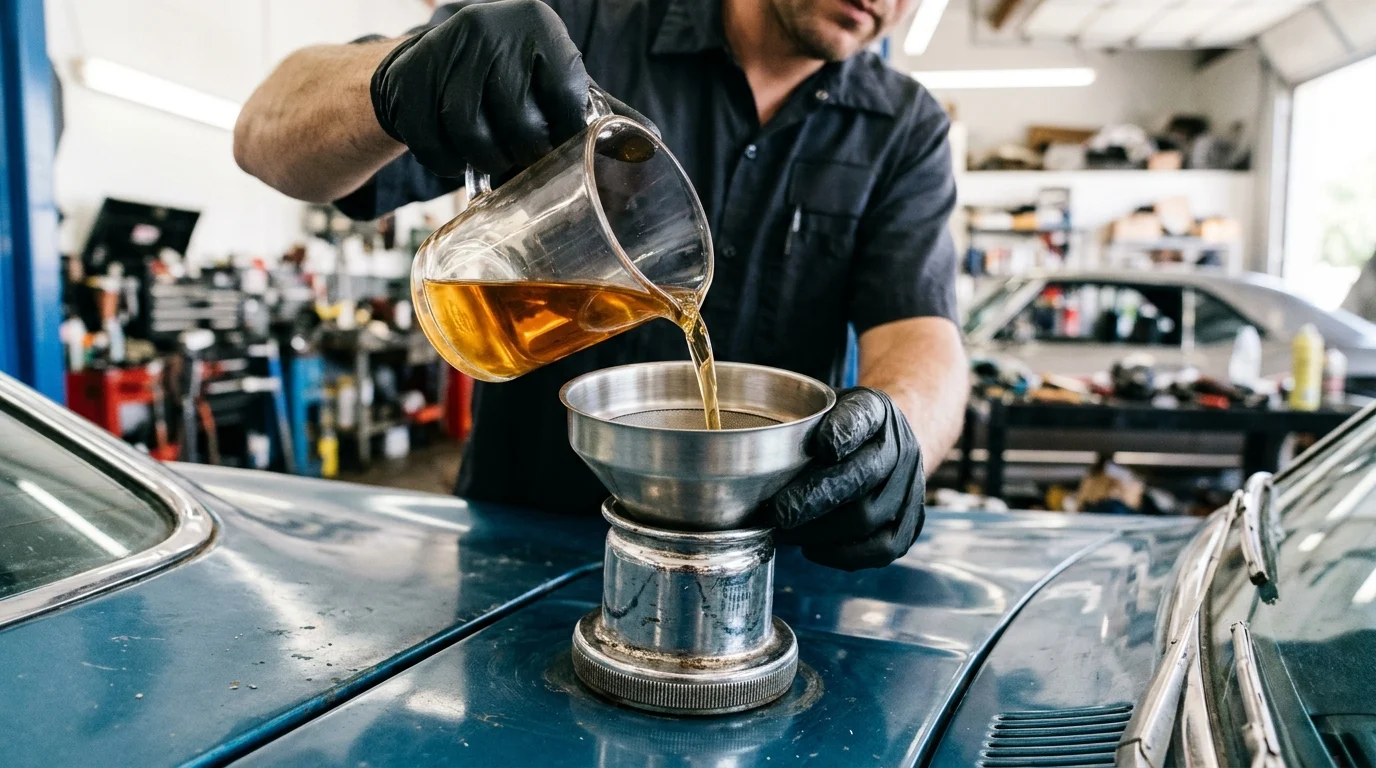
Adding a fuel stabilizer requires fresh gasoline and active engine circulation rather than pouring additive into stale fuel months after layup begins:
- Stale fuel limitation: For gas in a tank that has been there more than 2 months, STA-BIL Fuel Stabilizer will not restore or improve old gasoline; it will, however, stop it from degrading further.
- Twelve-month volatility boundary: Any gasoline stored for more than 12 months will tend to lose volatility (ignitability), and no additive, STA-BIL brand included, will prevent volatility loss in fuel.
- Small engine dosing and circulation: Briggs & Stratton instructs adding a fuel stabilizer to your gas can before filling it with clean, fresh fuel to stabilize fuel for long-term storage up to 24 months, and running the engine for 2 minutes to circulate stabilizer through the fuel system.
- Vehicle tank fill and circulation: STA-BIL directions state to use STA-BIL only with fresh fuel, keep the gas can or tank 95% full to avoid condensation build-up in the tank during storage, and run the engine for 5 minutes after adding the product.
- Carbureted vehicle circulation: After adding stabilizer, Mike’s Carburetor Parts advises running the engine for 5–10 minutes so the treated fuel reaches the carburetor bowl(s), fuel pump, and fuel lines.
Published Manufacturer Dosing & Shelf-Life Specifications
Each additive manufacturer specifies distinct treatment ratios, blend compatibility, and bottle storage limits in its product documentation:
| Product Name | Manufacturer Specification & Dosing Ratio |
|---|---|
| STA-BIL Storage Fuel Stabilizer | For vehicles or equipment you plan to store for 30-days or longer, STA-BIL Storage Fuel Stabilizer keeps the fuel fresh for up to 24 months in blends up to E-85, and 1-ounce (30-milliliter) treats up to 2½ gallons (9.5-liters) of fuel. |
| STA-BIL 360° Protection & Marine | For STA-BIL 360° Protection use one ounce (30mL) to 5 gallons (19 L), and for STA-BIL 360° Marine use one ounce (30mL) to 10 gallons (38 L) of gasoline, gas/oil mixtures, or ethanol blends. |
| STA-BIL In-Season Protection | STA-BIL In-Season Protection offers protection by using a PEA fuel system cleaner, industry-leading corrosion inhibitors, and water removers, and will stabilize the fuel for up to 12 months. |
| STA-BIL Opened Bottle Shelf Life | The shelf life of all STA-BIL brand products is 2 years after the bottle has been opened, provided it has been tightly capped and stored in a cool, dry place. |
| STA-BIL Over-Dosage Ceiling | Over-dosage of STA-BIL is OK, but Gold Eagle does not recommend adding more than 4 times the recommended amount and recommends diluting the fuel if more than 4 times has been added. |
| Lucas Safeguard Ethanol Fuel Conditioner | Lucas Safeguard Ethanol Fuel Conditioner applies to E-10, E-15, and E-85, is not recommended for diesel applications, and is dosed by adding one (1) ounce for every five (5) gallons of fuel (30 mL treats 18.9 L of fuel). |
| Sea Foam Motor Treatment | Sea Foam Motor Treatment is made with 100% petroleum cleaning and lubricating ingredients, and to stabilize fuel for storage you add 1 ounce per gallon of fuel. |
Ethanol Fuel Phase Separation & Vintage Fuel System Material Compatibility
Understanding ethanol fuel phase separation starts with the physical and chemical differences between alcohol oxygenates, ethers, and hydrocarbon gasoline.
Water Solubility Limits in Ethanol-Blended, MTBE, and Conventional Gasoline
Ethanol will readily dissolve water and is considered infinitely soluble in water. Ethanol is extremely hygroscopic (attracts water), and at higher water concentrations in E85 the gasoline portion separates from the ethanol/water mixture. MTBE has little affinity for water and can only be dissolved in water to a content of 4.3 volume percent at room temperature.
- E10 water capacity by volume: At 60 degrees F, water can be absorbed by a blend of 90% gasoline and 10% ethanol up to a content of 0.5 volume percent before it will phase separate.
- E10 water capacity per gallon: Approximately 3.8 teaspoons of water can be dissolved per gallon of the 90% gasoline and 10% ethanol fuel at 60 degrees F before the water will begin to phase separate.
- MTBE blend water capacity: A blend of 85% gasoline and 15% MTBE can hold only 0.5 teaspoons of water per gallon at 60 degrees F before the water will phase separate.
- Conventional gasoline water capacity: One gallon of 100% gasoline can dissolve only 0.15 teaspoons of water at 60 degrees F.
- Dissolved water fuel economy effect: Assuming a high dissolved water concentration of 0.5 volume percent in solution with gasoline, fuel economy decreases by 0.5 percent.
- Freezing garage saturation drop: At 32°F (0°C) freezing garage temperature, the E10 water saturation ceiling drops to approximately 0.35 vol% (3.5 mL/L, or 238 mL in an 18-gallon tank).
- Mid-winter cold snap saturation drop: At 10°F (-12°C) unheated mid-winter cold snap temperature, the saturation ceiling falls to 0.30 vol% (3.0 mL/L, or 204 mL in an 18-gallon tank).
Physical & Combustion Properties of Ethanol, Gasoline, and High-Ethanol Blends
| Fuel Property | Published Specification Across Ethanol, Gasoline & High-Ethanol Blends |
|---|---|
| Chemical composition | Ethanol has a chemical formula of C2H5OH, while gasoline consists of C4 to C12 hydrocarbons. |
| Anti-knock octane rating | Octane (R+M)/2 rating is 113 for pure ethanol, 86-94 for gasoline, and 95–97 for E85. |
| Retail pump octane grades | U.S. retail gasoline grades by octane rating are Regular (generally 87), Midgrade (generally 89–90), and Premium (generally 91–94). |
| Energy density per gallon | Lower heating value is 76,300 Btu per gallon for ethanol, 116,900 Btu per gallon for gasoline, and 83,600–95,450 Btu per gallon for E85. |
| E10 fuel economy difference | Because ethanol has about 67% of the energy content of gasoline per gallon, vehicle fuel economy may decrease by about 3% when using E10. |
| Reid Vapor Pressure | Reid Vapor Pressure is 2.3 psi for pure ethanol, 7–16 psi for gasoline, and 7–12 psi for E85. |
| Specific gravity | Specific gravity at 60°/65°F is 0.794 for ethanol, 0.72–0.78 for gasoline, and 0.78 for E85. |
| Stoichiometric air-fuel ratio | Air-fuel ratio by weight is 9 for ethanol, 14.7 for gasoline, and 10 for E85. |
Two-Layer Phase Separation Damage & Engine Effects
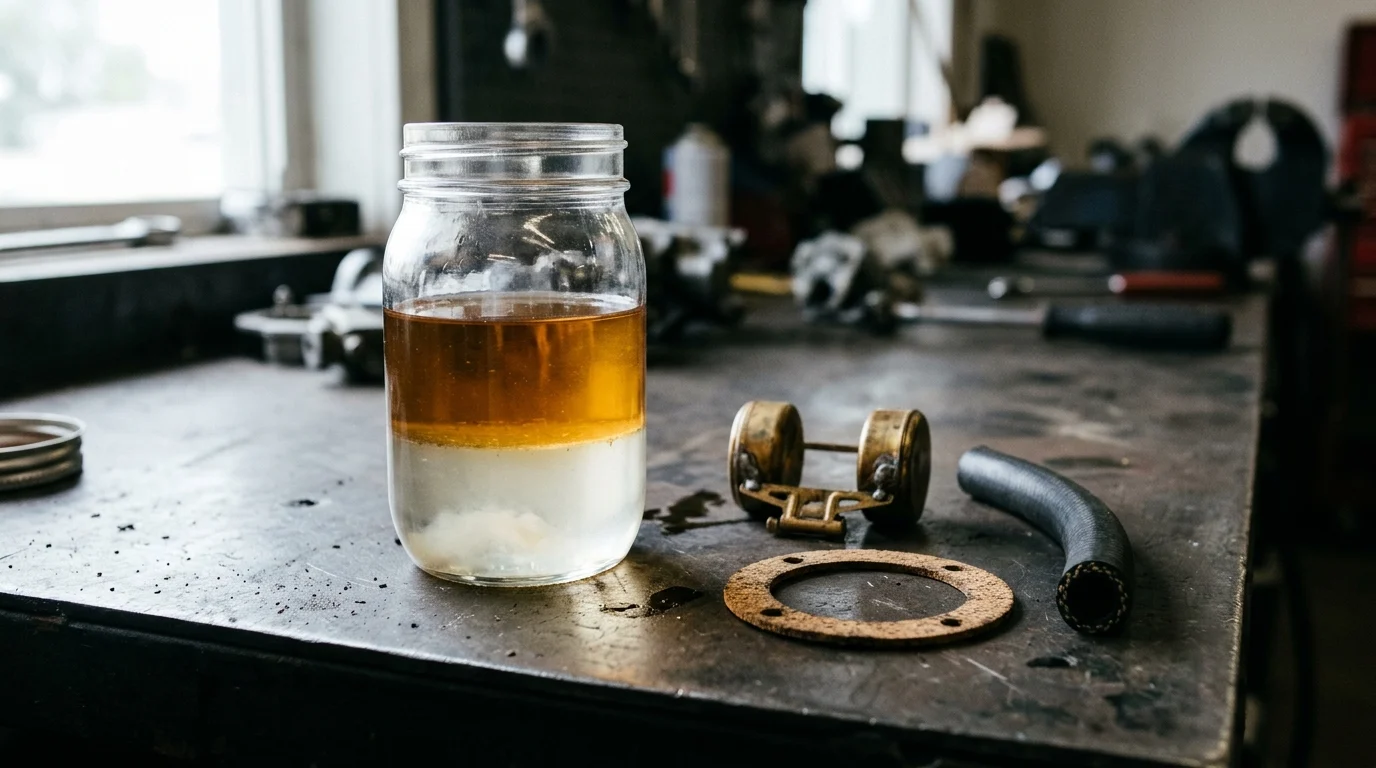
Water is more dense than gasoline and therefore sinks to the bottom of a storage tank. When a separate water phase forms in conventional and MTBE-blended gasolines, it drops to the bottom of the fuel tank and can be drawn into the engine by the fuel pump. When phase separation occurs in an ethanol-blended gasoline, the water begins to remove the ethanol from the gasoline, forming a second phase that contains both ethanol and water.
- Pure ethanol octane rating: Pure ethanol has an (R+M)/2 octane rating of approximately 113.
- Two-stroke lubrication loss: In two-stroke engines, the separated water-ethanol phase competes with blended oil for bonding to metal engine parts, leaving the engine without enough lubrication.
- Four-stroke lean combustion damage: In four-stroke engines, combustion of the separated water-ethanol phase creates a leaner combustion mixture that combusts at higher temperatures and can damage engines without air-to-fuel ratio sensors.
Ethanol Blend Classifications & Vintage Material Compatibility
Federal blend definitions and materials guidance establish which ethanol concentrations and fuel-system components are compatible:
- E10 approval: E10 is a low-level blend composed of 10% ethanol and 90% gasoline and is approved by the U.S. Environmental Protection Agency (EPA) for use in any conventional, gasoline-powered vehicle.
- E15 definition and model-year approval: EPA defines E15 as gasoline blended with 10.5% to 15% ethanol and approved E15 in 2011 for use in model year 2001 and newer conventional vehicles.
- E15 prohibited vehicles and engines: Vehicles and engines prohibited from using E15 include all motorcycles, all vehicles with heavy-duty engines, and all off-road vehicles such as boats and snowmobiles.
- E85 composition: E85 (or flex fuel) is an ethanol-gasoline blend containing 51% to 83% ethanol, depending on geography and season.
- Small engine octane and ethanol limits: Briggs & Stratton specifies a minimum of 87 octane / 87 Anti-Knock Index (AKI) / 91 Research Octane Number (RON), accepts gasoline with up to 10% ethanol (gasohol) or up to 15% MTBE, and states not to use unapproved gasoline such as E15 and E85.
- Metals sensitive to E85: Zinc, brass, lead, and aluminum have shown sensitivity to degradation with E85, and terne-plated steel (lead-tin alloy coating commonly used for vehicle fuel tanks) and lead-based solder are incompatible with E85.
- Aqueous-phase corrosion threshold: Blends below E25 do not cause corrosion of metals unless accompanied by a separate aqueous phase.
- Nonmetallic materials degraded by fuel ethanol: Nonmetallic materials that degrade when in contact with fuel ethanol include natural rubber, polyurethane, cork gasket material, leather, polyvinyl chloride, and nylon 6/6.
Fuel Ethanol Content, Layup Duration & Carburetor Float-Bowl Draining Checklist
Record each pre-storage fuel action in the vehicle file alongside your classic car total cost worksheet and provenance and documentation records. Any intervention to compensate for loss should be documented in treatment records and reports, should be detectable by common examination methods, and should be reversible.
- Verify fuel freshness and blend grade before dosing: Clean and fresh fuel can begin to deteriorate in as little as 30 days. For gas in a tank that has been there more than 2 months, STA-BIL Fuel Stabilizer will not restore or improve old gasoline; it will, however, stop it from degrading further.
- Match seasonal vapor pressure and octane grade: U.S. retail gasoline grades by octane rating are Regular (generally 87), Midgrade (generally 89–90), and Premium (generally 91–94). The main difference between winter- and summer-grade gasoline is vapor pressure: during winter months vapor pressure must be high enough for the engine to start easily, while summer gasoline has lower vapor pressure.
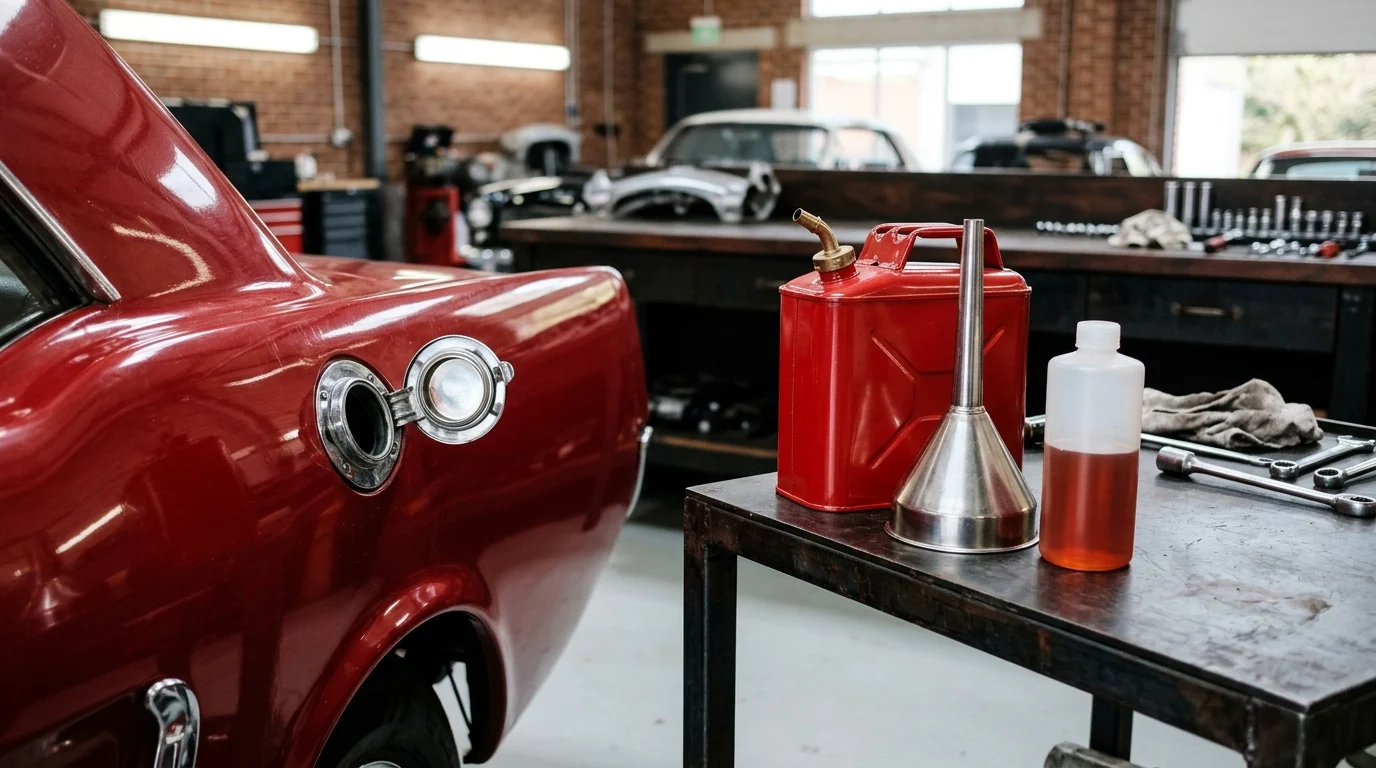
- Fill the tank to 95% capacity and circulate stabilized fuel: STA-BIL directions state to use STA-BIL only with fresh fuel, keep the gas can or tank 95% full to avoid condensation build-up in the tank during storage, and run the engine for 5 minutes after adding the product. After adding stabilizer, Mike’s Carburetor Parts advises running the engine for 5–10 minutes so the treated fuel reaches the carburetor bowl(s), fuel pump, and fuel lines.
- Isolate and drain the carburetor float bowl when layup exceeds 6 months: If storage is expected to exceed 6 months, Mike’s Carburetor Parts states it is safest to drain the carb bowl using the drain plug or by running the engine with the fuel shutoff closed, because even stabilized fuel can evaporate in the small bowl, leaving varnish.
- Drain tank and carburetor completely for storage exceeding 1 year: For long-term (>1 Year) storage when the vehicle will not be driven for a year or more, Mike’s Carburetor Parts recommends draining the fuel tank and carb completely and fogging the engine cylinders with fogging oil to prevent corrosion. Any gasoline stored for more than 12 months will tend to lose volatility (ignitability), and no additive, STA-BIL brand included, will prevent volatility loss in fuel.
- Monitor storage room relative humidity and temperature: Above 65 percent relative humidity corrosion speeds up, a moderate band of 40 to 55 percent relative humidity is described for composite collections, and dry environments of 30 percent relative humidity or lower are described as ideal for metals.
Sources
- U.S. Environmental Protection Agency — Water Phase Separation in Oxygenated Gasoline
- U.S. Department of Energy / National Renewable Energy Laboratory — Handbook for Handling, Storing, and Dispensing Ethanol-Gasoline Blends
- U.S. Department of Energy Alternative Fuels Data Center — Ethanol Blends
- U.S. Energy Information Administration — Biofuels Explained: Use of Ethanol
- U.S. Energy Information Administration — Gasoline Explained and Octane in Depth
- ASTM International — Standard Specification for Automotive Spark-Ignition Engine Fuel
- ASTM International — Standard Test Method for Oxidation Stability of Gasoline (Induction Period Method)
- ASTM International — Standard Test Method for Gum Content in Fuels by Jet Evaporation
- Briggs & Stratton — Engine Fuel Recommendations and Storage FAQ
- Gold Eagle Co. — STA-BIL Storage Fuel Stabilizer and STA-BIL In-Season Protection Product Specifications and Directions
- Lucas Oil Products — Safeguard Ethanol Fuel Conditioner with Stabilizers Product Specifications
- Sea Foam Sales Company — Sea Foam Motor Treatment Oil and Fuel Additive Product Specifications
- Mike’s Carburetor Parts — Storing Your Vehicle or Boat (Carburetor and Fuel Tank Storage Guide)
- IGA Funds — Winter Car Storage, Storage Facility Checklist, and Restoration vs Preservation Notes