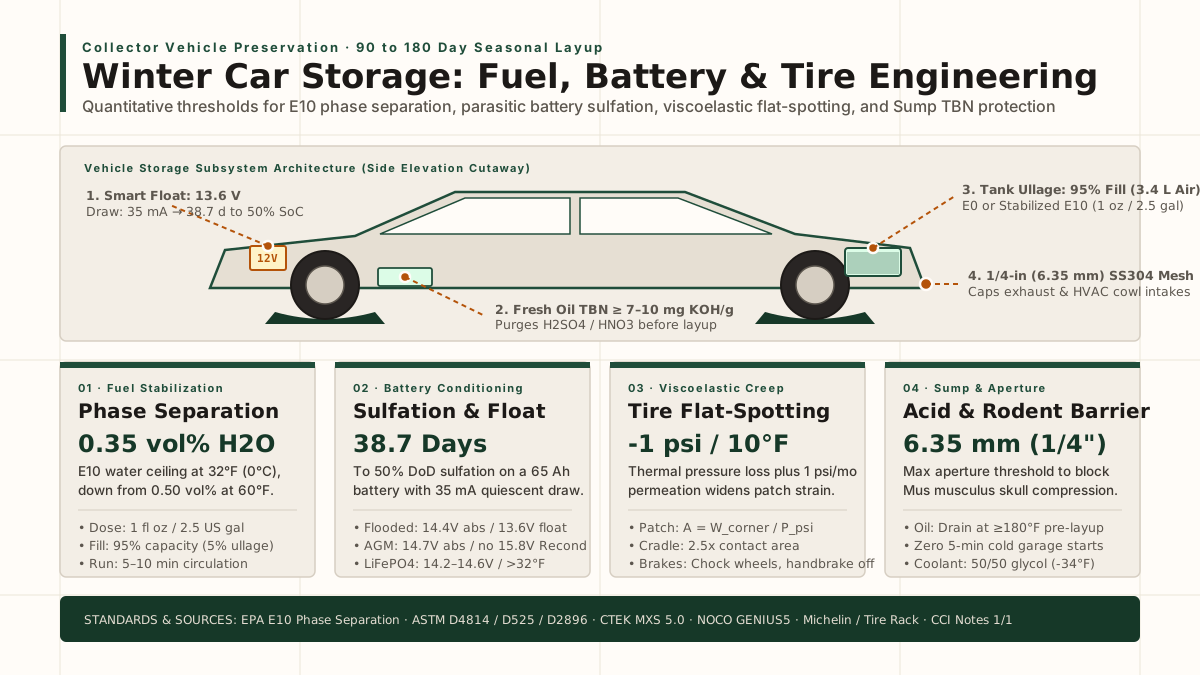
Unprepared winter car storage causes costly mechanical damage and component failure across four subsystems while a vehicle sits stationary for 90 to 180 days: thermal phase separation in ethanol-blended gasoline, irreversible lead-sulfate crystallization from quiescent battery drains, viscoelastic flat-spotting in radial tire carcasses, and acidic blow-by corrosion inside engine bearings. Stabilizing these vehicle subsystems before seasonal layup complements the room-level environmental inspections in our storage facility checklist and supports the material-stabilization discipline detailed in our restoration versus preservation guide.
When ambient garage temperatures fall from autumn levels (60°F / 15°C) toward freezing (32°F / 0°C), physical thresholds shift simultaneously across the vehicle. Water dissolved in E10 fuel precipitates out of solution once saturation drops to 0.35 vol%; a 35 mA clock and ECU draw depletes a 65 Ah battery to its 50% sulfation limit in 38.7 days; and a 40°F temperature drop combined with four months of liner permeation cuts tire pressure by 8 psi, expanding static contact-patch deflection by more than 33%. Every consumables invoice, maintainer purchase, and seasonal inspection reading belongs in the ownership costs records alongside your provenance and service documentation.
90-to-180 Day Winter Car Storage Subsystem Specification Table
The engineering reference table below consolidates the target operating parameters, quantitative failure thresholds, and hardware protocols for seasonal vehicle storage prep across all five vehicle subsystems.
| Subsystem | Primary Winter Degradation Mechanism | Critical Numerical Threshold | Preservation Protocol & Hardware Specification |
|---|---|---|---|
| Fuel System & Tank Ullage | Hygroscopic E10 water absorption, thermal phase separation, and olefin gum oxidation (ASTM D525) | E10 water ceiling drops from 0.50 vol% at 60°F (15°C) to 0.35 vol% at 32°F (0°C) and 0.30 vol% at 10°F (-12°C) |
Fill tank to 95% capacity (3.4 L ullage in an 18-gal tank) with E0 or fresh E10 dosed with STA-BIL Storage (1 fl oz / 2.5 US gal); run engine 5–10 min to circulate through rails and bowls |
| Battery & Charging Profile | Parasitic draw depletion, irreversible lead-sulfate (PbSO4) crystallization, and dilute electrolyte freezing |
50% DoD sulfation limit reached in 38.7 days at 35 mA draw on a 65 Ah battery (12.06 V OCV); discharged electrolyte freezes at +15°F to +19°F |
Connect chemistry-matched microprocessor maintainer: Flooded Lead-Acid (14.4 V abs / 13.6 V float), AGM (14.7 V abs / 13.6 V float, no 15.8 V Recond), LiFePO4 (14.2–14.6 V, charge only at >32°F) |
| Tires, Wheels & Brakes | Viscoelastic creep in nylon-6,6 cap plies, cold pressure loss, and hygroscopic brake pad rust-welding | ~1 psi per 10°F thermal drop plus 1–2 psi/month permeation widens front contact patch from 28.7 sq in (at 32 psi) to 38.3 sq in (at 24 psi) |
Inflate to high-load placard or +5 to +8 psi above base placard (never above sidewall Max Press); park on concave cradles (Race Ramps FlatStoppers); chock wheels and release parking brake |
| Crankcase Oil & Cooling | Sulfuric (H2SO4) and nitric (HNO3) blow-by acid etching of copper-lead/babbitt bearings as oil TBN depletes |
Fresh motor oil Total Base Number (ASTM D2896) of 7–10 mg KOH/g; oil drain temperature ≥180–212°F (82–100°C); glycol freeze point -34°F (-37°C) |
Warm-drain used oil and replace filter immediately before layup; circulate fresh oil with appropriate ZDDP for 5–10 min; avoid brief 5-minute winter garage idling; verify 50/50 coolant concentration |
| Rodent & Cabin Moisture Control | Mus musculus entry through exhaust/HVAC ducts and interior leather/carpet mildew or desiccation | House mice penetrate apertures down to 1/4 inch (6.35 mm); target cabin and bay humidity of 40%–55% RH (corrosion accelerates above 65% RH) |
Cap tailpipes, airbox snorkels, and cowl intakes with 1/4-inch Type 304/316 stainless hardware cloth (0.025–0.028 in wire) with red warning tags; place non-spillable silica gel packs in cabin |
Fuel System Stabilization & E10 Phase-Separation Physics
Modern pump gasoline blended with 10% anhydrous ethanol (E10 under ASTM D4814) behaves differently during winter storage than straight hydrocarbon gasoline (E0). Ethanol (C2H5OH) is a polar molecule with a strong hydroxyl (-OH) group that forms hydrogen bonds with water molecules absorbed from humid garage air through fuel tank vents.
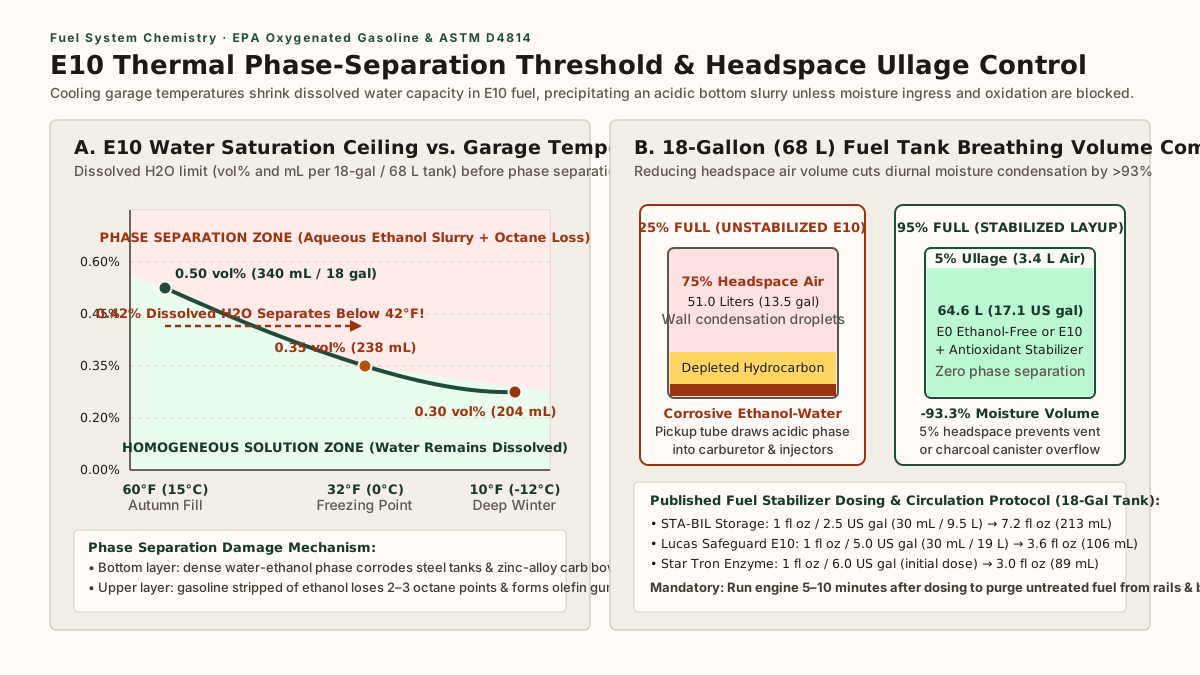
According to the U.S. Environmental Protection Agency (EPA) technical review on Water Phase Separation in Oxygenated Gasoline, E10 gasoline at 60°F (15.6°C) can hold approximately 0.50 volume percent water in a single homogeneous liquid phase—equivalent to 3.8 teaspoons (19 mL) of water per US gallon, or 340 mL across an 18-gallon (68.1 L) fuel tank. However, the solubility of water in an ethanol-gasoline blend is strongly temperature-dependent:
- At
60°F (15°C)(autumn layup temperature): E10 retains up to0.50 vol%(5.0 mL/L) dissolved water without separating. - At
32°F (0°C)(freezing garage temperature): The water saturation ceiling drops to approximately0.35 vol%(3.5 mL/L, or238 mLin an 18-gallon tank). - At
10°F (-12°C)(unheated mid-winter cold snap): The saturation ceiling falls to0.30 vol%(3.0 mL/L, or204 mLin an 18-gallon tank).
If an 18-gallon tank of E10 absorbs 0.42 vol% moisture (286 mL total water) during humid autumn weeks, the fuel looks crystal-clear at 60°F. Once the garage cools below 40°F to 32°F in December, the saturation ceiling drops below 0.35 vol%, forcing thermal phase separation even if zero additional moisture enters the tank during winter.
Two-Layer Damage After Phase Separation
Once water concentration exceeds the thermal saturation threshold, gravity separates the tank contents into two destructive layers:
- Corrosive bottom aqueous-ethanol slurry: Because water and ethanol have higher density than liquid hydrocarbons, the water strips ethanol out of the gasoline and sinks to the bottom of the tank around the fuel pickup sock. Partial oxidation of ethanol yields weak organic acids (formic and acetic acid), while dissolved chlorides and water trigger galvanic corrosion. In bare steel tanks, rust scale forms on the sump floor; in carbureted classics (Weber, SU, Solex, Zenith, Holley) and mechanical fuel-injection systems (Bosch K-Jetronic, Kugelfischer, Spica), the aqueous slurry pits zinc-aluminum die-cast float bowls, precipitating white powdery zinc hydroxide and carbonate crusts that plug idle jets and seize metering plungers.
- Octane-depleted upper hydrocarbon layer: Pure ethanol has a blending octane rating of approximately
113 RON(99–100 AKI). When ethanol is pulled into the bottom water layer, the remaining upper gasoline layer loses2 to 3 octane numbersand is left with reactive olefins that oxidize via free-radical chain reactions (measured by the ASTM D525 oxidation stability induction period), depositing sticky hydroperoxide varnish on injector pintles and intake valve stems.
Worked Headspace Ullage Math & Stabilizer Dosing Protocol
Leaving a fuel tank quarter-full over winter maximizes diurnal condensation. As garage air warms and cools across day-night cycles, the air volume above the liquid fuel expands and contracts, drawing moist ambient air through the tank vent or evaporative canister (a relationship governed by the room moisture loads analyzed in our climate-controlled car storage humidity specifications).
For a classic grand tourer or sports sedan with an 18-gallon (68.1 L) fuel tank:
- At 25% fill (
4.5 US gal / 17.0 Lfuel): The tank contains51.1 liters(13.5 US gal) of breathing headspace air. Every thermal cycle condenses moisture droplets across75%of the exposed upper steel tank walls. - At 95% fill (
17.1 US gal / 64.7 Lfuel): The tank leaves3.4 liters(0.9 US gal, or5%ullage) for thermal expansion. This cuts the moisture-bearing air volume by93.3%while submerging the internal tank surfaces and preventing liquid fuel from overflowing into the charcoal canister if garage temperatures rise by20°Fto30°F.
Before filling the tank to 95% at the station, pour the measured dose of antioxidant and metal-deactivator stabilizer into the tank so the incoming fuel stream mixes the chemistry thoroughly:
- STA-BIL Storage Fuel Stabilizer (
Gold Eagle Co.): Standard dosing is1 fl oz (30 mL)per2.5 US gallons (9.5 L)of fresh fuel (rated for up to 24 months). An 18-gallon tank filled to17.1 gallonsrequires6.8 to 7.2 fl oz(201 to 213 mL). - Lucas Safeguard Ethanol Fuel Conditioner: Standard dosing is
1 fl oz (30 mL)per5.0 US gallons (19 L), requiring3.4 to 3.6 fl oz(101 to 106 mL) for an 18-gallon tank. - Star Tron Enzyme Fuel Treatment: Initial storage dose is
1 fl oz (30 mL)per6.0 US gallons (22.7 L), requiring2.9 to 3.0 fl oz(86 to 89 mL).
Where available, fill carbureted and mechanical-injection vehicles with ethanol-free E0 recreational or collector fuel on the final tank before winter, still adding the antioxidant stabilizer dose to prevent olefin gum formation. Always run the engine for 5 to 10 minutes after dosing (or dose at the pump before driving the final 3 to 5 miles home) so treated fuel completely displaces unstabilized gasoline inside mechanical or electric pumps, fuel filters, pressure accumulators, injector rails, and carburetor float bowls.
Battery Chemistry, Parasitic Draw Depletion & Smart Maintainer Profiles
A starter battery left unmaintained in a stored vehicle loses charge through two parallel pathways: external quiescent parasitic draw (I_draw) from vehicle electronics and internal electrochemical self-discharge across the plates.
In all lead-acid chemistries (flooded wet-cell, Enhanced Flooded Battery, and Absorbed Glass Mat), normal discharge converts lead dioxide (PbO2) at the positive plate and sponge lead (Pb) at the negative plate into amorphous lead sulfate (PbSO4) while consuming sulfuric acid (H2SO4) from the electrolyte. When the battery’s State of Charge (SoC) drops below 50% Depth of Discharge (DoD)—corresponding to an open-circuit resting voltage near 12.06 V (flooded) or 12.20 V (AGM)—that soft amorphous deposit recrystallizes into hard, non-conductive lead-sulfate crystals. Hard sulfation permanently insulates active plate surface area, slashes Cold Cranking Amps (CCA), and prevents the battery from accepting a normal bulk charge in spring.
Worked Parasitic Draw Depletion Math (t_days)
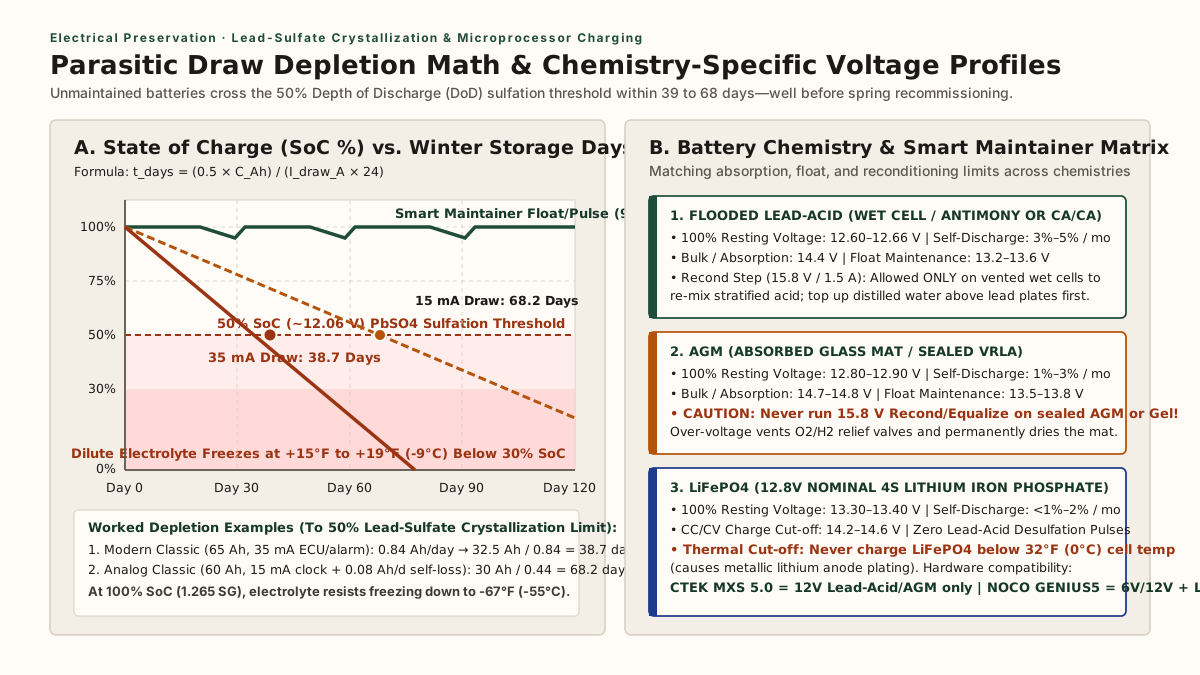
The number of winter storage days (t_days) before a fully charged battery crosses the 50% sulfation threshold under a continuous quiescent draw (I_draw in amperes) is governed by:
t_days = (0.5 × C_Ah) / (I_draw × 24)
Consider two common collector car electrical profiles over a 120-to-180-day winter layup:
- 1990s–2010s Modern Classic (
C_Ah = 65 Ah,I_draw = 35 mA = 0.035 A): immobilized alarm modules, keyless entry receivers, ECU keep-alive memory, and digital instrument clusters commonly draw30 to 45 mAcontinuously. At0.035 A, daily capacity loss is0.035 A × 24 h = 0.84 Ah/day. The usable 50% reserve (32.5 Ah) is exhausted in:t_days = 32.5 Ah / 0.84 Ah/day = 38.7 daysIn less than six weeks—barely one-third through a four-month winter—the battery enters irreversible hard sulfation. By Day 77.4, theoretical capacity reaches0%, and the diluted electrolyte (specific gravity~1.100–1.120vs.1.265at full charge) can freeze solid at+15°F to +19°F (-9°C to -7°C), cracking the polypropylene battery case. By contrast, a fully charged lead-acid battery (1.265specific gravity) resists freezing down to-67°F (-55°C). - 1960s–1970s Analog Classic (
C_Ah = 60 Ah,I_draw = 15 mA = 0.015 A+4%/monthself-discharge): An older classic with only an electromechanical or quartz dashboard clock draws0.015 A × 24 h = 0.36 Ah/day, while antimony-grid internal self-discharge adds~0.08 Ah/day(2.4 Ah/month), totaling0.44 Ah/day. Time to reach the30.0 Ah(50% SoC) sulfation threshold is:t_days = 30.0 Ah / 0.44 Ah/day = 68.2 daysEven in an analog collector car, the battery crosses the sulfation threshold slightly past two months.
Multi-Chemistry Voltage Matrix & Smart Maintainer Selection
Replacing an unregulated constant-current trickle charger with a microprocessor-controlled smart maintainer prevents both sulfation and electrolyte boil-off. However, the maintainer’s voltage profile must match the exact battery chemistry installed in the vehicle:
- Flooded Lead-Acid (Wet Cell / Antimony or Calcium-Calcium):
- 100% SoC Resting Voltage:
12.60 V to 12.66 V(3%–5%monthly self-discharge at20°C). - Bulk / Absorption Stage:
14.4 Vtapering current. - Float / Pulse Maintenance:
13.2 V to 13.6 Vfloat, followed by pulse monitoring (12.9 V to 14.4 V). - Reconditioning (
15.8 V / 1.5 A): Permitted only on vented wet-cell batteries to equalize acid stratification; inspect and top up cell plates with distilled water before initiating.
- 100% SoC Resting Voltage:
- AGM (Absorbed Glass Mat, Sealed VRLA):
- 100% SoC Resting Voltage:
12.80 V to 12.90 V(1%–3%monthly self-discharge). - Bulk / Absorption Stage:
14.7 V to 14.8 V(select the dedicatedAGMmode). - Float Maintenance:
13.5 V to 13.8 V. - Critical Precaution: Never activate a
15.8 VRecond or equalization step on a sealed AGM or Gel battery. Excess voltage drives water electrolysis faster than the internal recombinant catalyst can recombine oxygen and hydrogen, forcing gas out the one-way pressure relief valve and permanently drying the glass mat.
- 100% SoC Resting Voltage:
- LiFePO4 (Lithium Iron Phosphate,
12.8 Vnominal 4-cell series):- 100% SoC Resting Voltage:
13.30 V to 13.40 V(<1%–2%monthly self-discharge plus internal Battery Management System quiescent draw). - CC/CV Charge Cut-Off:
14.2 V to 14.6 Vconstant-current/constant-voltage profile with zero high-voltage desulfation pulses (which can trip or damage MOSFETs inside the internal BMS). - Low-Temperature Cut-Off: Never charge a LiFePO4 battery when internal cell temperature is below
32°F (0°C)unless the battery incorporates an internal self-heating circuit; sub-freezing charging causes metallic lithium plating on the graphite anode, permanently degrading capacity and creating internal short-circuit paths.
- 100% SoC Resting Voltage:
When budgeting for support hardware on your equipment life-cycle cost sheet or verifying what is included in a commercial facility contract under our monthly car storage cost comparison, compare the published specifications of two industry-standard 5-amp maintainers:
- CTEK MXS 5.0 (
5.0 A max,12VLead-Acid & AGM only): Uses an 8-step cycle for1.2–110 Ahcharging (up to160 Ahmaintenance): Step 1 Desulphation (15.8 Vpulses if sulfated) → Step 2 Soft Start → Step 3 Bulk (5.0 Ato80%) → Step 4 Absorption (14.4 VNormal /14.7 VAGM) → Step 5 Analyse → Step 6 Recond (optional15.8 V / 1.5 Afor flooded batteries) → Step 7 Float (13.6 Vfor 10 days) → Step 8 Pulse (12.9 V–14.4 Vtop-up when capacity drops to95%). Note that the MXS 5.0 does not include a6 Vmode or a12 VLithium (LiFePO4) mode. - NOCO GENIUS5 (
5.0 A max,6V & 12VWet, Gel, MF, CA, EFB, AGM, plus12V Lithium): Features a 9-step profile with an integrated thermal sensor that adjusts charge voltage in hot or cold garages (-4°F to 104°Foperating range), a dedicated12V Lithiummode for BMS-equipped LiFePO4 batteries, dead-battery detection down to1.0 V(plus manual Force Mode from0 V), and continuous maintenance optimization.
Tire Viscoelastic Creep, Pressure Loss & Concave Cradles
Radial tires fitted to performance and collector cars—especially H, V, W, Y, and ZR speed-rated tires—incorporate circumferential nylon-6,6 or aramid cap plies wound over the steel belt package to restrict centrifugal tread growth at high speed. Both the tread rubber compound and the nylon cap cords are viscoelastic polymers whose mechanical behavior combines elastic spring response with time- and temperature-dependent viscous flow.
As explained in the technical engineering guidance from Tire Rack and Michelin, when a warm tire is parked under static vertical corner load (W_corner), the tread flattens at the road contact patch while the surrounding sidewall and belt edges bend sharply. Over days and weeks at rest, viscoelastic creep allows the polymer chains in the nylon cords and rubber matrix to relax into that deformed geometry. As winter garage temperatures drop toward or below freezing, the compound stiffens toward its viscoelastic transition zone, locking the flattened contour into a semi-permanent or permanent flat spot that produces severe vertical steering-wheel vibration at 50 to 70 mph in spring.
Worked Contact-Patch Deflection & Cold Pressure Drop Math (A_patch)
To first order, the static macro contact-patch area (A_patch in square inches) supporting a corner vertical load (W_corner in pounds-force) at inflation pressure (P_inflation in psi) is:
A_patch ≈ W_corner / P_inflation
Consider a 3,400 lb (1,542 kg) front-engine collector sports coupe with a 54% / 46% front-to-rear weight distribution:
- Static front corner load (
W_corner):(3,400 lbf × 0.54) / 2 = 918 lbfper front tire (782 lbfper rear tire). - Warm autumn baseline at
70°Fand32 psiplacard pressure:A_patch = 918 lbf / 32 psi = 28.7 sq in(185 cm²) per front tire. - Uncompensated winter drop to
30°Fover 4 months: By the ideal gas law (P1 / T1 = P2 / T2on the absolute Rankine scale), enclosed tire gauge pressure drops approximately1 psifor every10°F(5.6°C) drop in ambient temperature. Cooling from70°Fto30°F(-40°Fdelta) removes4.0 psi. Simultaneously, halobutyl innerliner permeation bleeds approximately1.0 psi per month(4.0 psiover four winter months), dropping actual cold inflation pressure from32 psito24 psi:A_patch (at 24 psi) = 918 lbf / 24 psi = 38.3 sq in(247 cm²) That8 psiloss expands the flattened footprint area by+33.4%(+9.6 sq in), increasing sidewall deflection and concentrating high bending strain at the steel belt shoulders.
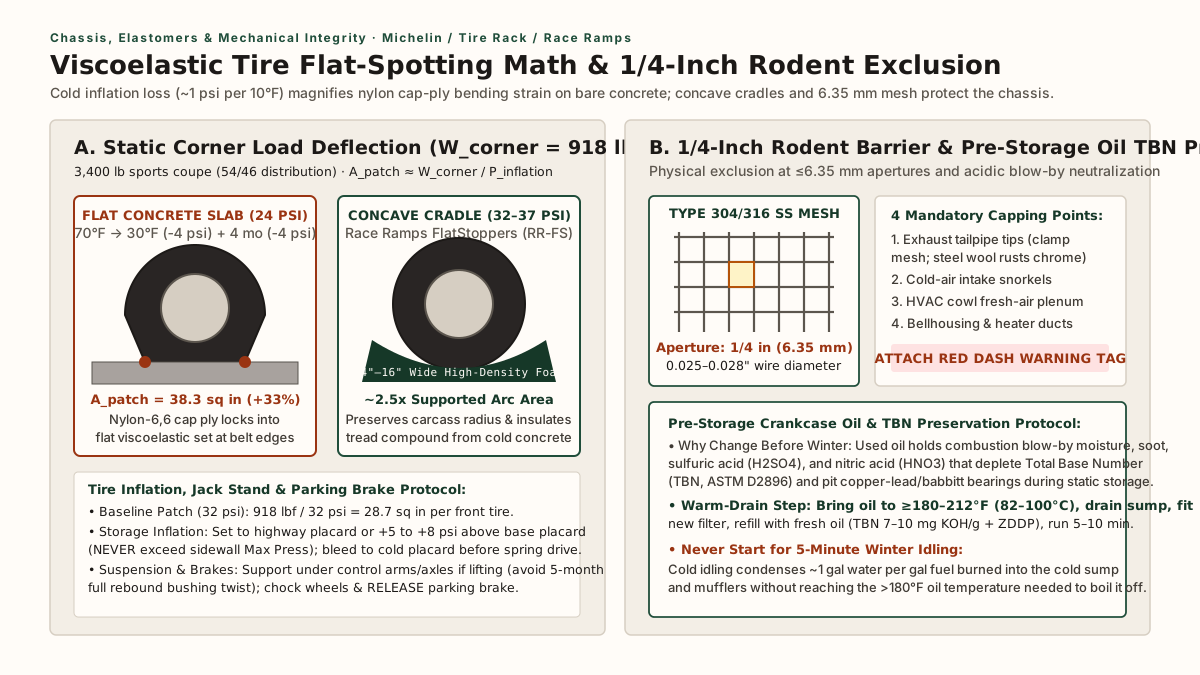
Storage Inflation Protocol, Concave Cradles & Suspension Support
- Cold storage inflation adjustment: Before parking the vehicle for the season, inflate all four tires to the vehicle manufacturer’s high-load / highway placard specification or
+5 to +8 psiabove base cold placard pressure (for example,37 to 40 psion a32 psibase placard) to pre-compensate for the-4 psithermal drop and-4 psiwinter permeation loss. Both Michelin and Tire Rack emphasize a strict boundary: never exceed the maximum cold inflation pressure (Max Press, typically44,50, or51 psi) molded on the tire sidewall. Log the raised storage pressure on a windshield tag so you bleed the tires back to standard cold placard pressure before the first spring drive. - Concave radius tire cradles: Parking on flat concrete concentrates
918 lbfacross a flat chord. Driving the vehicle onto concave high-density closed-cell foam cradles—such as Race Ramps FlatStoppers (Model RR-FS,14 inwide ×28 inlong ×3.29 inhigh with a1.25 inpad lift height for25–30 indiameter tires up to12 inwide; orModel RR-FS-16-SC,16 inwide for14 intread widths, rated at1,500 lbper pad /6,000 lbper set)—cradles the tire’s natural curvature across roughly2.5×the supported arc surface area while thermally insulating the rubber compound from conductive heat loss into cold concrete slabs. When stacking two vehicles vertically in a single bay, pair concave cradles or rolling bridge jacks with overlapping polypropylene drip trays as detailed in our 4-post car lift for storage slab and clearance guide. - Jack stands and suspension bushing geometry: Michelin and Tire Rack note that completely unloading the tires on jack stands eliminates flat-spotting during extended storage. However, on classic vehicles equipped with bonded rubber control-arm bushings (which are torqued at normal static ride height) or aging hydraulic damper seals, letting the suspension hang at full rebound droop for five months places continuous torsional shear on the rubber bushings and exposes damper shafts. If supporting the vehicle on stands, place the stands under the lower control arms or axle tubes so the suspension remains compressed near normal ride height while the tires sit unloaded.
- Parking brake release: Always chock the wheels (or seat the tires inside concave cradles), leave a manual transmission in
1stgear orReverse(Parkon an automatic), and release the mechanical parking brake / handbrake. Over a humid winter, hygroscopic brake lining material absorbs trace moisture and rust-welds cast-iron brake drums or rear rotors to the friction pads, tearing the lining surface upon spring release.
Pre-Storage Engine Oil TBN Chemistry, Coolant & Rodent Exclusion
Why Engine Oil Must Be Changed Before Layup, Not After
A recurring debate in classic car maintenance is whether to change the engine oil before winter storage or wait until spring recommissioning. Combustion chemistry settles the question decisively: always change the engine oil and filter immediately before winter storage.
During a driving season, piston ring blow-by forces water vapor, unburned hydrocarbons, soot, sulfur oxides (SOx), and nitrogen oxides (NOx) into the crankcase sump. These gases react with condensed moisture to form strong inorganic acids—chiefly sulfuric acid (H2SO4) and nitric acid (HNO3)—alongside organic carboxylic acids from oil oxidation. Fresh motor oil contains an alkaline detergent/dispersant additive package (calcium and magnesium sulfonates, phenates, and salicylates) quantified by its Total Base Number (TBN) under ASTM D2896, typically measuring 7.0 to 10.0 mg KOH/g in new passenger and classic car oils.
As the oil neutralizes acids over a driving season, TBN progressively drops toward 2.0 to 3.0 mg KOH/g while acidic reaction products accumulate in suspension. If used oil is left sitting statically in the crankcase and bearing clearances for 120 to 180 winter days, those acids chemically etch soft copper-lead (Cu-Pb) and babbitt (Sn-Sb-Cu) connecting-rod and main bearing overlays, pit cast-iron cylinder bores along the piston ring line, and corrode flat-tappet camshaft lobes.
Follow a strict pre-layup oil change sequence:
- Take the car on a 20-to-30-minute road drive to bring crankcase oil temperature to
≥180°F–212°F (82°C–100°C)(note that oil temperature lags coolant temperature by 10 to 15 minutes). Full operating heat boils off emulsified moisture and holds soot and metallic wear particles in suspension. - Drain the warm sump immediately, replace the spin-on or cartridge oil filter, and refill with fresh oil of the specified viscosity and zinc dialkyldithiophosphate (
ZDDP, typically1,000–1,400 ppmphosphorus/zinc for flat-tappet valve trains). - Run the engine for 5 to 10 minutes after refilling so fresh, high-TBN alkaline oil purges the oil galleries, hydraulic or solid lifters, timing chains, and bearing journals, leaving a clean protective boundary film.
- Never start the engine for brief 5-minute garage warm-ups during winter. Burning one gallon of gasoline produces roughly one gallon of water vapor as a stoichiometric combustion byproduct (
2 C8H18 + 25 O2 → 16 CO2 + 18 H2O). During a brief cold idle in a winter garage, cylinder walls, crankcase oil, and rear exhaust mufflers never reach the>180°Fthreshold required to vaporize that moisture. Instead, acidic water condenses directly into the fresh oil and pools inside muffler baffles, rotting the exhaust from the inside out.
Coolant Freeze Protection & Reserve Alkalinity
Before final parking, test the engine coolant with an optical refractometer (more accurate than floating-ball hydrometers and suitable for both ethylene glycol and propylene glycol). A 50/50 volumetric mixture of glycol antifreeze and distilled water lowers the freezing point to -34°F (-37°C) for ethylene glycol (-26°F / -32°C for propylene glycol). Also verify coolant age and pH (7.5 to 10.5 depending on IAT, OAT, or HOAT inhibitor formulation); depleted corrosion inhibitors allow galvanic corrosion between cast-iron engine blocks, aluminum cylinder heads, brass radiator cores, and water pump impellers during static storage.
Physical Rodent Exclusion (1/4-Inch Stainless Mesh Protocol)
According to the Canadian Conservation Institute’s CCI Notes 1/1: General Precautions for Storage Areas, keeping storage areas free of food, inspecting weekly for pest activity, and maintaining clean perimeter clearances are primary preventive controls. In automotive storage, rodents—specifically the house mouse (Mus musculus) and white-footed deer mouse (Peromyscus leucopus)—seek dark cavities to nest and gnaw on soy-based or PVC wire harness insulation, vacuum hoses, and hood sound deadening.
An adult house mouse has a collapsible ribcage and only requires an opening large enough for its skull to pass through: 1/4 inch (6.35 mm / 6 mm). Stuffing tailpipes with shop rags, plastic mesh, or carbon-steel wool fails in practice—mice shred cloth and plastic for nesting material, and ordinary steel wool absorbs exhaust condensation and rust-stains chrome tailpipe tips.
Install physical mechanical barriers across all four vehicle entry vectors:
- Exhaust tailpipes: Form caps of
1/4-inch(4×4mesh,0.025–0.028 inchwire diameter) Type 304 or Type 316 stainless steel hardware cloth over every tailpipe outlet, secured with a worm-drive band clamp over a silicone protective sleeve. - Engine air intake snorkels: Cap the cold-air intake horn ahead of the air filter box with
1/4-inchstainless steel mesh so rodents cannot build nests on the paper or cotton-gauze filter element. - HVAC cowl fresh-air plenum: Inspect the windshield cowl grille; if factory louver slots exceed
6.35 mm, lay a removable magnetic or weighted1/4-inchstainless mesh screen over the cowl intake. - Steering wheel warning streamer: Every physical intake or exhaust cap must be tied to a high-visibility red “Remove Before Flight / Storage Caps Installed” tag draped over the steering wheel or ignition switch, and logged on the blank collector-car cost and maintenance worksheet so no cap is overlooked during spring startup.